Product Design, Manufacturing & Innovation Resources
家 » 超导

超导

1911-04-08
  • Heike Kamerlingh Onnes
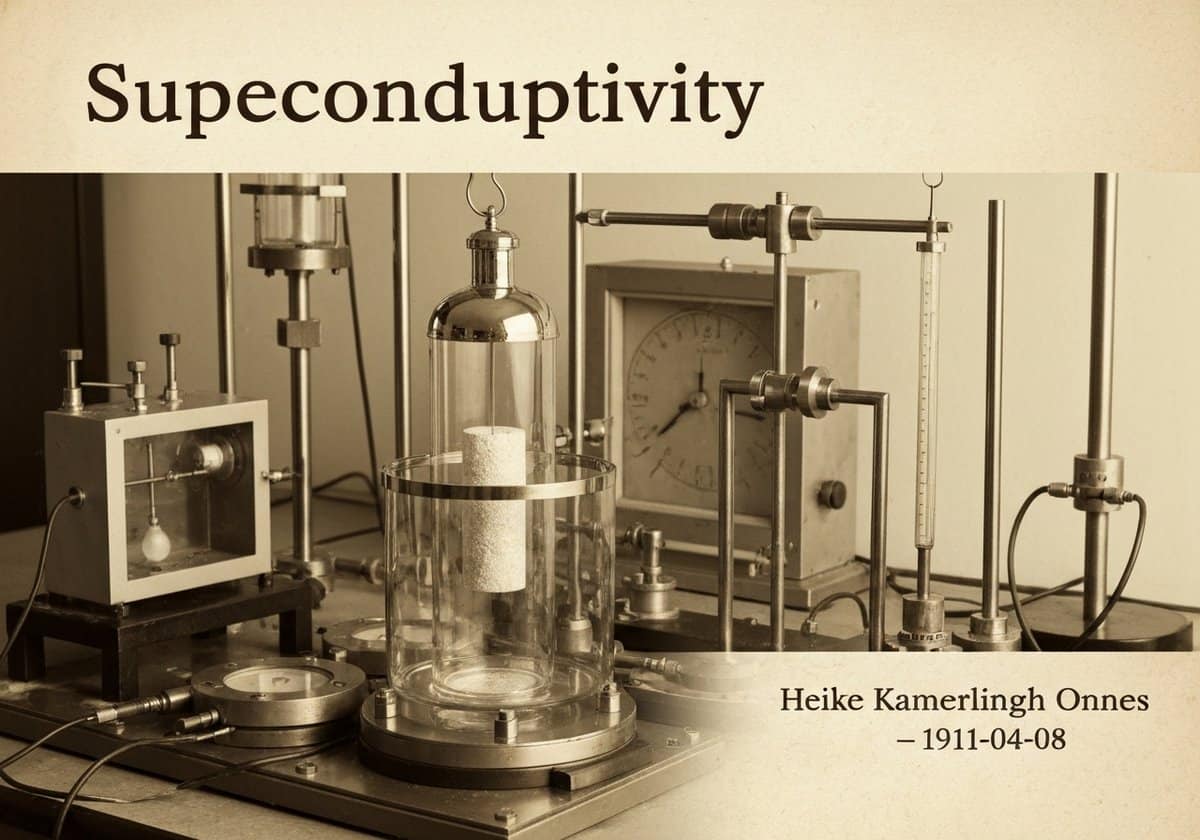
利用固态汞演示超导性的低温实验室装置。

(图片仅供参考)

1911年,海克·卡末林·昂内斯在研究固体汞的电阻时发现了超导现象。 低温 temperatures. He observed that the electrical resistance of mercury abruptly dropped to zero at a 临界温度 ([latex]T_c[/latex]) of 4.2 K. This phenomenon, termed superconductivity, represents a state of matter with exactly zero electrical resistance and expulsion of magnetic fields.

The discovery was a direct consequence of Onnes’s pioneering work in low-temperature physics, specifically his successful liquefaction of helium in 1908. This achievement opened up a new temperature regime for experimental investigation, down to about 1 K. Onnes was initially investigating how the electrical resistance of pure metals behaved at these extremely low temperatures. Prevailing theories suggested that resistance would either level off to a constant value or increase again as electron motion ceased. However, when his team cooled a sample of solid mercury, they observed a sudden, complete disappearance of resistance at 4.2 K. Onnes initially suspected a short circuit but soon confirmed the phenomenon was real and intrinsic to the material. He called this new state “supraconductivity” (later superconductivity). This discovery was revolutionary because classical physics could not explain how electrons could move through a material lattice without any energy loss. It marked the birth of a new field of physics and demonstrated the existence of macroscopic quantum phenomena, where quantum effects become visible on a large scale. The zero-resistance state implies that a current induced in a superconducting loop could persist indefinitely without a power source, a concept later verified in persistent current experiments.

The implications were profound, suggesting possibilities for lossless energy transmission and the creation of extremely powerful magnets. However, the extremely low temperatures required (liquid helium temperatures) made practical applications challenging for many decades. The discovery spurred a global research effort to find materials with higher critical temperatures and to develop a theoretical understanding of the underlying mechanism, a puzzle that would remain unsolved for nearly 50 years until the advent of the BCS theory.

UNESCO Nomenclature: 2211
- 固体物理学

类型

物理特性

中断

革命

用法

广泛使用

前体

  • 氦的液化(1908年)
  • 发展 低温
  • 德鲁德电传导模型
  • 低温电阻研究

应用程序

  • magnetic resonance imaging (mri)
  • 粒子加速器
  • 磁悬浮列车
  • 超导量子干涉装置(鱿鱼)
  • 输电线路

专利:

NA

潜在创新理念

  • 室温超导计算机处理器
  • 个人磁悬浮交通舱
  • city-scale 超导磁能存储 (中小企业)
  • 航天器抗宇宙辐射的超导屏蔽
  • 无损全球电网
  • 救护车用便携式高场核磁共振扫描仪
  • 基于稳定、高温超导量子比特的量子计算
  • 用于机器人的超导人造肌肉
  • 用于太空探索的电磁发射系统
  • 具有更紧凑、更高效磁约束的聚变反应堆
相关术语:超导性、海克·卡末林·昂内斯、临界温度、零电阻、汞、​​低温学、低温物理学、相变 凝聚态物质量子力学。

历史背景

超导

1907
1909
1910
1911-04-08
1913
1915
1916
1904
1907
1909
1910
1912
1915
1915-11
1916

(如果日期未知或不相关,例如“流体力学”,则提供其显著出现的近似估计)

第十年 周年纪念日

只有注册会员才能免费获得 100% 的全尺寸图片和下载。.

> 登录 <