Product Design, Manufacturing & Innovation Resources
Hogar » Superconductividad

Superconductividad

1911-04-08
  • Heike Kamerlingh Onnes
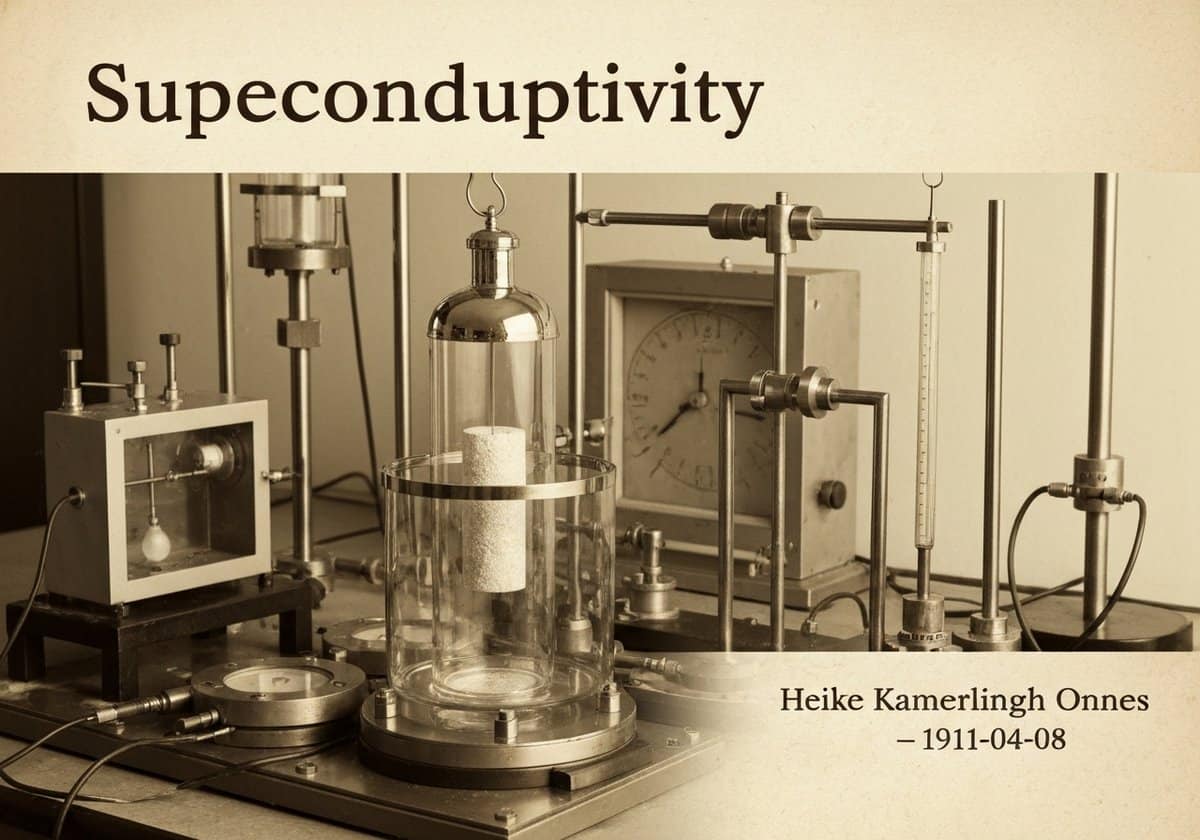
Configuración de laboratorio criogénico que demuestra superconductividad con mercurio sólido.

(Imagen generada únicamente con fines ilustrativos)

En 1911, Heike Kamerlingh Onnes descubrió la superconductividad mientras estudiaba la resistencia del mercurio sólido a cryogenic temperatures. He observed that the electrical resistance of mercury abruptly dropped to zero at a critical temperature ([latex]T_c[/latex]) of 4.2 K. This phenomenon, termed superconductivity, represents a state of matter with exactly zero electrical resistance and expulsion of magnetic fields.

The discovery was a direct consequence of Onnes’s pioneering work in low-temperature physics, specifically his successful liquefaction of helium in 1908. This achievement opened up a new temperature regime for experimental investigation, down to about 1 K. Onnes was initially investigating how the electrical resistance of pure metals behaved at these extremely low temperatures. Prevailing theories suggested that resistance would either level off to a constant value or increase again as electron motion ceased. However, when his team cooled a sample of solid mercury, they observed a sudden, complete disappearance of resistance at 4.2 K. Onnes initially suspected a short circuit but soon confirmed the phenomenon was real and intrinsic to the material. He called this new state “supraconductivity” (later superconductivity). This discovery was revolutionary because classical physics could not explain how electrons could move through a material lattice without any energy loss. It marked the birth of a new field of physics and demonstrated the existence of macroscopic quantum phenomena, where quantum effects become visible on a large scale. The zero-resistance state implies that a current induced in a superconducting loop could persist indefinitely without a power source, a concept later verified in persistent current experiments.

The implications were profound, suggesting possibilities for lossless energy transmission and the creation of extremely powerful magnets. However, the extremely low temperatures required (liquid helium temperatures) made practical applications challenging for many decades. The discovery spurred a global research effort to find materials with higher critical temperatures and to develop a theoretical understanding of the underlying mechanism, a puzzle that would remain unsolved for nearly 50 years until the advent of the BCS theory.

UNESCO Nomenclature: 2211
– Solid state physics

Tipo

Physical Property

Ruptura

Revolucionario

Uso

Uso generalizado

Precursores

  • licuefacción de helio (1908)
  • development of cryogenics
  • Modelo de conducción eléctrica de Drude
  • Estudios sobre resistencia eléctrica a bajas temperaturas

Aplicaciones

  • magnetic resonance imaging (mri)
  • aceleradores de partículas
  • trenes de levitación magnética
  • dispositivos superconductores de interferencia cuántica (calamares)
  • líneas de transmisión eléctrica

Patentes:

NA

Ideas para posibles innovaciones

  • procesadores informáticos superconductores a temperatura ambiente
  • cápsulas de transporte personal de levitación magnética
  • city-scale superconducting magnetic energy storage (pymes)
  • Blindaje superconductor para naves espaciales contra la radiación cósmica
  • red eléctrica global sin pérdidas
  • escáneres de resonancia magnética portátiles de alto campo para ambulancias
  • Computación cuántica basada en cúbits superconductores estables de alto tc
  • Músculos artificiales superconductores para robótica
  • sistemas de lanzamiento electromagnéticos para la exploración espacial
  • Reactores de fusión con confinamiento magnético más compactos y eficientes
Relacionado con: superconductividad, Heike Kamerlingh Onnes, temperatura crítica, resistencia cero, mercurio, criogenia, física de bajas temperaturas, transición de fase, condensed mattermecánica cuántica.

Contexto histórico

Superconductividad

1907
1909
1910
1911-04-08
1913
1915
1916
1904
1907
1909
1910
1912
1915
1915-11
1916

(Si la fecha es desconocida o no es relevante, por ejemplo "mecánica de fluidos", se proporciona una estimación redondeada de su aparición notable)

décimo año aniversario

Las imágenes en tamaño completo y las descargas solo están disponibles, de forma totalmente gratuita, para los miembros registrados.

> Acceso <