Product Design, Manufacturing & Innovation Resources
家 » 超伝導BCS理論

超伝導BCS理論

1957
  • John Bardeen
  • Leon Cooper
  • John Robert Schrieffer
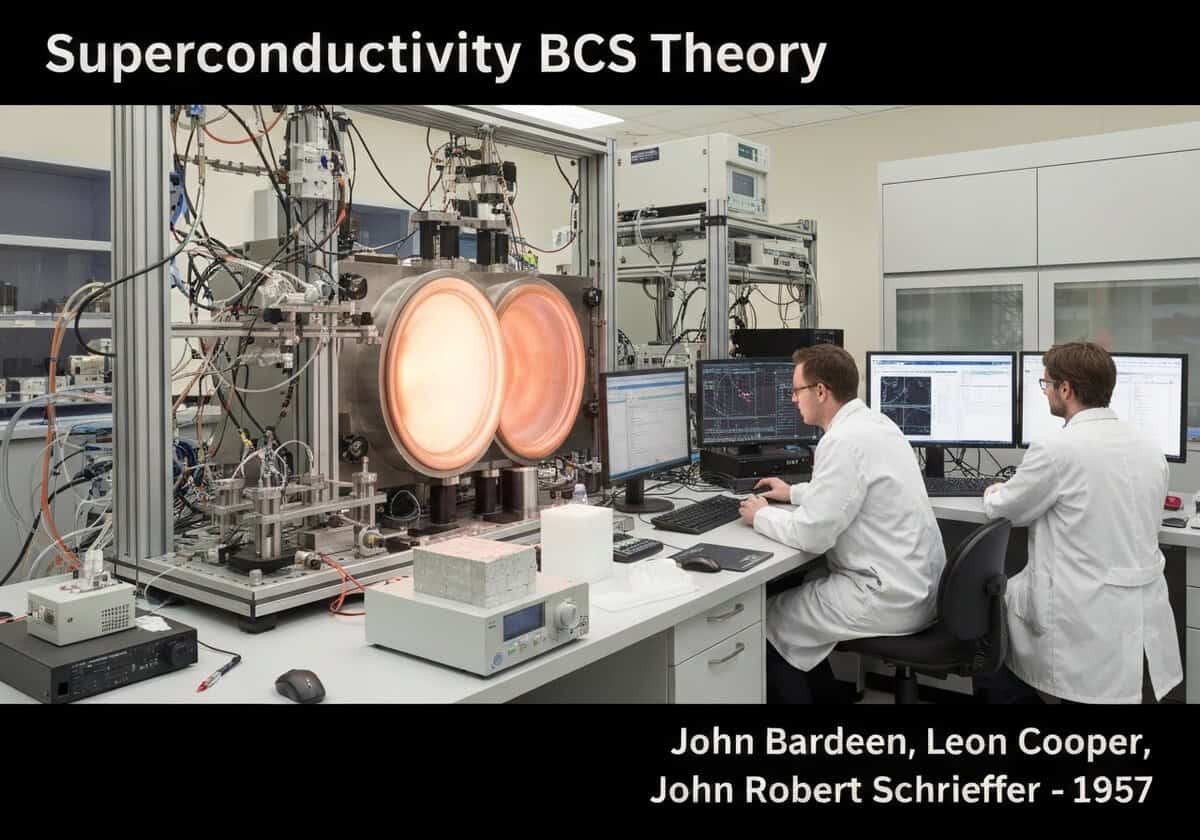
最先端のクライオスタットを備え、科学者がデータを分析する超伝導に特化した研究室。.

(画像はイメージです)

Developed in 1957 by John Bardeen, Leon Cooper, and Robert Schrieffer, the BCS theory provides a microscopic explanation for conventional 超伝導. It posits that below the 臨界温度 ([latex]T_c[/latex]), electrons can overcome their electrostatic repulsion and form bound pairs, called Cooper pairs, through interactions with the crystal lattice (phonons). These pairs behave as bosons and can condense into a single macroscopic quantum state.

The BCS theory was a monumental achievement that solved a 46-year-old puzzle in physics. Its central concept is the Cooper pair. In a normal metal, electrons move independently and scatter off impurities and lattice vibrations (phonons), which causes electrical resistance. In the BCS model, an electron moving through the crystal lattice attracts the positive ions, creating a slight distortion or ripple in the lattice. This region of increased positive charge can then attract a second electron. This indirect, phonon-mediated attraction can overcome the direct Coulomb repulsion between the two electrons, binding them into a Cooper pair. These pairs have an integer spin (0 or 1), making them bosons, unlike individual electrons which are fermions. According to quantum statistics, bosons are not subject to the Pauli exclusion principle and can all occupy the same lowest-energy quantum state. Below [latex]T_c[/latex], a significant fraction of Cooper pairs condenses into this single macroscopic ground state, described by a single wave function. This condensate of pairs can move through the lattice without 散乱単一の電子対を散乱させるには、それを破壊して両方の電子を励起するのに十分なエネルギーが必要であり、そのエネルギーは超伝導エネルギーギャップ [latex]Delta[/latex] によって与えられる。低温では、このエネルギーは利用できず、抵抗はゼロになる。この理論は、[latex]T_c propto M^{-1/2}[/latex] (M は同位体質量) という同位体効果をうまく予測し、臨界温度の式 [latex]k_B T_c approx 1.13 hbar omega_D exp(-1/N(0)V)[/latex] を提供し、[latex]T_c[/latex] を デバイ 周波数[latex]omega_D[/latex]、状態密度[latex]N(0)[/latex]、および電子-フォノン相互作用ポテンシャル[latex]V[/latex]。

UNESCO Nomenclature: 2211
固体物理学

タイプ

理論モデル

混乱

革命的

使用法

広く普及している

前駆物質

  • discovery of 超伝導 (1911)
  • quantum mechanics
  • ロンドン方程式
  • Ginzburg-Landau theory
  • 同位体効果の発見(1950年)
  • 電子-フォノン相互作用の概念

アプリケーション

  • 新たな超伝導材料の探索に関する指針
  • ヘリウム3の超流動性の理解
  • 超伝導エレクトロニクスの理論的基礎
  • models in nuclear physics and 素粒子物理学

特許:

NA

潜在的なイノベーションのアイデア

  • designing “designer” superconductors by engineering phonon spectra
  • creating novel bosonic condensates for quantum information processing
  • developing materials with tunable superconducting gaps for advanced sensors
  • exploring phonon-mediated pairing in other quantum systems like cold atoms
  • creating fault-tolerant quantum computers based on topological superconductors
  • developing bcs-inspired models for social and economic network coherence
  • engineering artificial lattices to test and extend bcs theory
  • creating new forms of matter based on exotic pairing mechanisms
  • developing superconducting materials for thermoelectric energy conversion
  • using bcs principles to enhance catalytic reactions
関連: BCS理論、クーパー対、超伝導、フォノン、電子-フォノン結合、量子力学、 凝縮物質 理論、エネルギーギャップ、巨視的量子状態、バーディーン・クーパー・シュリーファー。

歴史的背景

超伝導BCS理論

1950
1950
1950
1957
1958
1960
1960
1950
1950
1950
1957
1957
1959-11
1960
1960

(日付が不明または関連性がない場合、例えば「流体力学」などでは、その注目すべき出現時期の概算値が提示されます。)

10年目 周年

フルサイズの画像とダウンロードは、登録会員のみが100%無料で利用できます。