Product Design, Manufacturing & Innovation Resources
घर » अतिचालकता

अतिचालकता

1911-04-08
  • Heike Kamerlingh Onnes
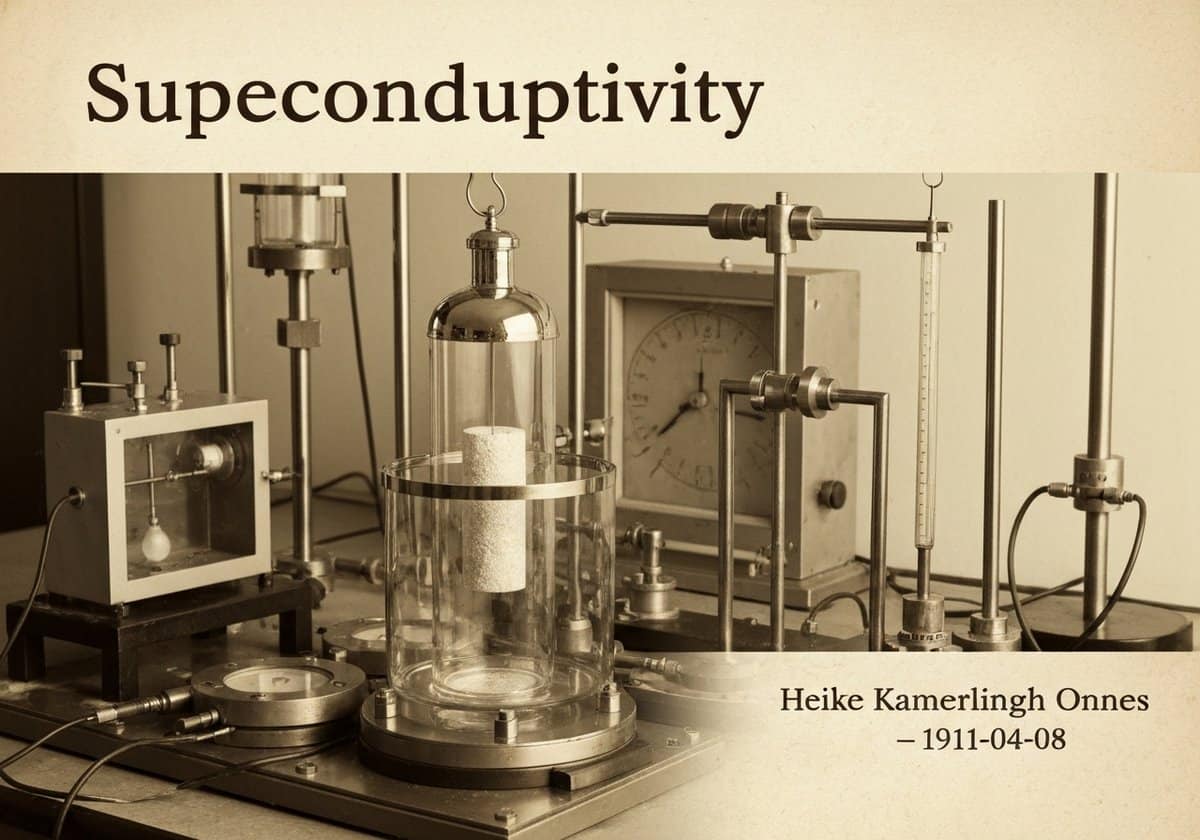
ठोस पारे के साथ अतिचालकता प्रदर्शित करने वाला क्रायोजेनिक प्रयोगशाला सेटअप।

(यह छवि केवल उदाहरण के लिए बनाई गई है)

1911 में, हाइके कैमरलिंग ओन्स ने ठोस पारे के प्रतिरोध का अध्ययन करते हुए अतिचालकता की खोज की। क्रायोजेनिक temperatures. He observed that the electrical resistance of mercury abruptly dropped to zero at a critical temperature ([latex]T_c[/latex]) of 4.2 K. This phenomenon, termed superconductivity, represents a state of matter with exactly zero electrical resistance and expulsion of magnetic fields.
The discovery was a direct consequence of Onnes’s pioneering work in low-temperature physics, specifically his successful liquefaction of helium in 1908. This achievement opened up a new temperature regime for experimental investigation, down to about 1 K. Onnes was initially investigating how the electrical resistance of pure metals behaved at these extremely low temperatures. Prevailing theories suggested that resistance would either level off to a constant value or increase again as electron motion ceased. However, when his team cooled a sample of solid mercury, they observed a sudden, complete disappearance of resistance at 4.2 K. Onnes initially suspected a short circuit but soon confirmed the phenomenon was real and intrinsic to the material. He called this new state “supraconductivity” (later superconductivity). This discovery was revolutionary because classical physics could not explain how electrons could move through a material lattice without any energy loss. It marked the birth of a new field of physics and demonstrated the existence of macroscopic quantum phenomena, where quantum effects become visible on a large scale. The zero-resistance state implies that a current induced in a superconducting loop could persist indefinitely without a power source, a concept later verified in persistent current experiments.

The implications were profound, suggesting possibilities for lossless energy transmission and the creation of extremely powerful magnets. However, the extremely low temperatures required (liquid helium temperatures) made practical applications challenging for many decades. The discovery spurred a global research effort to find materials with higher critical temperatures and to develop a theoretical understanding of the underlying mechanism, a puzzle that would remain unsolved for nearly 50 years until the advent of the BCS theory.

UNESCO Nomenclature: 2211
ठोस अवस्था भौतिकी

Type

स्थूल संपत्ति

व्यवधान

क्रांतिकारी

उपयोग

व्यापक उपयोग

शगुन

  • हीलियम का द्रवीकरण (1908)
  • का विकास cryogenics
  • विद्युत चालन का ड्रूड मॉडल
  • कम तापमान पर विद्युत प्रतिरोध पर अध्ययन

आवेदन

  • magnetic resonance imaging (mri)
  • कण त्वरक
  • मैग्लेव ट्रेनें
  • अतिचालक क्वांटम व्यतिकरण उपकरण (स्क्विड)
  • बिजली पारेषण लाइनें

पेटेंट:

NA

संभावित नवाचार विचार

  • कमरे के तापमान पर अतिचालक कंप्यूटर प्रोसेसर
  • व्यक्तिगत मैग्लेव परिवहन पॉड
  • city-scale superconducting magnetic energy storage (एसएमई)
  • अंतरिक्ष यान को ब्रह्मांडीय विकिरण से बचाने के लिए अतिचालक परिरक्षण
  • हानि रहित वैश्विक विद्युत ग्रिड
  • एम्बुलेंस के लिए पोर्टेबल, हाई-फील्ड एमआरआई स्कैनर
  • स्थिर, उच्च-टीसी सुपरकंडक्टिंग क्यूबिट्स पर आधारित क्वांटम कंप्यूटिंग
  • रोबोटिक्स के लिए अतिचालक कृत्रिम मांसपेशियां
  • अंतरिक्ष अन्वेषण के लिए विद्युत चुम्बकीय प्रक्षेपण प्रणालियाँ
  • अधिक सघन और कुशल चुंबकीय परिरोधन वाले संलयन रिएक्टर
संबंधित विषय: अतिचालकता, हाइके कैमरलिंग ओन्स, क्रांतिक तापमान, शून्य प्रतिरोध, पारा, क्रायोजेनिक्स, निम्न-तापमान भौतिकी, चरण संक्रमण संघनित पदार्थ, क्वांटम यांत्रिकी।

ऐतिहासिक संदर्भ

अतिचालकता

1907
1909
1910
1911-04-08
1913
1915
1916
1904
1907
1909
1910
1912
1915
1915-11
1916

(यदि तिथि अज्ञात है या प्रासंगिक नहीं है, उदाहरण के लिए "द्रव यांत्रिकी", तो इसके उल्लेखनीय उद्भव का एक अनुमानित आंकड़ा प्रदान किया गया है)

नवीनतम परिवर्धन

शीर्ष पोस्ट और लेख

शीर्ष मूल उपकरण

10वां वर्ष सालगिरह

पंजीकृत सदस्यों के लिए पूर्ण आकार की छवियाँ और डाउनलोड 100% निःशुल्क उपलब्ध हैं।