Product Design, Manufacturing & Innovation Resources
家 » 生体活性物質

生体活性物質

1969
  • Larry L. Hench
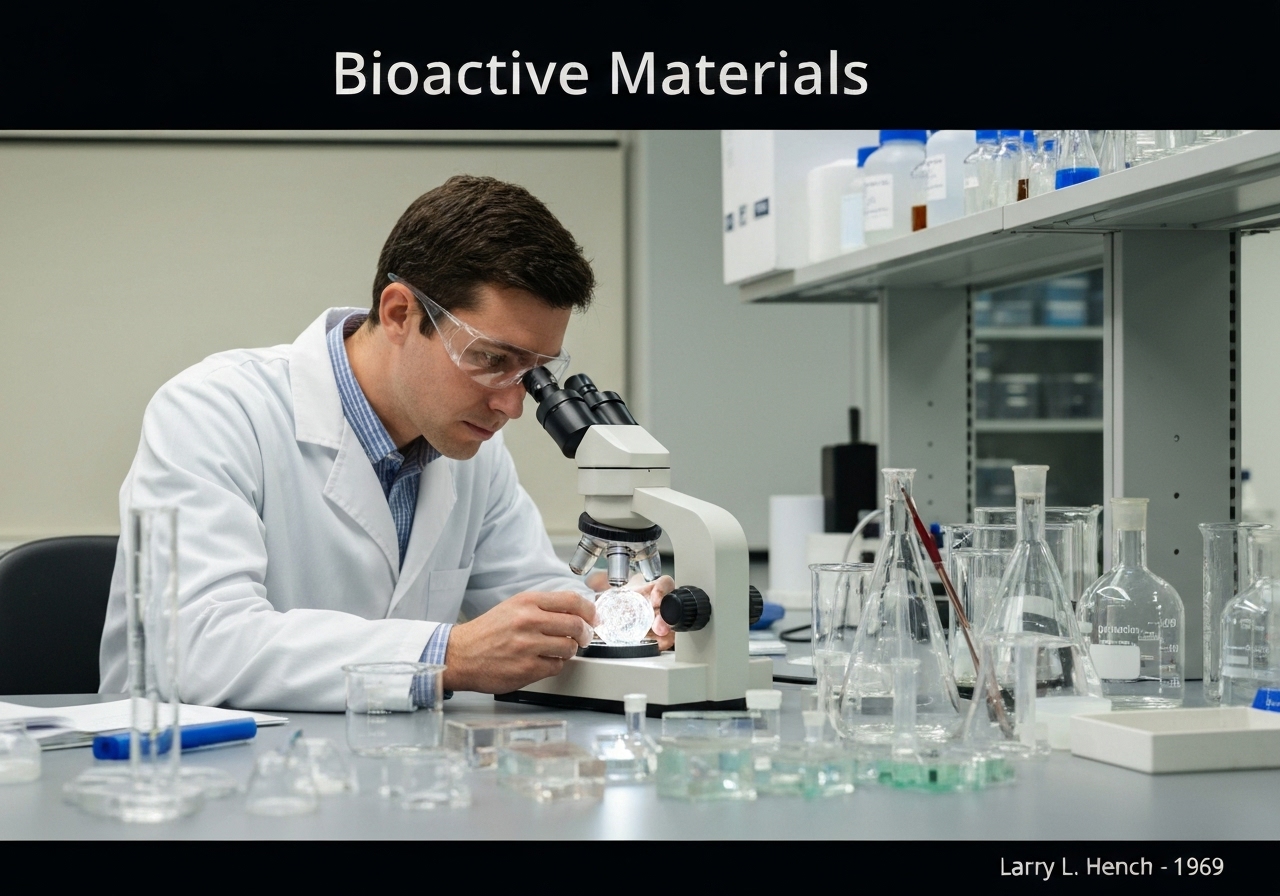
Bioglass samples in a laboratory for biomaterials research.

(画像はイメージです)

Bioactive materials are a class of biomaterials designed to elicit a specific, positive biological response at the material-tissue interface, resulting in the formation of a bond between them. Unlike bioinert materials that aim for minimal interaction, bioactive materials actively participate in healing processes. A classic example is Bioglass, which forms a hydroxyapatite layer on its surface, bonding directly to bone.

The concept of bioactivity was pioneered by Larry Hench with his 1969 invention of Bioglass® 45S5, a specific composition of 45 wt% SiO2, 24.5% CaO, 24.5% Na2O, and 6% P2O5. The mechanism of bone bonding involves a sequence of five surface chemical reactions. When exposed to bodily fluids, (1) rapid ion exchange of Na+ from the glass with H+ from solution occurs, creating a silica-rich layer. (2) This increases local pH, which causes (3) the glass network to break down, releasing silicic acid (Si(OH)4) and forming silanols (Si-OH) at the surface. (4) A high local concentration of calcium and phosphate ions, both from the glass and surrounding fluid, leads to the formation of an amorphous calcium-phosphate layer. (5) This layer crystallizes into hydroxycarbonate apatite (HCA), which is chemically and structurally similar to the mineral phase of bone. This HCA layer provides a bioactive scaffold for osteoblasts to colonize, differentiate, and deposit new bone matrix, creating a strong, direct, and seamless bond with the host bone. This process, known as osseointegration, is crucial for the long-term stability of implants. Furthermore, the dissolution products, particularly silicic acid, have been shown to stimulate genes within osteoprogenitor cells, upregulating the production of growth factors. This makes the material not only osteoconductive (a scaffold for bone growth) but also osteoinductive (actively stimulating new bone formation).

UNESCO Nomenclature: 3201
医学

タイプ

化学プロセス

混乱

革命的

使用法

広く普及している

前駆物質

  • ガラス科学と製造の発展
  • understanding of bone composition and the role of hydroxyapatite
  • 整形外科におけるアルミナなどの不活性セラミックスの初期使用
  • 材料と組織の界面を研究するための表面分析技術の進歩

アプリケーション

  • 整形外科および歯科手術における骨移植および骨欠損充填材
  • 骨結合を促進するための金属製インプラント(例:股関節ステム)へのコーティング
  • scaffolds for bone tissue engineering
  • エナメル質の再石灰化を促進するバイオアクティブ歯磨き粉の成分
  • 組織修復を促進する創傷治癒用ドレッシング

特許:

  • US3929971A

潜在的なイノベーションのアイデア

  • bioactive inks for 3d printing patient-specific bone scaffolds
  • ion-releasing dental fillings that inhibit secondary caries and promote dentin regeneration
  • injectable bioactive glass putties for minimally invasive bone repair
  • bioactive coatings for cardiovascular stents that promote endothelialization and prevent restenosis
  • nerve guidance conduits doped with bioactive ions to enhance nerve regeneration
  • bioactive glass nanoparticles for targeted cancer therapy (hyperthermia)
  • antimicrobial bioactive glasses containing silver or copper ions for wound dressings
  • bioactive cements for vertebroplasty that integrate with spinal bone
  • scaffolds that release different ions at different times to orchestrate complex tissue formation
  • bioactive soft materials (hydrogels) for cartilage and soft tissue regeneration
関連キーワード:生体活性、バイオグラス、ラリー・ヘンチ、ヒドロキシアパタイト、骨統合、骨結合、イオン交換、骨誘導、骨伝導、セラミック生体材料。

歴史的背景

生体活性物質

1960
1960
1969
1976-05-28
1980
1990
1960
1965
1970
1980
1980
1990

(日付が不明または関連性がない場合、例えば「流体力学」などでは、その注目すべき出現時期の概算値が提示されます。)

10年目 周年

フルサイズの画像とダウンロードは、登録会員のみが100%無料で利用できます。