Product Design, Manufacturing & Innovation Resources
Maison » Matériaux bioactifs

Matériaux bioactifs

1969
  • Larry L. Hench
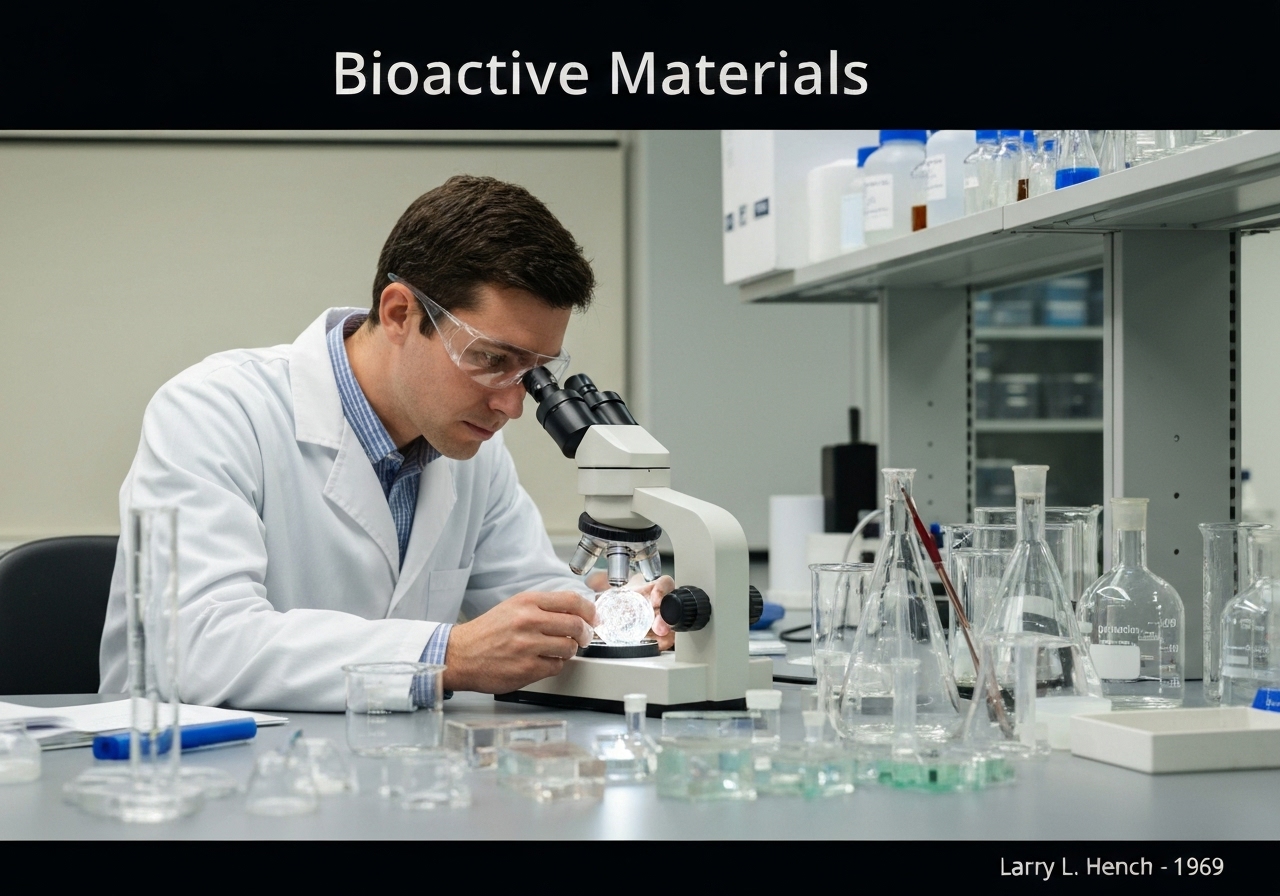
Échantillons de bioglass dans un laboratoire de recherche sur les biomatériaux.

(Image générée à titre d'illustration uniquement)

Bioactive materials are a class of biomaterials designed to elicit a specific, positive biological response at the material-tissue interface, resulting in the formation of a bond between them. Unlike bioinert materials that aim for minimal interaction, bioactive materials actively participate in healing processes. A classic example is Bioglass, which forms a hydroxyapatite layer on its surface, bonding directly to bone.

The concept of bioactivity was pioneered by Larry Hench with his 1969 invention of Bioglass® 45S5, a specific composition of 45 wt% SiO2, 24.5% CaO, 24.5% Na2O, and 6% P2O5. The mechanism of bone bonding involves a sequence of five surface chemical reactions. When exposed to bodily fluids, (1) rapid ion exchange of Na+ from the glass with H+ from solution occurs, creating a silica-rich layer. (2) This increases local pH, which causes (3) the glass network to break down, releasing silicic acid (Si(OH)4) and forming silanols (Si-OH) at the surface. (4) A high local concentration of calcium and phosphate ions, both from the glass and surrounding fluid, leads to the formation of an amorphous calcium-phosphate layer. (5) This layer crystallizes into hydroxycarbonate apatite (HCA), which is chemically and structurally similar to the mineral phase of bone. This HCA layer provides a bioactive scaffold for osteoblasts to colonize, differentiate, and deposit new bone matrix, creating a strong, direct, and seamless bond with the host bone. This process, known as ostéointégration, is crucial for the long-term stability of implants. Furthermore, the dissolution products, particularly silicic acid, have been shown to stimulate genes within osteoprogenitor cells, upregulating the production of growth factors. This makes the material not only osteoconductive (a scaffold for bone growth) but also osteoinductive (actively stimulating new bone formation).

UNESCO Nomenclature: 3201
- Sciences médicales

Taper

Procédé chimique

Perturbation

Révolutionnaire

Usage

Utilisation généralisée

Précurseurs

  • développement de la science et de la fabrication du verre
  • understanding of bone composition and the role of hydroxyapatite
  • utilisation précoce de céramiques inertes comme l'alumine en orthopédie
  • progrès dans les techniques d'analyse de surface pour étudier l'interface matériau-tissu

Applications

  • greffes osseuses et comblements de vides en chirurgie orthopédique et dentaire
  • revêtements sur implants métalliques (par exemple, tiges de hanche) pour favoriser l'ostéointégration
  • scaffolds for bone tissue engineering
  • composants des dentifrices bioactifs pour reminéraliser l'émail
  • pansements cicatrisants qui stimulent la réparation des tissus

Brevets:

  • US3929971A

Idées d'innovations potentielles

  • encres bioactives pour l'impression 3D d'échafaudages osseux spécifiques aux patients
  • obturations dentaires libérant des ions qui inhibent les caries secondaires et favorisent la régénération de la dentine
  • mastics de verre bioactifs injectables pour une réparation osseuse mini-invasive
  • revêtements bioactifs pour stents cardiovasculaires favorisant l'endothélialisation et prévenant la resténose
  • conduits de guidage nerveux dopés aux ions bioactifs pour améliorer la régénération nerveuse
  • bioactive glass nanoparticles for targeted cancer therapy (hyperthermia)
  • verres bioactifs antimicrobiens contenant des ions argent ou cuivre pour pansements
  • ciments bioactifs pour vertébroplastie qui s'intègrent à l'os rachidien
  • des échafaudages qui libèrent différents ions à différents moments pour orchestrer la formation de tissus complexes
  • matériaux mous bioactifs (hydrogels) pour la régénération du cartilage et des tissus mous
Lié à : bioactif, bioverre, Larry Hench, hydroxyapatite, ostéointégration, liaison osseuse, échange d'ions, ostéoinduction, ostéoconduction, biomatériau céramique.

Contexte historique

Matériaux bioactifs

1960
1960
1969
1976-05-28
1980
1990
1960
1965
1970
1980
1980
1990

(si la date est inconnue ou non pertinente, par exemple « mécanique des fluides », une estimation arrondie de son émergence notable est fournie)

10e année anniversaire

Les images en pleine résolution et les téléchargements sont uniquement disponibles, et 100% gratuits, pour les membres inscrits.