Product Design, Manufacturing & Innovation Resources
家 » 生物活性材料

生物活性材料

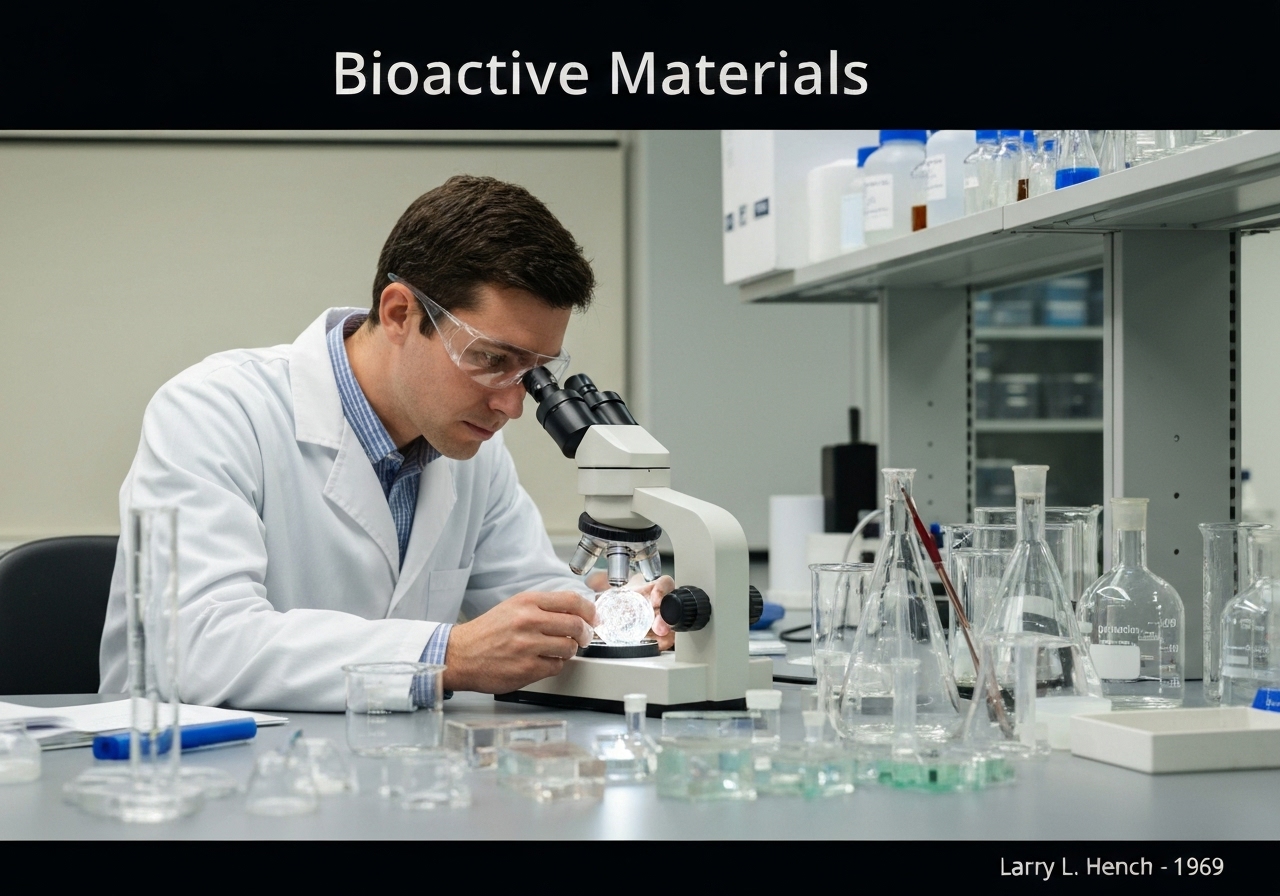
1969
  • Larry L. Hench
Bioglass samples in a laboratory for biomaterials research.

(图片仅供参考)

Bioactive materials are a class of biomaterials designed to elicit a specific, positive biological response at the material-tissue interface, resulting in the formation of a bond between them. Unlike bioinert materials that aim for minimal interaction, bioactive materials actively participate in healing processes. A classic example is Bioglass, which forms a hydroxyapatite layer on its surface, bonding directly to bone.

The concept of bioactivity was pioneered by Larry Hench with his 1969 invention of Bioglass® 45S5, a specific composition of 45 wt% SiO2, 24.5% CaO, 24.5% Na2O, and 6% P2O5. The mechanism of bone bonding involves a sequence of five surface chemical reactions. When exposed to bodily fluids, (1) rapid ion exchange of Na+ from the glass with H+ from solution occurs, creating a silica-rich layer. (2) This increases local pH, which causes (3) the glass network to break down, releasing silicic acid (Si(OH)4) and forming silanols (Si-OH) at the surface. (4) A high local concentration of calcium and phosphate ions, both from the glass and surrounding fluid, leads to the formation of an amorphous calcium-phosphate layer. (5) This layer crystallizes into hydroxycarbonate apatite (HCA), which is chemically and structurally similar to the mineral phase of bone. This HCA layer provides a bioactive scaffold for osteoblasts to colonize, differentiate, and deposit new bone matrix, creating a strong, direct, and seamless bond with the host bone. This process, known as osseointegration, is crucial for the long-term stability of implants. Furthermore, the dissolution products, particularly silicic acid, have been shown to stimulate genes within osteoprogenitor cells, upregulating the production of growth factors. This makes the material not only osteoconductive (a scaffold for bone growth) but also osteoinductive (actively stimulating new bone formation).

UNESCO Nomenclature: 3201
– Medical sciences

类型

化学过程

中断

Revolutionary

用法

广泛使用

前体

  • 玻璃科学和制造的发展
  • understanding of bone composition and the role of hydroxyapatite
  • 氧化铝等惰性陶瓷在骨科的早期应用
  • 研究材料-组织界面的表面分析技术进展

应用程序

  • 骨科和牙科手术中的骨移植和空隙填充物
  • 金属植入物(例如髋关节柄)上的涂层可促进骨整合
  • scaffolds for bone tissue engineering
  • 生物活性牙膏中的成分可使牙釉质再矿化
  • 刺激组织修复的伤口愈合敷料

专利:

  • US3929971A

潜在创新理念

  • 用于3D打印患者专用骨支架的生物活性墨水
  • 释放离子的牙科填充物,可抑制继发性龋齿并促进牙本质再生
  • 用于微创骨修复的可注射生物活性玻璃腻子
  • 促进内皮化并防止再狭窄的心血管支架生物活性涂层
  • 掺杂生物活性离子的神经引导导管可增强神经再生
  • bioactive glass nanoparticles for targeted cancer therapy (hyperthermia)
  • 用于伤口敷料的含银或铜离子的抗菌生物活性玻璃
  • 用于椎体成形术的生物活性水泥,可与脊椎骨结合
  • 在不同时间释放不同离子以协调复杂组织形成的支架
  • 用于软骨和软组织再生的生物活性软材料(水凝胶)
相关术语:生物活性物质、生物玻璃、拉里·亨奇、羟基磷灰石、骨整合、骨结合、离子交换、骨诱导、骨传导、陶瓷生物材料。

历史背景

生物活性材料

1960
1960
1969
1976-05-28
1980
1990
1960
1965
1970
1980
1980
1990

(如果日期未知或不相关,例如“流体力学”,则提供其显著出现的近似估计)

第十年 周年纪念日

只有注册会员才能免费获取完整尺寸的图片和下载内容。

> 登录 <