Product Design, Manufacturing & Innovation Resources
家 » カーボンナノチューブ

カーボンナノチューブ

1991
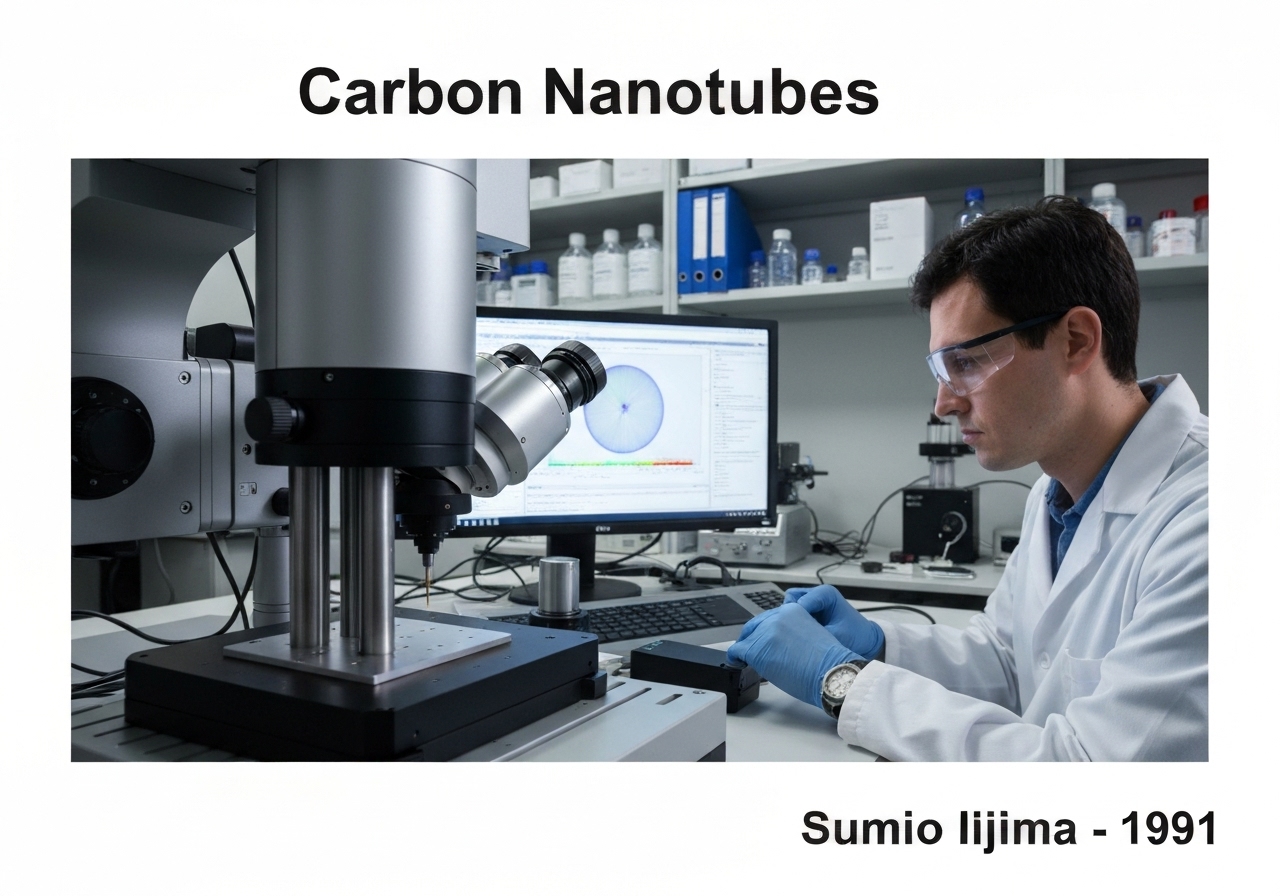
  • Sumio Iijima
原子間力顕微鏡でカーボンナノチューブを操作する研究者。.

(画像はイメージです)

カーボンナノチューブ(CNT)は、単層炭素原子(グラフェン)のシートが巻き上げられた円筒状の分子です。単層カーボンナノチューブ(SWCNT)と多層カーボンナノチューブ(MWCNT)があります。その特性は、驚異的な引張強度(約100 GPa)、高い電気伝導率、高い熱伝導率など、非常に優れています。その電子特性(金属的または半導体的)は、キラリティ、すなわちグラフェン格子が巻き上げられる角度によって決まります。

炭素の構造 ナノチューブ is key to its remarkable properties. A single-walled carbon nanotube (SWCNT) can be conceptualized by taking a sheet of グラフェン and rolling it into a seamless cylinder. The way the sheet is rolled is defined by a chiral vector, [latex]vec{C}_h = nvec{a}_1 + mvec{a}_2[/latex], where [latex]vec{a}_1[/latex] and [latex]vec{a}_2[/latex] are the graphene lattice vectors and (n, m) are integers. This chiral vector dictates the nanotube’s diameter and its electronic properties. If n = m, the nanotube is called “armchair” and is always metallic. If n – m is a multiple of 3, the nanotube is a narrow-gap semiconductor or quasi-metallic. Otherwise, it is a moderate-gap semiconductor. This extreme sensitivity of electronic properties to subtle structural changes is a unique feature of CNTs.

Multi-walled carbon nanotubes (MWCNTs) consist of multiple concentric cylinders of graphene, nested like Russian dolls. They are generally easier and cheaper to produce than SWCNTs but have more complex properties due to inter-wall interactions. Their mechanical strength is exceptional. The strong sp² carbon-carbon bonds make CNTs one of the stiffest and strongest materials ever discovered, with a Young’s modulus over 1 TPa and tensile strength up to 100 GPa, far exceeding that of steel. Their thermal conductivity along the tube axis can also surpass that of diamond. These properties make them ideal reinforcement agents in 複合材料. However, challenges remain in achieving uniform dispersion within a matrix and in producing CNTs with a single, selected chirality on a large scale, which has limited their application in electronics where purity is paramount.

UNESCO Nomenclature: 2211
固体物理学

タイプ

材料

混乱

革命的

使用法

ニッチ/専門分野

前駆物質

  • 1985年にフラーレン(C60)が発見された。
  • カーボンナノチューブの存在と安定性に関する理論的予測
  • アーク放電およびレーザーアブレーション合成技術の開発
  • 高解像度透過型電子顕微鏡(HRTEM)によるイメージングの進歩

アプリケーション

  • 高強度複合材料(例:自転車のフレーム、自動車部品)における添加剤
  • タッチスクリーンや電子機器用の導電性フィルム
  • 原子間力顕微鏡(AFM)プローブ用チップ
  • 電子機器冷却用熱界面材料
  • components in スーパーキャパシタ and batteries

特許:

  • US 5,747,161
  • US 6,683,783

潜在的なイノベーションのアイデア

  • space elevator tether material
  • ballistic transistors for ultra-fast computing
  • artificial muscles based on cnt yarn
  • field emission displays
  • nanoscale wires for next-generation integrated circuits
  • membranes for highly efficient water 脱塩
  • scaffolds for nerve cell regeneration
  • hydrogen storage materials for 燃料電池 vehicles
  • super-black coatings for optical instruments
  • thermal cloaking materials
Related to: carbon nanotube, cnt, swcnt, mwcnt, graphene, chirality, tensile strength, sumio iijima, composite material, ナノテクノロジー.

歴史的背景

カーボンナノチューブ

1984
1986
1986
1991
1994
1997
2002
1984
1985
1986
1990
1993-01-01
1995
2000
2004

(日付が不明または関連性がない場合、例えば「流体力学」などでは、その注目すべき出現時期の概算値が提示されます。)

10年目 周年

フルサイズの画像とダウンロードは、登録会員のみが100%無料で利用できます。