Product Design, Manufacturing & Innovation Resources
집 » 생체 활성 물질

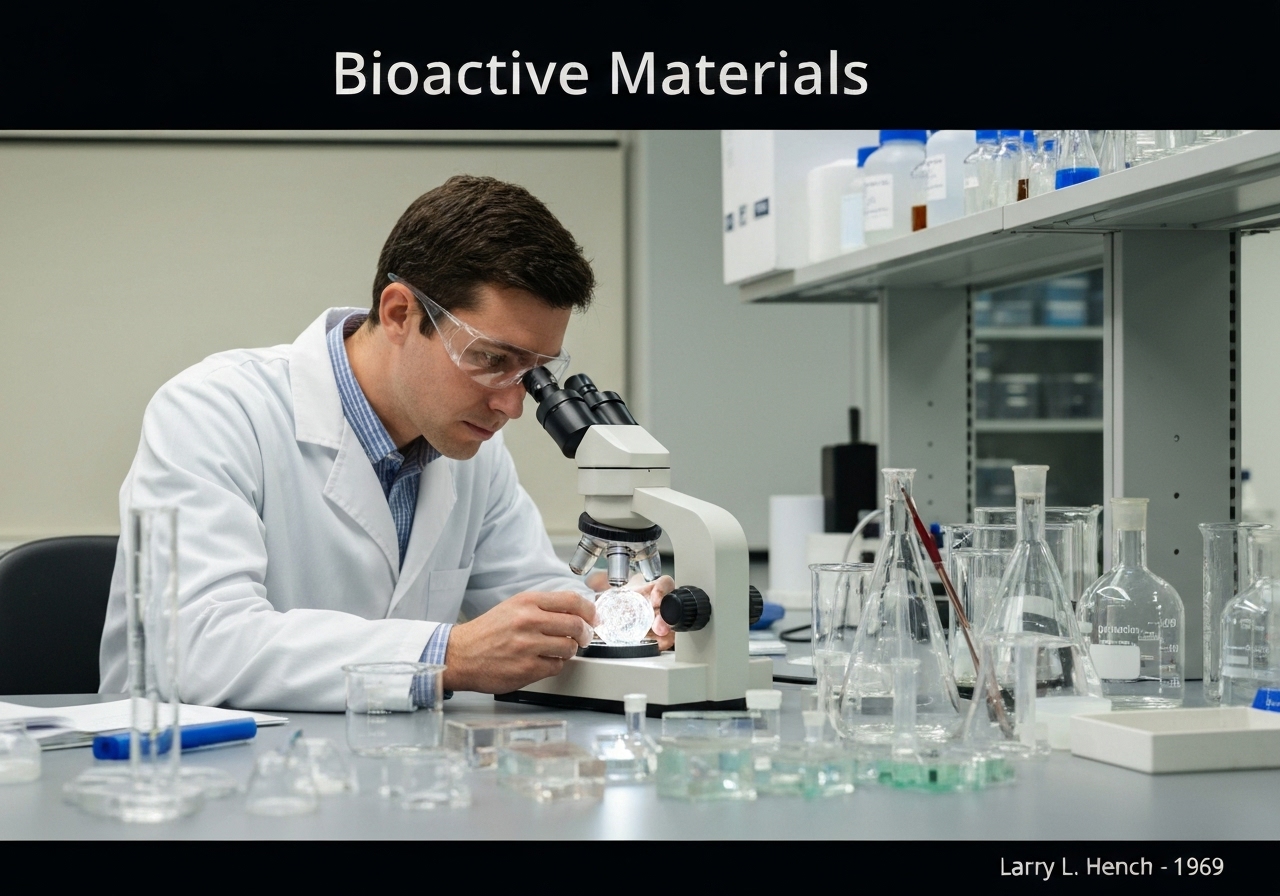
생체 활성 물질

1969
  • Larry L. Hench
Bioglass samples in a laboratory for biomaterials research.

(설명을 위한 생성된 이미지입니다)

Bioactive materials are a class of biomaterials designed to elicit a specific, positive biological response at the material-tissue interface, resulting in the formation of a bond between them. Unlike bioinert materials that aim for minimal interaction, bioactive materials actively participate in healing processes. A classic example is Bioglass, which forms a hydroxyapatite layer on its surface, bonding directly to bone.

The concept of bioactivity was pioneered by Larry Hench with his 1969 invention of Bioglass® 45S5, a specific composition of 45 wt% SiO2, 24.5% CaO, 24.5% Na2O, and 6% P2O5. The mechanism of bone bonding involves a sequence of five surface chemical reactions. When exposed to bodily fluids, (1) rapid ion exchange of Na+ from the glass with H+ from solution occurs, creating a silica-rich layer. (2) This increases local pH, which causes (3) the glass network to break down, releasing silicic acid (Si(OH)4) and forming silanols (Si-OH) at the surface. (4) A high local concentration of calcium and phosphate ions, both from the glass and surrounding fluid, leads to the formation of an amorphous calcium-phosphate layer. (5) This layer crystallizes into hydroxycarbonate apatite (HCA), which is chemically and structurally similar to the mineral phase of bone. This HCA layer provides a bioactive scaffold for osteoblasts to colonize, differentiate, and deposit new bone matrix, creating a strong, direct, and seamless bond with the host bone. This process, known as osseointegration, is crucial for the long-term stability of implants. Furthermore, the dissolution products, particularly silicic acid, have been shown to stimulate genes within osteoprogenitor cells, upregulating the production of growth factors. This makes the material not only osteoconductive (a scaffold for bone growth) but also osteoinductive (actively stimulating new bone formation).

UNESCO Nomenclature: 3201
의학

유형

화학 공정

분열

혁명가

용법

널리 사용됨

전구체

  • 유리 과학 및 제조의 발전
  • understanding of bone composition and the role of hydroxyapatite
  • 정형외과 분야에서 알루미나와 같은 불활성 세라믹의 초기 사용
  • 재료-조직 계면 연구를 위한 표면 분석 기술의 발전

응용 프로그램

  • 정형외과 및 치과 수술에서의 뼈 이식 및 결손 부위 충전재
  • 금속 임플란트(예: 고관절 스템)에 골융합을 촉진하는 코팅
  • scaffolds for bone tissue engineering
  • 치아 법랑질 재광화를 위한 생체 활성 치약의 성분
  • 조직 재생을 촉진하는 상처 치유 드레싱

특허:

  • US3929971A

잠재적 혁신 아이디어

  • bioactive inks for 3d printing patient-specific bone scaffolds
  • ion-releasing dental fillings that inhibit secondary caries and promote dentin regeneration
  • injectable bioactive glass putties for minimally invasive bone repair
  • bioactive coatings for cardiovascular stents that promote endothelialization and prevent restenosis
  • nerve guidance conduits doped with bioactive ions to enhance nerve regeneration
  • bioactive glass nanoparticles for targeted cancer therapy (hyperthermia)
  • antimicrobial bioactive glasses containing silver or copper ions for wound dressings
  • bioactive cements for vertebroplasty that integrate with spinal bone
  • scaffolds that release different ions at different times to orchestrate complex tissue formation
  • bioactive soft materials (hydrogels) for cartilage and soft tissue regeneration
관련 용어: 생체 활성 물질, 바이오글라스, 래리 헨치, 하이드록시아파타이트, 골융합, 뼈 결합, 이온 교환, 골유도, 골전도, 세라믹 생체재료.

역사적 맥락

생체 활성 물질

1960
1960
1969
1976-05-28
1980
1990
1960
1965
1970
1980
1980
1990

(날짜를 알 수 없거나 관련이 없는 경우, 예를 들어 "유체역학"의 경우, 주목할 만한 등장 시기를 대략적으로 추정하여 제공합니다.)

10년차 기념일

고화질 이미지 및 다운로드는 등록된 회원에게만 100% 무료로 제공됩니다.

> 로그인 <