Product Design, Manufacturing & Innovation Resources
Heim » Bioaktive Materialien

Bioaktive Materialien

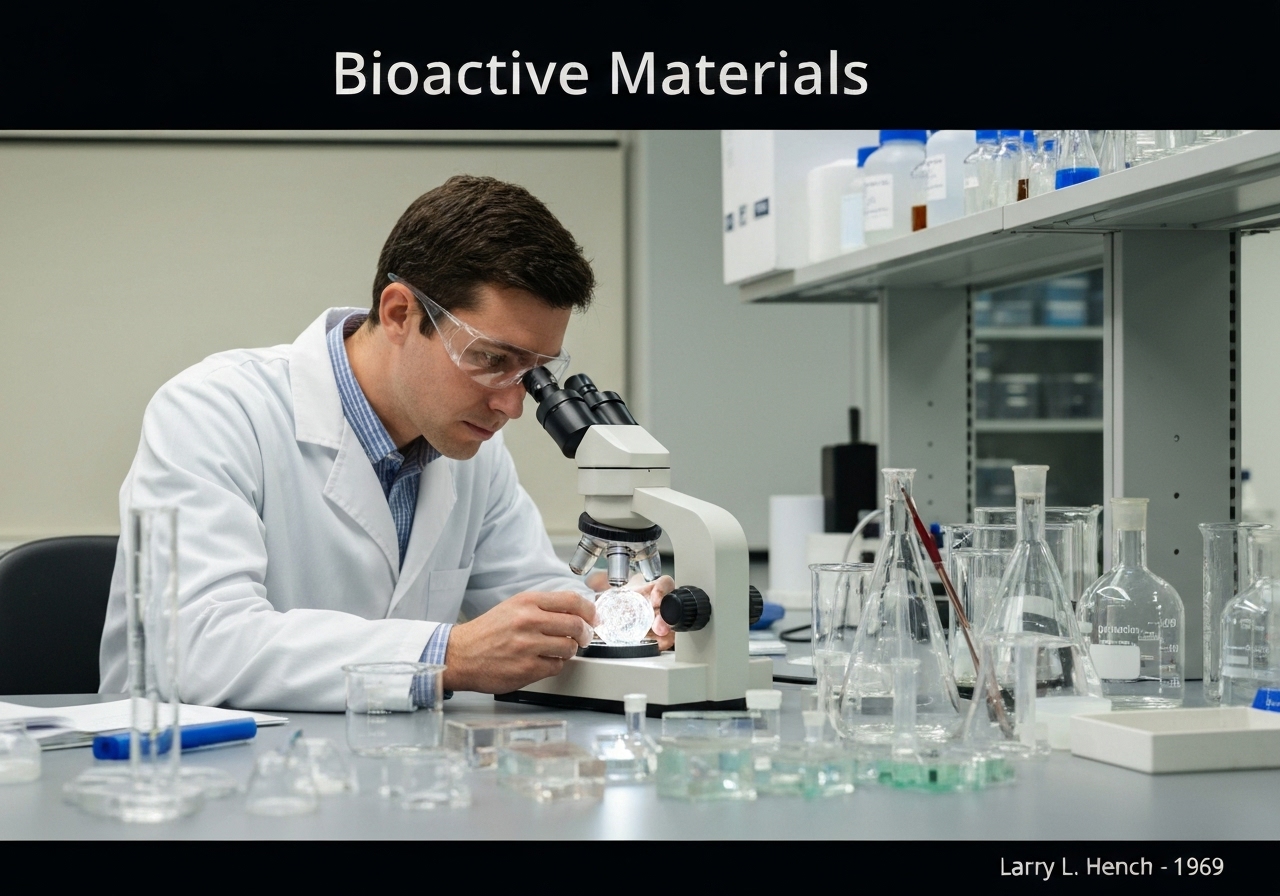
1969
  • Larry L. Hench
Bioglasproben in einem Labor für Biomaterialforschung.

(Abbildung dient nur zur Veranschaulichung)

Bioactive materials are a class of biomaterials designed to elicit a specific, positive biological response at the material-tissue interface, resulting in the formation of a bond between them. Unlike bioinert materials that aim for minimal interaction, bioactive materials actively participate in healing processes. A classic example is Bioglass, which forms a hydroxyapatite layer on its surface, bonding directly to bone.


The concept of bioactivity was pioneered by Larry Hench with his 1969 invention of Bioglass® 45S5, a specific composition of 45 wt% SiO2, 24.5% CaO, 24.5% Na2O, and 6% P2O5. The mechanism of bone bonding involves a sequence of five surface chemical reactions. When exposed to bodily fluids, (1) rapid ion exchange of Na+ from the glass with H+ from solution occurs, creating a silica-rich layer. (2) This increases local pH, which causes (3) the glass network to break down, releasing silicic acid (Si(OH)4) and forming silanols (Si-OH) at the surface. (4) A high local concentration of calcium and phosphate ions, both from the glass and surrounding fluid, leads to the formation of an amorphous calcium-phosphate layer. (5) This layer crystallizes into hydroxycarbonate apatite (HCA), which is chemically and structurally similar to the mineral phase of bone. This HCA layer provides a bioactive scaffold for osteoblasts to colonize, differentiate, and deposit new bone matrix, creating a strong, direct, and seamless bond with the host bone. This process, known as Osseointegration, is crucial for the long-term stability of implants. Furthermore, the dissolution products, particularly silicic acid, have been shown to stimulate genes within osteoprogenitor cells, upregulating the production of growth factors. This makes the material not only osteoconductive (a scaffold for bone growth) but also osteoinductive (actively stimulating new bone formation).

UNESCO Nomenclature: 3201
- Medizinische Wissenschaften

Typ

Chemischer Prozess

Störung

Revolutionär

Verwendung

Weitverbreitete Verwendung

Vorläufer

  • Entwicklung der Glaswissenschaft und -herstellung
  • understanding of bone composition and the role of hydroxyapatite
  • frühe Verwendung inerter Keramiken wie Aluminiumoxid in der Orthopädie
  • Fortschritte in der Oberflächenanalyse zur Untersuchung der Material-Gewebe-Grenzfläche

Anwendungen

  • Knochentransplantate und Hohlraumfüller in der orthopädischen und zahnärztlichen Chirurgie
  • Beschichtungen auf metallischen Implantaten (z. B. Hüftschäften) zur Förderung der Osseointegration
  • scaffolds for bone tissue engineering
  • Komponenten in bioaktiven Zahnpasten zur Remineralisierung des Zahnschmelzes
  • Wundheilungsverbände, die die Gewebereparatur stimulieren

Patente:

  • US3929971A

Potenzielle Innovationsideen

  • bioaktive Tinten für den 3D-Druck patientenspezifischer Knochengerüste
  • Ionenfreisetzende Zahnfüllungen, die Sekundärkaries hemmen und die Dentinregeneration fördern
  • injizierbare bioaktive Glaskitte für die minimalinvasive Knochenreparatur
  • bioaktive Beschichtungen für kardiovaskuläre Stents, die die Endothelisierung fördern und Restenosen verhindern
  • Mit bioaktiven Ionen dotierte Nervenleitkanäle zur Verbesserung der Nervenregeneration
  • bioactive glass nanoparticles for targeted cancer therapy (hyperthermia)
  • antimikrobielle bioaktive Gläser mit Silber- oder Kupferionen für Wundauflagen
  • bioaktive Zemente für die Vertebroplastie, die sich in den Wirbelsäulenknochen integrieren
  • Gerüste, die zu unterschiedlichen Zeiten unterschiedliche Ionen freisetzen, um die Bildung komplexer Gewebe zu orchestrieren
  • bioaktive weiche Materialien (Hydrogele) für die Knorpel- und Weichteilregeneration
Verwandt mit: bioaktiv, Bioglas, Larry Hench, Hydroxylapatit, Osseointegration, Knochenbindung, Ionenaustausch, Osteoinduktion, Osteokonduktion, keramisches Biomaterial.

Historischer Kontext

Bioaktive Materialien

1960
1960
1969
1976-05-28
1980
1990
1960
1965
1970
1980
1980
1990

(wenn das Datum unbekannt oder nicht relevant ist, z. B. „Strömungsmechanik“, wird eine gerundete Schätzung seines bemerkenswerten Auftretens bereitgestellt)

10. Jahr Jubiläum

Bilder in voller Größe und Downloads sind nur für registrierte Mitglieder 100% kostenlos verfügbar.

> Login <