Product Design, Manufacturing & Innovation Resources
家 » 組織工学用足場

組織工学用足場

1990
  • Robert Langer
  • Joseph Vacanti
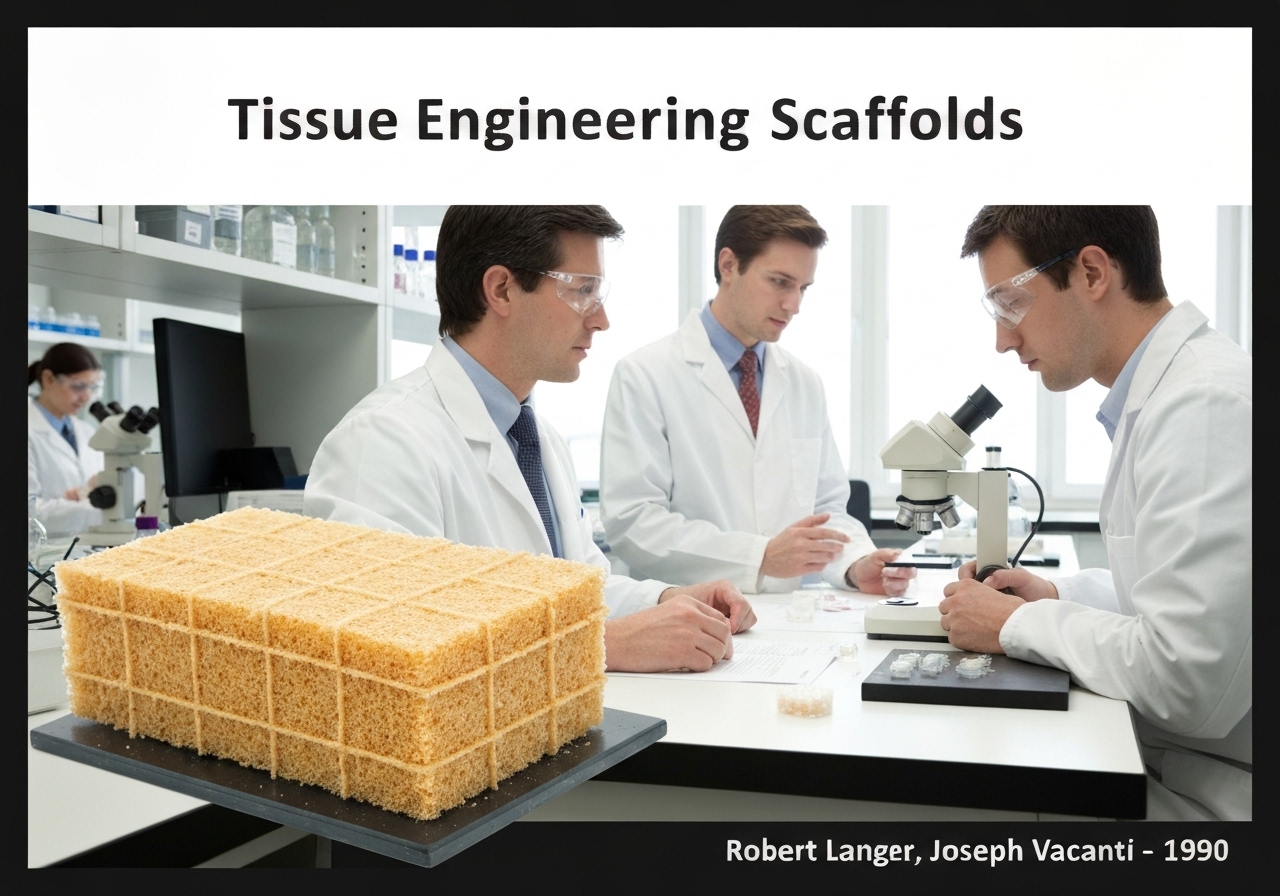
Biomaterial scaffold for tissue regeneration in medical sciences.

(画像はイメージです)

あ tissue engineering scaffold is a porous, three-dimensional biomaterial structure that serves as a temporary template for tissue regeneration. It is designed to support cell attachment, migration, proliferation, and differentiation, guiding the formation of new functional tissue. Key properties include biocompatibility, biodegradability, appropriate mechanical strength, high porosity, and an interconnected pore network to allow nutrient and waste transport.

組織工学用足場の設計は、複雑な最適化問題です。材料の選択は非常に重要です。コラーゲンやアルギン酸などの天然ポリマーは優れた生体適合性を示しますが、機械的特性が劣る場合があります。一方、ポリ(乳酸-co-グリコール酸)(PLGA)やポリカプロラクトン(PCL)などの合成ポリマーは、分解速度と機械的強度を調整できます。足場の構造も同様に重要です。高い多孔性と相互接続された細孔構造は、細胞の浸潤と酸素、栄養素、代謝老廃物の拡散に不可欠です。細孔サイズは、接着と組織形成を促進するために、特定の細胞タイプに合わせて最適化する必要があります。これらの構造的特徴を制御するために、高度な製造技術が使用されます。たとえば、エレクトロスピニングでは、高電圧を使用してポリマー溶液をナノファイバーに引き伸ばし、天然の細胞外マトリックス(ECM)を模倣します。 積層造形 (3D printing) allows for the creation of patient-specific scaffolds with precise geometries derived from medical images like CT scans. Furthermore, scaffolds can be functionalized by incorporating growth factors, signaling molecules, or nanoparticles to actively direct cell behavior. The ideal scaffold degrades via hydrolysis or enzymatic action at a rate that matches the rate of new tissue formation, gradually transferring mechanical load to the nascent tissue until the scaffold is completely replaced by healthy, functional host tissue. Bioreactors are often used to mature these constructs in vitro by providing controlled flow and mechanical stimuli before implantation.

UNESCO Nomenclature: 3201
医学

タイプ

物理デバイス

混乱

革命的

使用法

新興技術

前駆物質

  • 縫合糸用のPGAやPLAなどの生分解性ポリマーの開発
  • 細胞培養技術の進歩
  • 細胞と細胞外マトリックス(ECM)の相互作用の理解
  • 成長因子の発見と組織発生におけるそれらの役割

アプリケーション

  • 骨と軟骨の再生
  • 火傷患者のための皮膚移植の工学的研究
  • 血管と心臓弁の形成
  • 誘導管を用いた神経損傷の修復
  • 肝臓や膀胱などの生体人工臓器の開発

特許:

NA

潜在的なイノベーションのアイデア

  • 4d printed scaffolds that change shape over time in response to physiological stimuli
  • scaffolds with built-in gradients of biochemical cues to mimic native tissue complexity
  • vascularized scaffolds pre-loaded with endothelial cells to ensure blood supply to engineered tissue
  • ‘smart’ scaffolds that release therapeutic agents on demand in response to inflammation
  • decellularized extracellular matrix (ecm) from donor tissues used as natural, complex scaffolds
  • injectable, in-situ gelling ハイドロゲル scaffolds for minimally invasive procedures
  • scaffolds with integrated sensors to monitor tissue growth and health non-invasively
  • organ-on-a-chip platforms using scaffold technology for drug screening
  • hybrid scaffolds combining synthetic polymers for strength and natural polymers for bioactivity
  • scaffolds designed to recruit and direct the body’s own stem cells for repair
関連: tissue engineering, scaffold, biomaterial, porous, biodegradable, cell adhesion, regeneration, 3d printing, electrospinning, plga.

歴史的背景

組織工学用足場

1969
1976-05-28
1980
1990
1965
1970
1980
1980
1990

(日付が不明または関連性がない場合、例えば「流体力学」などでは、その注目すべき出現時期の概算値が提示されます。)

10年目 周年

フルサイズの画像とダウンロードは、登録会員のみが100%無料で利用できます。