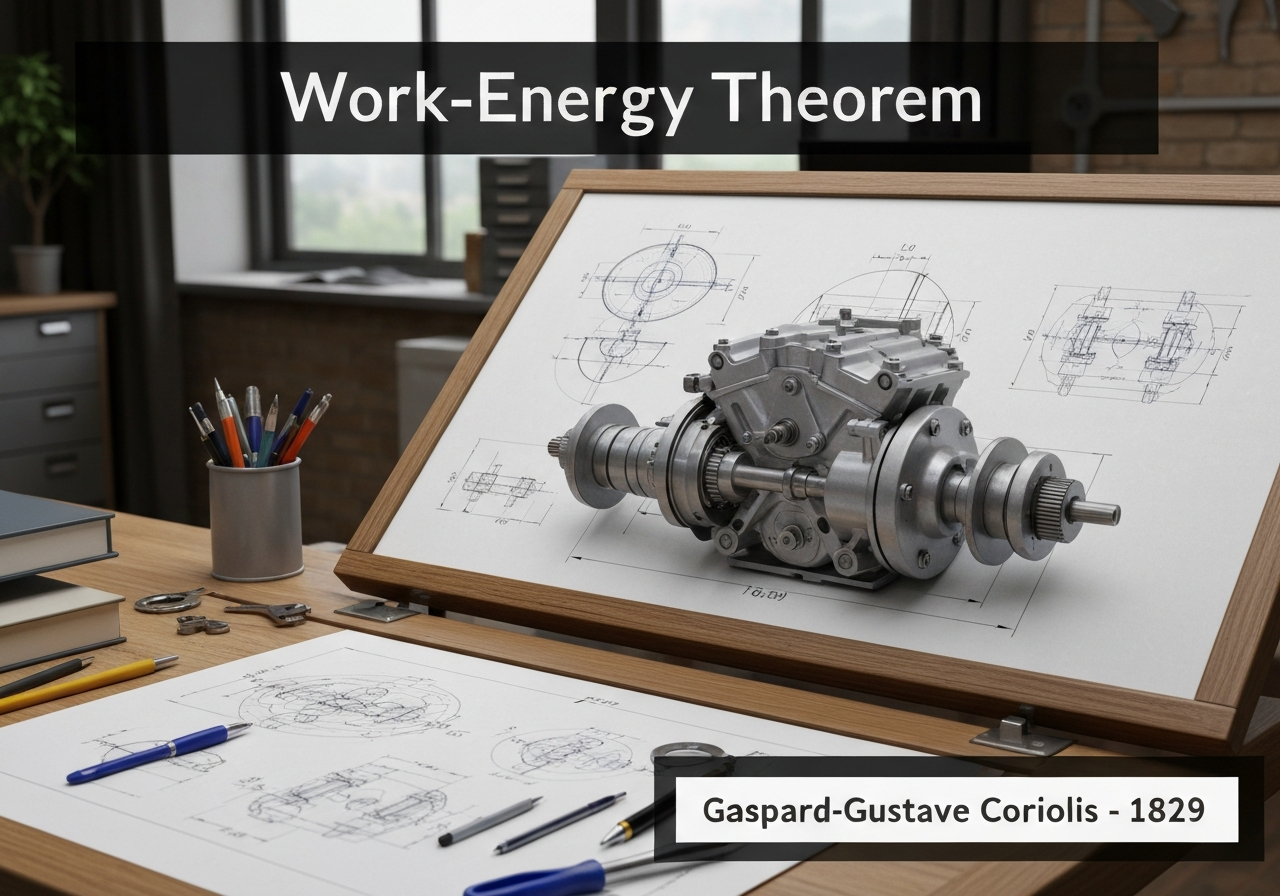
仕事エネルギー定理は、粒子に作用するすべての力によってなされる正味の仕事([latex]W[/latex])は、その粒子の運動エネルギーの変化([latex]Delta E_k[/latex])に等しいと述べています。数式で表すと、[latex]W = Delta E_k = E_{k,f} – E_{k,i}[/latex]となります。この原理は、力、変位、エネルギーの概念を直接結びつけ、ニュートンの法則を直接使用せずに運動を分析するための強力なツールを提供します。 第二法則.

(画像はイメージです)
仕事エネルギー定理は、粒子に作用するすべての力によってなされる正味の仕事([latex]W[/latex])は、その粒子の運動エネルギーの変化([latex]Delta E_k[/latex])に等しいと述べています。数式で表すと、[latex]W = Delta E_k = E_{k,f} – E_{k,i}[/latex]となります。この原理は、力、変位、エネルギーの概念を直接結びつけ、ニュートンの法則を直接使用せずに運動を分析するための強力なツールを提供します。 第二法則.
The work-energy theorem provides a direct link between the dynamics of forces and the kinematics of motion, expressed through the language of energy. It is derived directly from Newton’s 第二法則, [latex]F_{net} = ma[/latex]. By integrating the net force with respect to displacement, one can show that this integral equals the change in the quantity [latex]\frac{1}{2}mv^2[/latex]. Coriolis formally defined this integral as “work” and [latex]\frac{1}{2}mv^2[/latex] as “kinetic energy,” thereby formulating the theorem as [latex]W_{net} = \Delta E_k[/latex]. This was a significant conceptual advance because it allows for the analysis of complex systems without needing to solve differential equations of motion directly. For example, to find the final speed of an object after being acted upon by a variable force over a certain distance, one can simply calculate the total work done and equate it to the change in kinetic energy. The theorem applies to the work done by the *net* force. If one considers the work done by individual forces, it can be partitioned. For instance, the work done by conservative forces (like gravity) equals the negative change in potential energy, leading to the broader principle of the conservation of mechanical energy ([latex]\Delta E_k + \Delta E_p = W_{non-conservative}[/latex]).
仕事エネルギー定理
(日付が不明または関連性がない場合、例えば「流体力学」などでは、その注目すべき出現時期の概算値が提示されます。)

フルサイズの画像とダウンロードは、登録会員のみが100%無料で利用できます。
> ログイン <