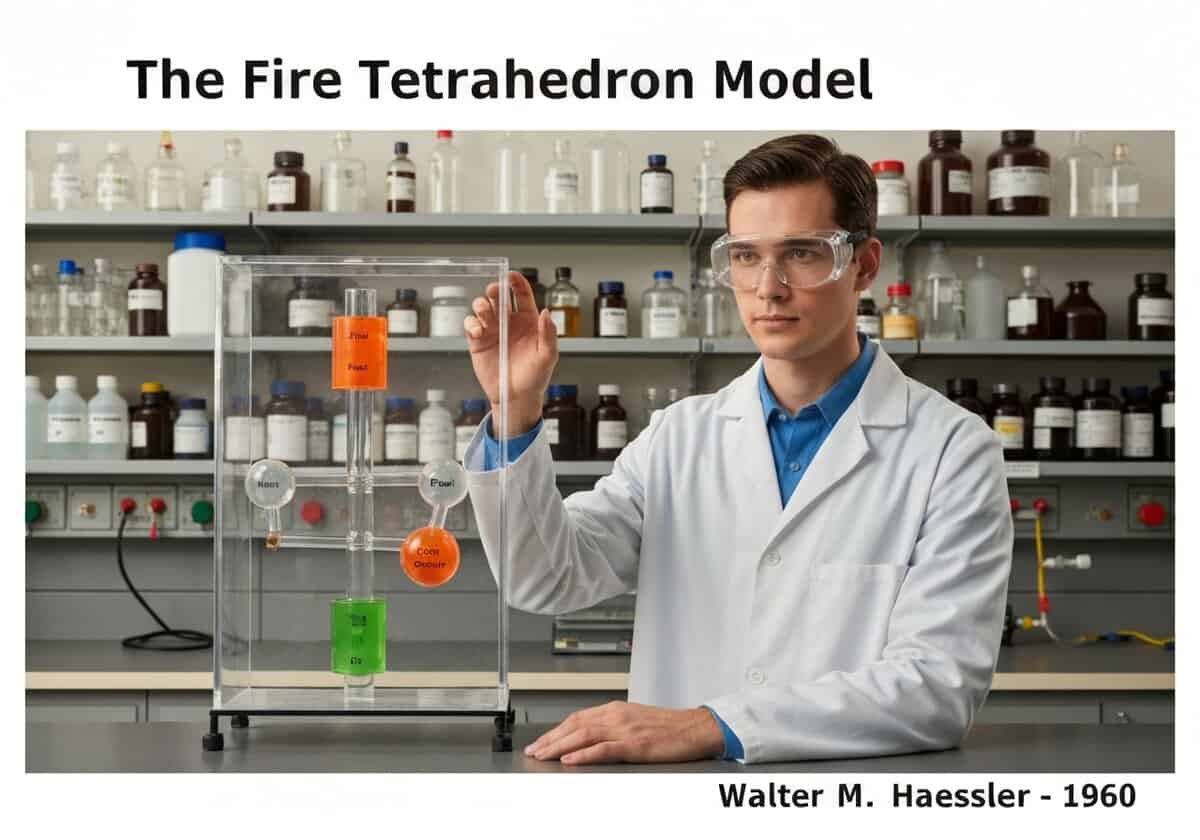
While the 火の三角地帯 is sufficient for explaining the initiation of combustion, the fire tetrahedron provides a more complete model for understanding sustained, flaming fires. It incorporates the three elements of the triangle—heat, fuel, and an oxidizing agent—and adds a fourth face: the uninhibited chemical chain reaction. In a flaming fire, the initial heat causes the fuel to pyrolyze, releasing flammable vapors. These vapors mix with the oxidizer and combust, releasing more heat. A portion of this newly generated heat radiates back to the fuel, causing it to release more vapors, thus creating a self-sustaining cycle. This cycle involves highly reactive, short-lived molecules called free radicals (e.g., H•, O•, OH•). The fire tetrahedron model highlights that a fire can be extinguished not only by removing heat, fuel, or oxygen but also by interrupting this chemical chain reaction. This is the principle behind many modern extinguishing agents, such as dry chemical powders and halocarbon clean agents. These agents work by chemically interfering with the free radicals, effectively poisoning the fire and stopping the chain reaction, even if sufficient heat, fuel, and oxygen are still present.
注記: while this 4th element does make complex cases more comprehensive -chemical powders and halocarbon clean agents-, it can still be viewed a classic 3 triangle case, where this 4th element is just adding or suppressing the root cause of one of the 3 others.
Related to: fire tetrahedron, chemical chain reaction, combustion, free radicals, extinguishment, halon, fire safety, flaming combustion,
熱分解, flame inhibition.