Product Design, Manufacturing & Innovation Resources
Home » Navier–Stokes Equations

Navier–Stokes Equations

1822
  • Claude-Louis Navier
  • George Gabriel Stokes
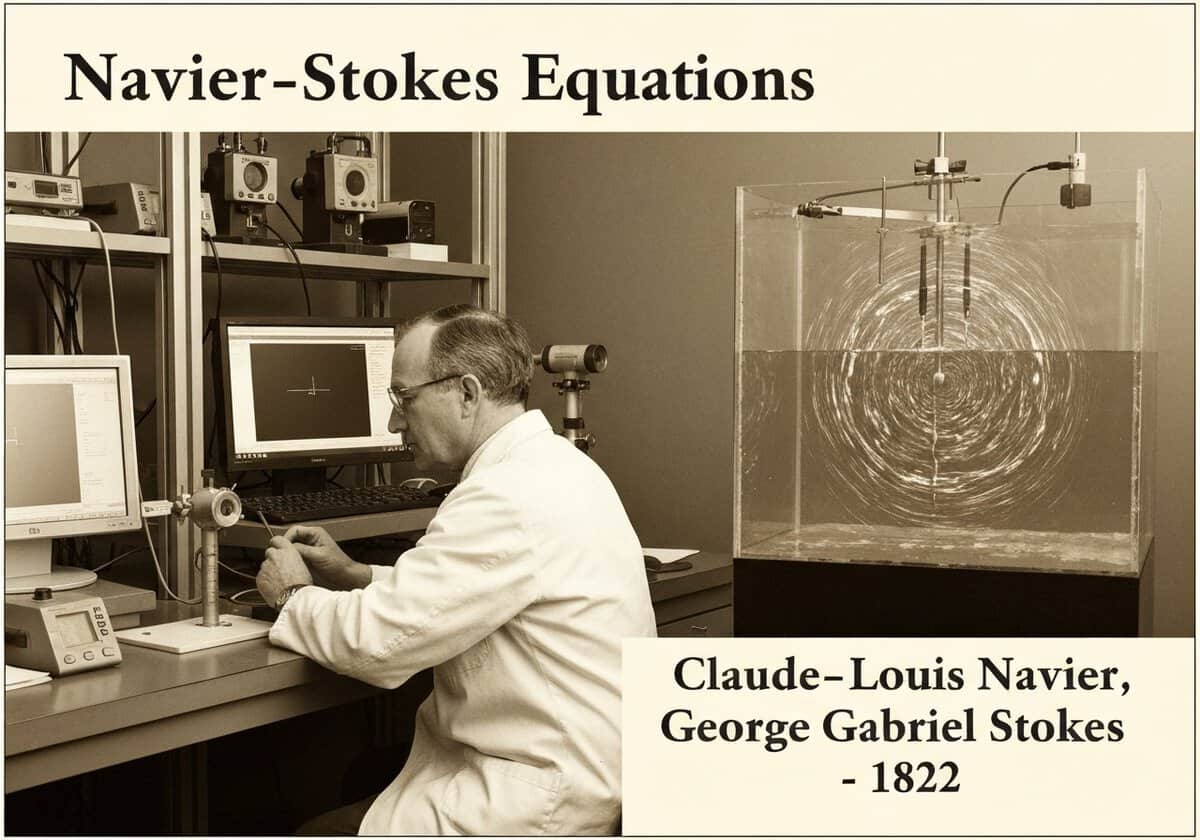
Fluid dynamics researcher analyzing flow patterns using Navier–Stokes equations.

(generated image for illustration only)

The Navier–Stokes equations are a set of non-linear partial differential equations describing the motion of viscous fluid substances. They are a statement of Newton’s second law, balancing momentum changes with pressure gradients, viscous forces, and external forces. For an incompressible fluid, the equation is \(\rho (\frac{\partial \mathbf{v}}{\partial t} + \mathbf{v} \cdot \nabla \mathbf{v}) = -\nabla p + \mu \nabla^2 \mathbf{v} + \mathbf{f}\).


The Navier-Stokes equations are the cornerstone of modern fluid dynamics. The terms in the equation represent the fundamental physical principles governing fluid motion. The left side, \(\rho (\frac{\partial \mathbf{v}}{\partial t} + \mathbf{v} \cdot \nabla \mathbf{v})\), represents the inertial forces per unit volume, broken down into the unsteady acceleration (change in velocity over time) and the convective acceleration (change in velocity due to the fluid moving to a new location). The right side details the forces acting on the fluid. The term \(-\nabla p\) is the pressure gradient, which drives flow from high-pressure to low-pressure regions. The term \(\mu \nabla^2 \mathbf{v}\) represents the viscous forces, which act as an internal friction within the fluid, resisting motion and dissipating energy. Finally, \(\mathbf{f}\) accounts for external body forces like gravity.

These equations are notoriously difficult to solve analytically due to their non-linear nature, specifically the convective acceleration term \(\mathbf{v} \cdot \nabla \mathbf{v}\). This non-linearity is the primary cause of turbulence, a complex and chaotic flow regime that remains one of the great unsolved problems in classical physics. In fact, proving the existence and smoothness of solutions to the three-dimensional Navier-Stokes equations is one of the seven Millennium Prize Problems posed by the Clay Mathematics Institute.

For practical applications, engineers and scientists rely on computational fluid dynamics (CFD), where supercomputers are used to find approximate numerical solutions. By discretizing the fluid domain into a fine mesh and solving the equations for each cell, CFD can simulate everything from the airflow over a Formula 1 car to the circulation of the Earth’s oceans, making the Navier-Stokes equations an indispensable tool in modern science and engineering.

UNESCO Nomenclature: 2210
– Mechanics

Type

Abstract System

Disruption

Revolutionary

Usage

Widespread Use

Precursors

  • isaac newton’s laws of motion
  • leonhard euler’s equations for inviscid flow
  • augustin-louis cauchy’s momentum equation
  • the development of partial differential calculus

Applications

  • aircraft and car design
  • weather forecasting
  • blood flow analysis
  • power station design
  • analysis of pollution dispersion
  • design of oil pipelines

Patents:

NA

Potential Innovations Ideas

Due to scrapping bot traffic, currently more than 40k per day, this content is reserved to community members.
> Login < or > Register < (100% free) to access this, so as all other restricted content and tools.

Related to: navier-stokes, CFD, viscous flow, incompressible flow, fluid dynamics, partial differential equation, newton’s second law, turbulence.

Historical Context

Navier–Stokes Equations

1816-11-16
1820
1820
1822
1824
1827
1831
1816-11-16
1820
1820
1821
1822
1827
1831
1831

(if date is unknown or not relevant, e.g. "fluid mechanics", a rounded estimation of its notable emergence is provided)

Related Invention, Innovation & Technical Principles

Full size images and downloads are only available, 100% free, for registered members.

> Login <