Product Design, Manufacturing & Innovation Resources
Home » Back Electromotive Force (Back-EMF)

Back Electromotive Force (Back-EMF)

1831
  • Michael Faraday
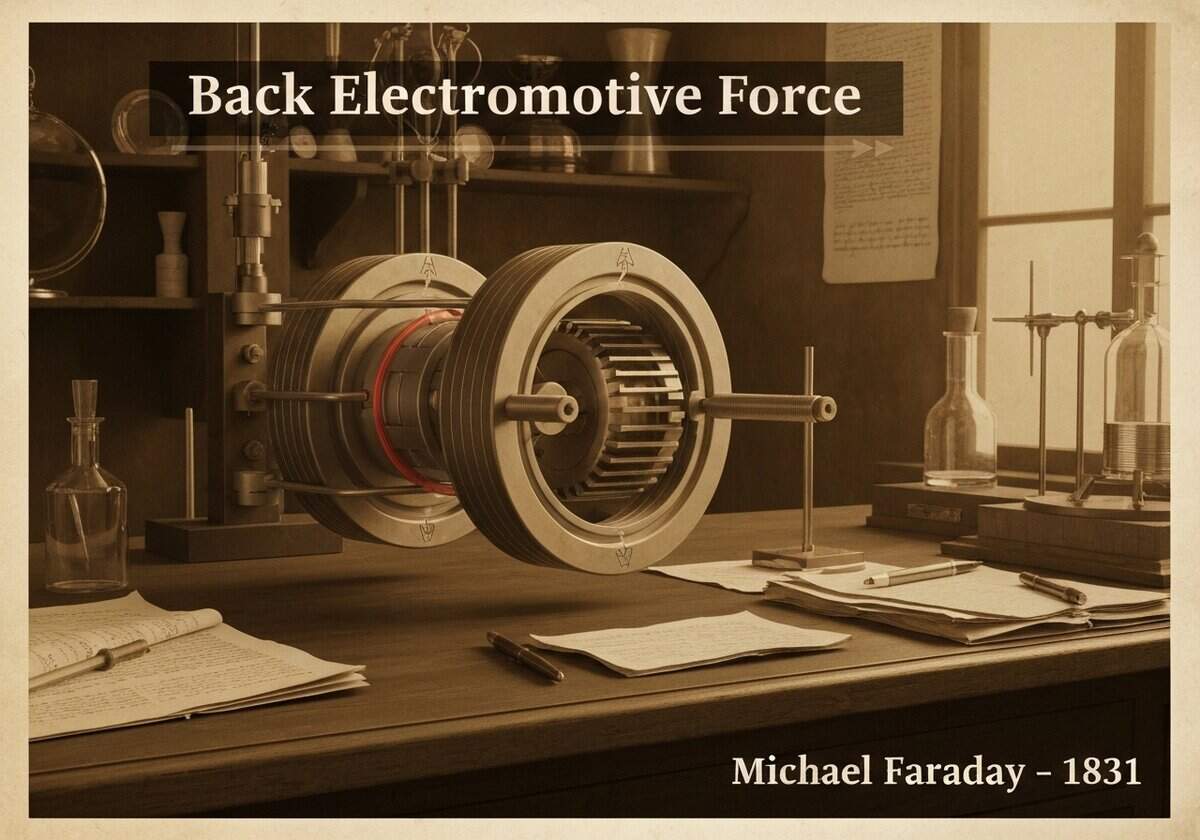
Motor armature rotating in magnetic field illustrating back electromotive force in electromagnetism.

(generated image for illustration only)

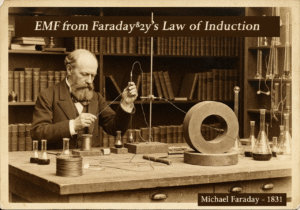
As a motor’s armature rotates, its conductors cut through the magnetic field, inducing a voltage according to Faraday’s law of induction. This ‘back-EMF’ opposes the main voltage driving the motor. Its magnitude is directly proportional to the motor’s rotational speed (\(\mathcal{E}_{back} \propto \omega\)). This phenomenon is crucial for the self-regulation of motor speed and current draw.
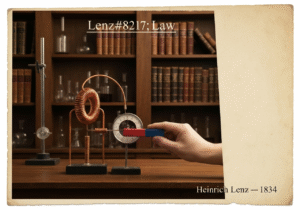
Back-EMF is a direct consequence of the motor also acting as a generator. While the applied voltage causes current to flow and produce torque (motor action), the resulting rotation of the conductors in the magnetic field generates a voltage (generator action). Lenz’s law dictates that this induced voltage must oppose the change that created it, which is the flow of current from the external supply. Therefore, it is called a ‘back’ or ‘counter’ electromotive force.

The net voltage across the armature windings is the difference between the supply voltage and the back-EMF: \(V_{net} = V_{applied} – \mathcal{E}_{back}\). According to Ohm’s law, the armature current is \(I_a = (V_{applied} – \mathcal{E}_{back}) / R_a\), where \(R_a\) is the armature resistance. At startup, the speed \(\omega\) is zero, so \(\mathcal{E}_{back}\) is zero. This results in a very large inrush current, limited only by the low armature resistance. As the motor speeds up, \(\mathcal{E}_{back}\) increases, reducing the net voltage and causing the current to drop. The motor settles at a stable speed where the torque produced by the current matches the load torque. This inherent self-regulating feature is fundamental to motor behavior.

UNESCO Nomenclature: 2212
– Electricity and magnetism

Type

Physical Phenomenon

Disruption

Foundational

Usage

Widespread Use

Precursors

  • Hans Christian Ørsted’s discovery of electromagnetism
  • Discovery of electromagnetic induction by Michael Faraday

Applications

  • motor speed regulation
  • regenerative braking in electric vehicles
  • sensorless speed control in bldc motors
  • inrush current limiting circuits
  • diagnostic systems for motor health

Patents:

    Potential Innovations Ideas

    Due to scrapping bot traffic, currently more than 40k per day, this content is reserved to community members.
    > Login < or > Register < (100% free) to access this, so as all other restricted content and tools.

    Related to: back-EMF, counter-EMF, Faraday’s law of induction, Lenz’s law, motor speed, self-regulation, armature current, electric generator, Inrush current, electromotive force.

    Historical Context

    Back Electromotive Force (Back-EMF)

    1822
    1827
    1831
    1831
    1832
    1834
    1835
    1822
    1824
    1827
    1831
    1831
    1833
    1834
    1836

    (if date is unknown or not relevant, e.g. "fluid mechanics", a rounded estimation of its notable emergence is provided)

    Related Invention, Innovation & Technical Principles

    Full size images and downloads are only available, 100% free, for registered members.

    > Login <