Product Design, Manufacturing & Innovation Resources
Home » Stirling Cycle

Stirling Cycle

1816-11-16
  • Robert Stirling
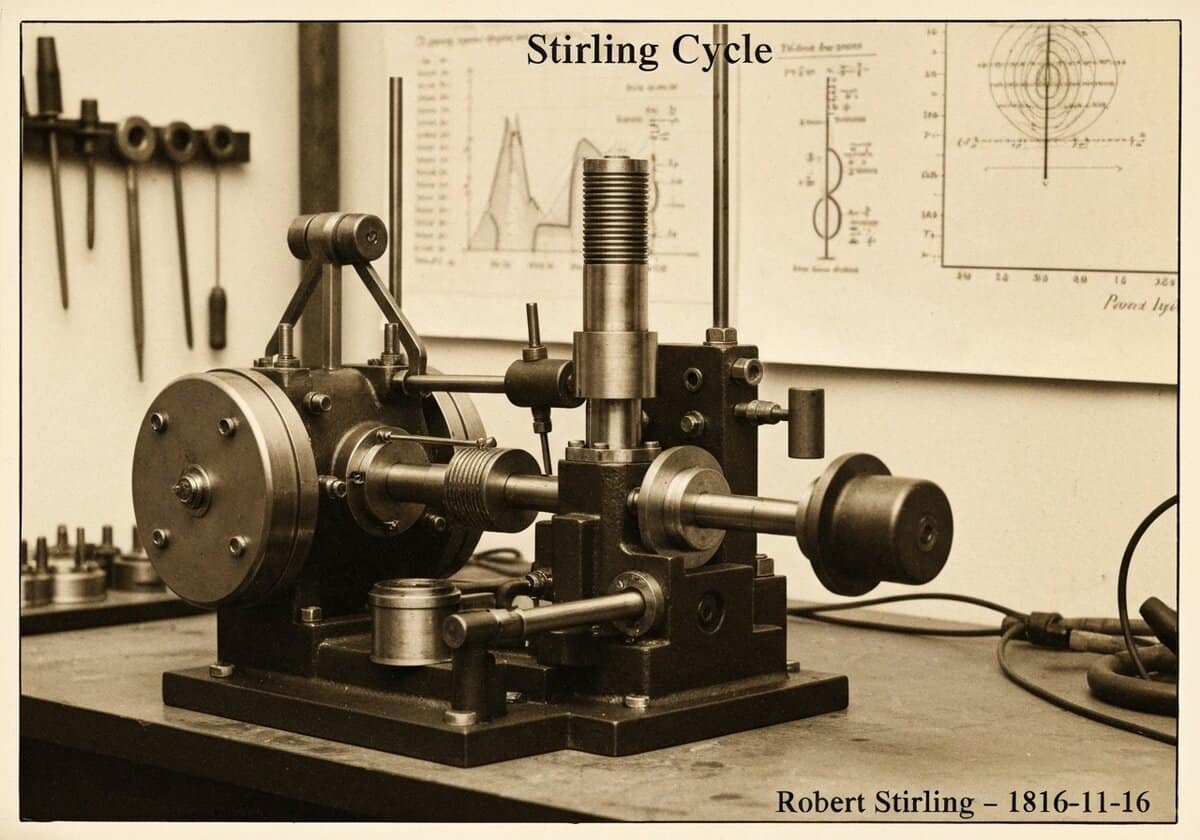
Stirling engine demonstrating thermodynamic principles in a laboratory setting.

(generated image for illustration only)

The ideal Stirling cycle is a closed regenerative thermodynamic cycle comprising four distinct processes: isothermal expansion, isochoric heat removal, isothermal compression, and isochoric heat addition. The working fluid is permanently contained. Its theoretical thermal efficiency equals the Carnot cycle efficiency, given by \(\eta_{th} = 1 – \frac{T_C}{T_H}\), where \(T_H\) and \(T_C\) are the absolute temperatures of the hot and cold reservoirs.


The Stirling cycle’s four processes can be visualized on a Pressure-Volume (P-V) diagram. Process 1-2 is isothermal expansion, where the gas expands at a constant high temperature \(T_H\), absorbing heat from the external source and performing work on the surroundings. Process 2-3 is isochoric (constant volume) heat removal, where the gas is passed through the regenerator, cooling to the low temperature \(T_C\) and transferring heat to the regenerator matrix. Process 3-4 is isothermal compression, where the gas is compressed at constant temperature \(T_C\), rejecting heat to the cold sink while work is done on the gas. Finally, process 4-1 is isochoric heat addition, where the gas passes back through the regenerator, picking up the stored heat and returning to temperature \(T_H\).

The regenerator is crucial to the ideal cycle’s high efficiency. By storing and returning heat during the isochoric steps, it ensures that all external heat exchange occurs only during the isothermal processes, just as in the Carnot cycle. This allows the Stirling cycle to theoretically achieve the maximum possible efficiency for any heat engine operating between two given temperatures. In practice, real Stirling engines deviate from this ideal. The processes are not perfectly isothermal or isochoric due to finite heat transfer rates and continuous piston motion, leading to rounded corners on the P-V diagram and lower efficiency.

UNESCO Nomenclature: 2212
– Thermodynamics

Type

Abstract System

Disruption

Foundational

Usage

Widespread Use

Precursors

  • Sadi Carnot’s theory of the ideal heat engine cycle (1824)
  • The development of the Ideal Gas Law from the work of Boyle, Charles, and Gay-Lussac
  • Early concepts of thermodynamics and conservation of energy
  • Invention of the piston and cylinder mechanism

Applications

  • cryocoolers for electronics and medical imaging
  • solar power generation in dish stirling systems
  • micro combined heat and power (mchp) units
  • waste heat recovery systems from industrial processes
  • quiet power sources for submarines and yachts
  • biomass-fueled power generators in remote areas

Patents:

  • GB 4081 of 1816

Potential Innovations Ideas

Due to scrapping bot traffic, currently more than 40k per day, this content is reserved to community members.
> Login < or > Register < (100% free) to access this, so as all other restricted content and tools.

Related to: stirling cycle, thermodynamics, isothermal, isochoric, regenerative cycle, heat engine, carnot efficiency, closed cycle, working fluid, thermal efficiency.

Historical Context

Stirling Cycle

1802
1808
1811
1816-11-16
1820
1820
1821
1802
1802
1810
1816
1816-11-16
1820
1820
1822

(if date is unknown or not relevant, e.g. "fluid mechanics", a rounded estimation of its notable emergence is provided)

Full size images and downloads are only available, 100% free, for registered members.

> Login <