Product Design, Manufacturing & Innovation Resources
家 » 纳维-斯托克斯方程

纳维-斯托克斯方程

1822
  • Claude-Louis Navier
  • George Gabriel Stokes
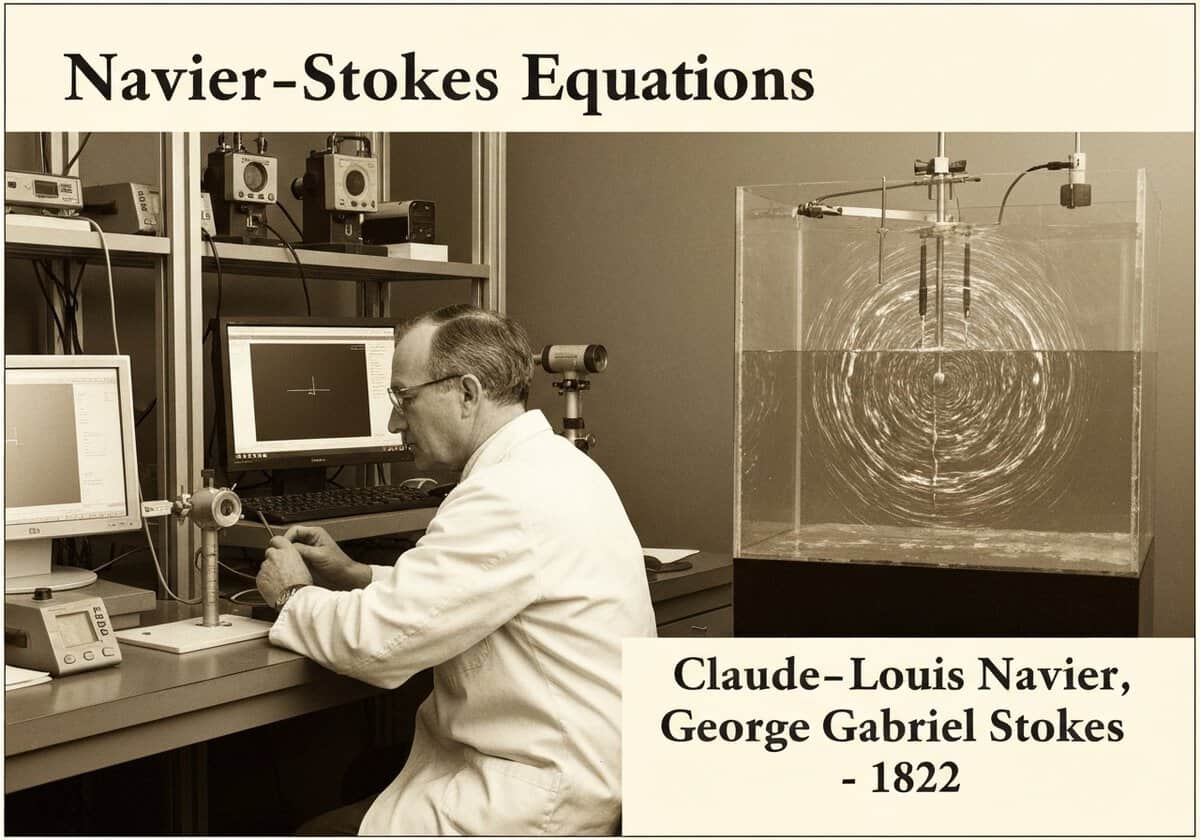
流体动力学研究人员使用纳维-斯托克斯方程分析流动模式。

(图片仅供参考)

The Navier–Stokes equations are a set of non-linear partial differential equations describing the motion of viscous fluid substances. They are a statement of Newton’s second law, balancing momentum changes with 压力 gradients, viscous forces, and external forces. For an incompressible fluid, the equation is [latex]\rho (\frac{\partial \mathbf{v}}{\partial t} + \mathbf{v} \cdot \nabla \mathbf{v}) = -\nabla p + \mu \nabla^2 \mathbf{v} + \mathbf{f}[/latex].


The Navier-Stokes equations are the cornerstone of modern fluid dynamics. The terms in the equation represent the fundamental physical principles governing fluid motion. The left side, [latex]\rho (\frac{\partial \mathbf{v}}{\partial t} + \mathbf{v} \cdot \nabla \mathbf{v})[/latex], represents the inertial forces per unit volume, broken down into the unsteady acceleration (change in velocity over time) and the convective acceleration (change in velocity due to the fluid moving to a new location). The right side details the forces acting on the fluid. The term [latex]-\nabla p[/latex] is the pressure gradient, which drives flow from high-pressure to low-pressure regions. The term [latex]\mu \nabla^2 \mathbf{v}[/latex] represents the viscous forces, which act as an internal friction within the fluid, resisting motion and dissipating energy. Finally, [latex]\mathbf{f}[/latex] accounts for external body forces like gravity.

These equations are notoriously difficult to solve analytically due to their non-linear nature, specifically the convective acceleration term [latex]\mathbf{v} \cdot \nabla \mathbf{v}[/latex]. This non-linearity is the primary cause of turbulence, a complex and chaotic flow regime that remains one of the great unsolved problems in classical physics. In fact, proving the existence and smoothness of solutions to the three-dimensional Navier-Stokes equations is one of the seven Millennium Prize Problems posed by the Clay Mathematics Institute.

For practical applications, engineers and scientists rely on computational fluid dynamics (CFD), where supercomputers are used to find approximate numerical solutions. By discretizing the fluid domain into a fine mesh and solving the equations for each cell, CFD can simulate everything from the airflow over a Formula 1 car to the circulation of the Earth’s oceans, making the Navier-Stokes equations an indispensable tool in modern science and engineering.

UNESCO Nomenclature: 2210
– Mechanics

类型

抽象系统

中断

Revolutionary

用法

广泛使用

前体

应用程序

  • 飞机和汽车设计
  • 天气预报
  • 血流分析
  • 发电站设计
  • 污染扩散分析
  • 石油管道设计

专利:

NA

潜在创新理念

  • ai solvers that find approximate solutions for turbulence in real-time for flight control
  • 个性化血流模拟器预测动脉瘤风险
  • 洋流模型优化塑料清理作业
  • 下一代静音潜艇船体设计
  • real-time smoke and fire propagation simulators for firefighters’ 增强现实 displays
  • 火山喷发的岩浆流预测模型
  • 聚变反应堆等离子体控制系统
  • 高超音速运输工具设计
Related to: navier-stokes, CFD, viscous flow, incompressible flow, fluid dynamics, partial differential equation, newton’s second law, turbulence.

历史背景

纳维-斯托克斯方程

1816-11-16
1820
1820
1822
1824
1827
1831
1816-11-16
1820
1820
1821
1822
1827
1829
1831

(如果日期未知或不相关,例如“流体力学”,则提供其显著出现的近似估计)

第十年 周年纪念日

只有注册会员才能免费获取完整尺寸的图片和下载内容。

> 登录 <