Product Design, Manufacturing & Innovation Resources
Home » Mode-locking (lasers)

Mode-locking (lasers)

1965
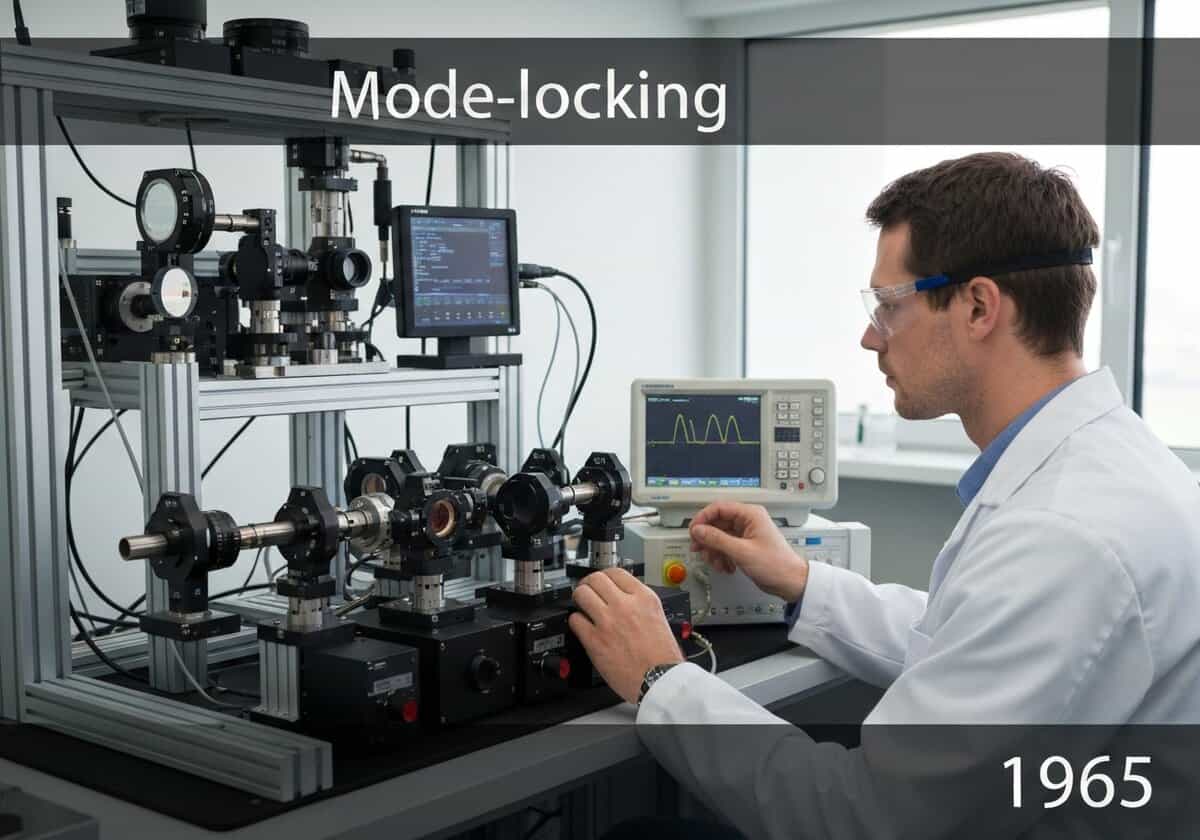
Mode-locking laser system in a modern optics laboratory.

(generated image for illustration only)

Mode-locking is a technique for producing extremely short laser pulses, on the order of picoseconds (\(10^{-12}\) s) to femtoseconds (\(10^{-15}\) s). It works by forcing the many longitudinal modes of the laser cavity to oscillate with a fixed phase relationship. This causes the modes to interfere constructively, creating a single, intense, ultrashort pulse circulating in the cavity.
A typical laser cavity supports multiple longitudinal modes, each corresponding to a specific resonant frequency. In a normal, free-running laser, these modes oscillate independently with random phases. Mode-locking synchronizes the phases of these modes. When the modes are locked in phase, they interfere constructively at one point in time and space, forming an intense, short pulse. At all other times, they interfere destructively, resulting in near-zero intensity. The result is a train of ultrashort pulses circulating within the laser cavity, with one pulse emitted from the output coupler for each round trip.

The duration of a mode-locked pulse is inversely proportional to the spectral bandwidth of the gain medium. A wider gain bandwidth supports more longitudinal modes, which can be locked to create a shorter pulse. This is governed by the Fourier uncertainty principle: \(\Delta t \Delta u \ge K\), where \(\Delta t\) is the pulse duration, \(\Delta u\) is the spectral bandwidth, and K is a constant near unity. Techniques for achieving mode-locking can be active (using an external modulator like an acousto-optic modulator) or passive (using a saturable absorber, a material whose absorption decreases at high light intensity). Passive mode-locking, particularly Kerr-lens mode-locking, has produced the shortest pulses to date, reaching the attosecond (\(10^{-18}\) s) regime.

UNESCO Nomenclature: 2210
– Optics

Type

Technique

Disruption

Substantial

Usage

Widespread Use

Precursors

  • invention of the laser
  • understanding of laser longitudinal modes
  • development of fast optical modulators and nonlinear optical materials
  • fourier analysis of wave superposition

Applications

  • femtochemistry
  • multiphoton microscopy
  • optical frequency combs for metrology
  • terahertz generation
  • ultrafast spectroscopy
  • laser eye surgery (femtosecond lasik)

Patents:

NA

Potential Innovations Ideas

Due to scrapping bot traffic, currently more than 40k per day, this content is reserved to community members.
> Login < or > Register < (100% free) to access this, so as all other restricted content and tools.

Related to: mode-locking, ultrashort pulse, femtosecond, picosecond, laser, longitudinal modes, phase locking, fourier transform, saturable absorber, kerr-lens modelocking.

Historical Context

Mode-locking (lasers)

1961
1962
1963
1965
1970
1970
1974-11-15
1960-05-16
1962
1963
1964
1968
1970
1970
1975

(if date is unknown or not relevant, e.g. "fluid mechanics", a rounded estimation of its notable emergence is provided)

Full size images and downloads are only available, 100% free, for registered members.

> Login <