Product Design, Manufacturing & Innovation Resources
بيت » معادلات نافييه-ستوكس

معادلات نافييه-ستوكس

1822
  • Claude-Louis Navier
  • George Gabriel Stokes
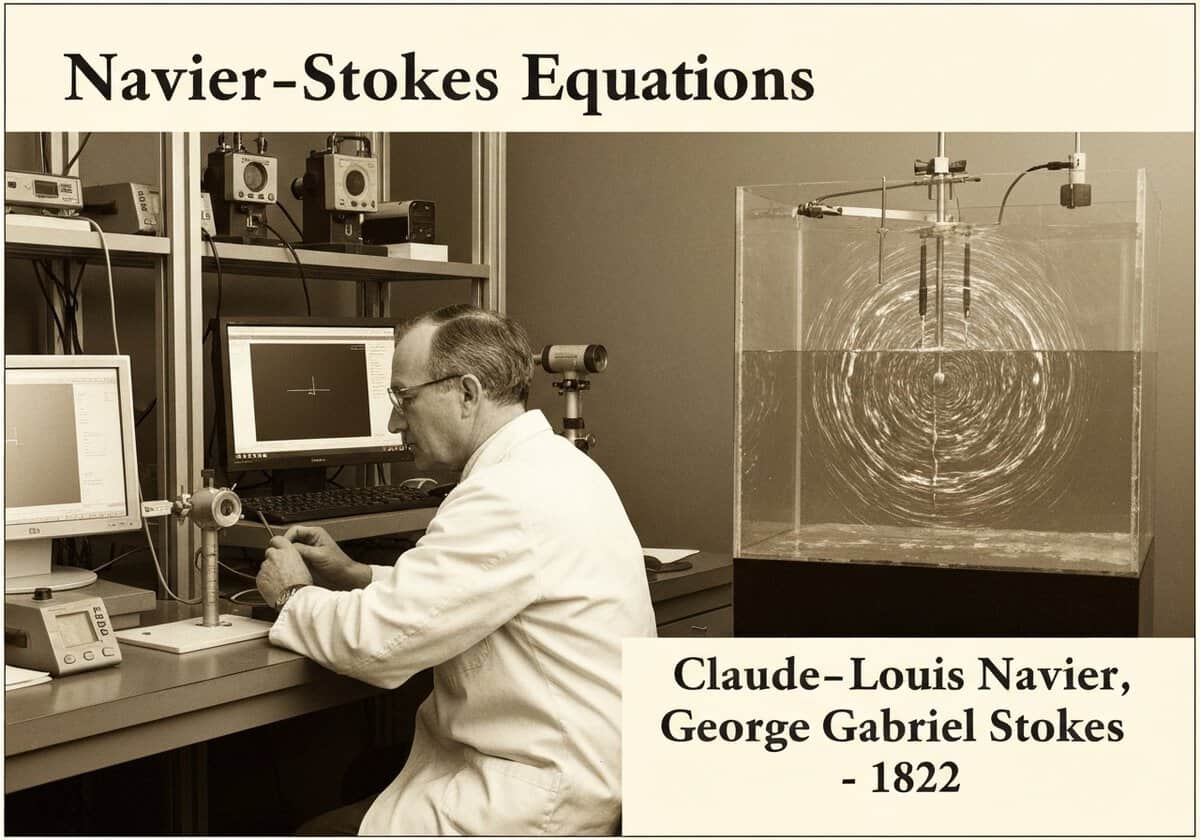
باحث في ديناميكيات الموائع يقوم بتحليل أنماط التدفق باستخدام معادلات نافير-ستوكس.

(صورة توضيحية فقط)

The Navier–Stokes equations are a set of non-linear partial differential المعادلات التي تصف حركة المواد السائلة اللزجة. وهي عبارة عن بيان لقانون نيوتن الثاني، الذي يوازن تغيرات الزخم مع ضغط التدرجات، وقوى اللزوجة، والقوى الخارجية. بالنسبة لسائل غير قابل للانضغاط، تكون المعادلة كالتالي: [latex]rho (frac{partial mathbf{v}}{partial t} + mathbf{v} cdot nabla mathbf{v}) = -nabla p + mu nabla^2 mathbf{v} + mathbf{f}[/latex].


The Navier-Stokes equations are the cornerstone of modern fluid dynamics. The terms in the equation represent the fundamental physical principles governing fluid motion. The left side, [latex]\rho (\frac{\partial \mathbf{v}}{\partial t} + \mathbf{v} \cdot \nabla \mathbf{v})[/latex], represents the inertial forces per unit volume, broken down into the unsteady acceleration (change in velocity over time) and the convective acceleration (change in velocity due to the fluid moving to a new location). The right side details the forces acting on the fluid. The term [latex]-\nabla p[/latex] is the pressure gradient, which drives flow from high-pressure to low-pressure regions. The term [latex]\mu \nabla^2 \mathbf{v}[/latex] represents the viscous forces, which act as an internal friction within the fluid, resisting motion and dissipating energy. Finally, [latex]\mathbf{f}[/latex] accounts for external body forces like gravity.

These equations are notoriously difficult to solve analytically due to their non-linear nature, specifically the convective acceleration term [latex]\mathbf{v} \cdot \nabla \mathbf{v}[/latex]. This non-linearity is the primary cause of turbulence, a complex and chaotic flow regime that remains one of the great unsolved problems in classical physics. In fact, proving the existence and smoothness of solutions to the three-dimensional Navier-Stokes equations is one of the seven Millennium Prize Problems posed by the Clay Mathematics Institute.

For practical applications, engineers and scientists rely on computational fluid dynamics (CFD), where supercomputers are used to find approximate numerical solutions. By discretizing the fluid domain into a fine mesh and solving the equations for each cell, CFD can simulate everything from the airflow over a Formula 1 car to the circulation of the Earth’s oceans, making the Navier-Stokes equations an indispensable tool in modern science and engineering.

UNESCO Nomenclature: 2210
الميكانيكا

يكتب

نظام مجرد

خلل

Revolutionary

الاستخدام

استخدام واسع النطاق

مقدمات

التطبيقات

  • تصميم الطائرات والسيارات
  • التنبؤ بالطقس
  • تحليل تدفق الدم
  • تصميم محطة الطاقة
  • تحليل انتشار التلوث
  • تصميم خطوط أنابيب النفط

براءات الاختراع:

NA

أفكار ابتكارية محتملة

  • ai solvers that find approximate solutions for turbulence in real-time for التحكم في الطيران
  • محاكيات تدفق الدم المخصصة للتنبؤ بخطر تمدد الأوعية الدموية
  • نماذج التيارات المحيطية لتحسين عمليات تنظيف البلاستيك
  • تصاميم هياكل الغواصات الهادئة من الجيل التالي
  • real-time smoke and fire propagation simulators for firefighters’ الواقع المعزز displays
  • نماذج التنبؤ بتدفق الصهارة للثورات البركانية
  • أنظمة التحكم في البلازما في مفاعلات الاندماج
  • تصميم مركبات النقل الأسرع من الصوت
Related to: navier-stokes, CFD, viscous flow, incompressible flow, fluid dynamics, partial differential equation, newton’s القانون الثاني, turbulence.

السياق التاريخي

معادلات نافييه-ستوكس

1816-11-16
1820
1820
1822
1824
1827
1831
1816-11-16
1820
1820
1821
1822
1827
1829
1831

(إذا كان التاريخ غير معروف أو غير ذي صلة، على سبيل المثال "ميكانيكا الموائع"، يتم توفير تقدير تقريبي لظهوره الملحوظ)

أحدث الإضافات

أهم المنشورات والمقالات

أفضل الأدوات الأصلية

السنة العاشرة عيد

الصور والتنزيلات بالحجم الكامل متاحة فقط، ومجانية تمامًا، للأعضاء المسجلين.