Product Design, Manufacturing & Innovation Resources
Home » Stirling Engine Regeneratoreconomiser

Stirling Engine Regeneratoreconomiser

1816-11-16
  • Robert Stirling
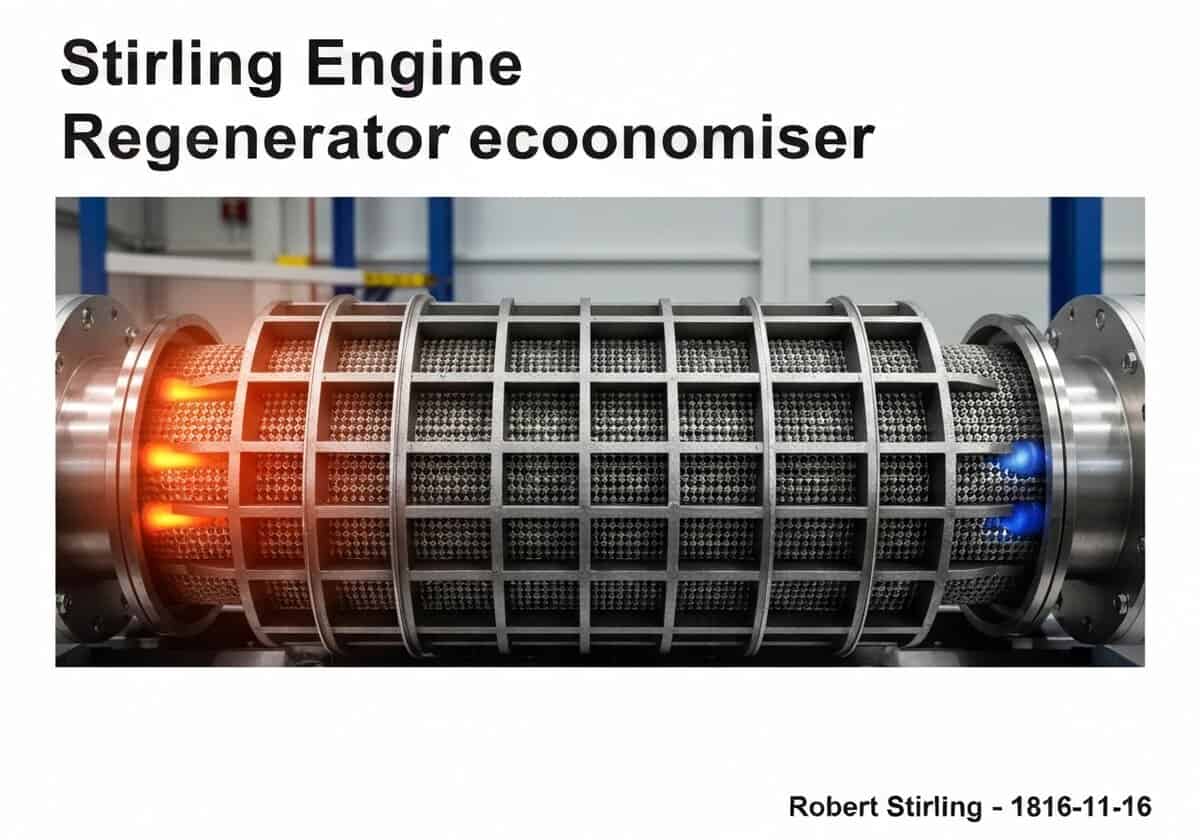
Regenerator matrix of a Stirling engine demonstrating thermal energy storage in thermodynamics.

(generated image for illustration only)

The regenerator, or ‘economiser’, is Robert Stirling’s most significant contribution and the key to the engine’s high efficiency. It is an internal heat exchanger that temporarily stores and releases thermal energy during the cycle. As hot gas moves to the cold side, it deposits heat in the regenerator matrix, which is then picked up by the cold gas on its return trip to the hot side.
The regenerator’s function is to pre-cool the working gas before it enters the main cooler and pre-heat it before it enters the main heater. This dramatically reduces the amount of heat that must be added from the external source and rejected to the external sink during the isochoric (constant volume) phases of the cycle. In an ideal regenerator, the heat transferred from the gas to the matrix during the isochoric cooling process is exactly equal to the heat transferred back to the gas during the isochoric heating process. This internal heat recycling is what allows the ideal Stirling cycle’s efficiency to match the Carnot efficiency.

Designing an effective regenerator involves a careful balance of competing factors. It must have a high heat capacity to store sufficient energy, a large internal surface area for rapid heat transfer, and high thermal conductivity perpendicular to the gas flow to facilitate this transfer. However, it must also have low thermal conductivity parallel to the gas flow to prevent heat from simply bypassing the cycle and conducting from the hot to the cold end. Furthermore, it must have low aerodynamic resistance to minimize the work needed to pump the gas through it, and it must contain a minimal volume of gas (dead volume) to maximize the engine’s compression ratio. Common materials include stacks of fine metal wire mesh, metal foams, or ceramic matrices.

UNESCO Nomenclature: 2212
– Thermodynamics

Type

Physical Device

Disruption

Revolutionary

Usage

Widespread Use

Precursors

  • Basic principles of heat transfer (conduction, convection)
  • Understanding of the heat capacity of materials
  • Early designs of heat exchangers and recuperators in industrial furnaces

Applications

  • high-efficiency stirling engines for solar power and chp
  • cryocoolers and pulse tube refrigerators where regeneration is critical for reaching cryogenic temperatures
  • thermoacoustic engines and coolers
  • gas separation processes
  • giromill cryocoolers
  • certain types of gas cycle heat pumps

Patents:

  • GB 4081 of 1816

Potential Innovations Ideas

Due to scrapping bot traffic, currently more than 40k per day, this content is reserved to community members.
> Login < or > Register < (100% free) to access this, so as all other restricted content and tools.

Related to: regenerator, heat exchanger, thermal efficiency, stirling engine, isochoric process, heat storage, working fluid, Carnot efficiency, pumping loss, dead volume.

Historical Context

Stirling Engine Regeneratoreconomiser

1802
1810
1816
1816-11-16
1820
1820
1822
1802
1808
1811
1816-11-16
1820
1820
1821
1822

(if date is unknown or not relevant, e.g. "fluid mechanics", a rounded estimation of its notable emergence is provided)

Related Invention, Innovation & Technical Principles

Full size images and downloads are only available, 100% free, for registered members.

> Login <