Product Design, Manufacturing & Innovation Resources
Home » Momentum Conservation in Continua

Momentum Conservation in Continua

1827
  • Augustin-Louis Cauchy
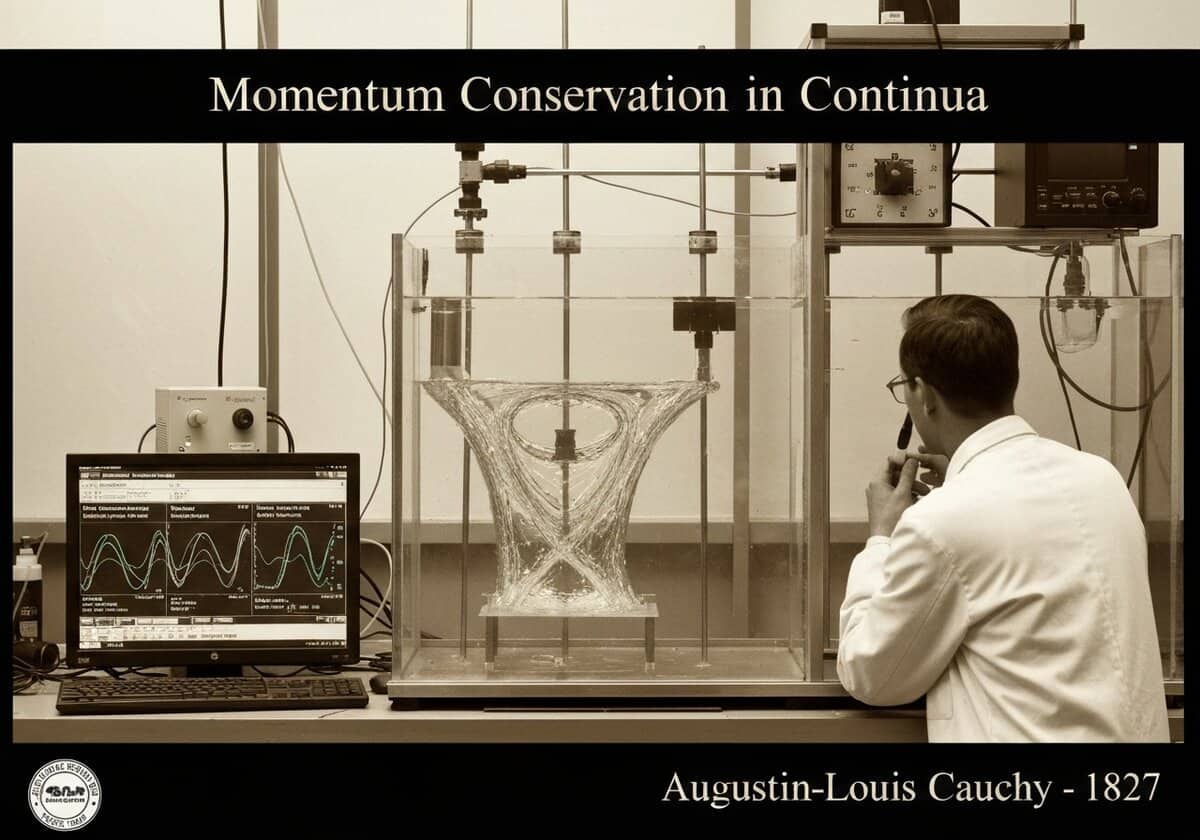
Fluid mechanics experiment demonstrating momentum conservation principles in a laboratory setting.

(generated image for illustration only)

For continuous systems like fluids or solids, momentum conservation is expressed in a differential form. The rate of change of momentum density \(\rho \vec{v}\) at a point is governed by the divergence of the Cauchy stress tensor \(\sigma\) and body forces \(\vec{f}\). This is described by the Cauchy momentum equation: \(\frac{\partial (\rho \vec{v})}{\partial t} + \nabla \cdot (\rho \vec{v} \otimes \vec{v}) = \nabla \cdot \sigma + \vec{f}\).


When dealing with a continuum, such as a fluid or a deformable solid, it is impractical to track individual particles. Instead, we describe the system using fields like density (\(\rho\)), velocity (\(\vec{v}\)), and stress (\(\sigma\)) that vary continuously in space and time. The principle of momentum conservation is applied to an infinitesimal volume element within the continuum.

The Cauchy momentum equation is essentially Newton’s second law applied to this volume element. The term \(\frac{\partial (\rho \vec{v})}{\partial t}\) represents the rate of change of momentum within the volume. The term \(\nabla \cdot (\rho \vec{v} \otimes \vec{v})\) represents the net rate of momentum flow out of the volume (advection). The term \(\nabla \cdot \sigma\) represents the surface forces acting on the volume element due to stress from the surrounding material. The Cauchy stress tensor \(\sigma\) is a second-order tensor that describes the state of stress at a point. Finally, \(\vec{f}\) represents the body forces (like gravity) acting on the volume.

This equation is a cornerstone of continuum mechanics. When combined with the continuity equation (conservation of mass) and an equation of state, it forms the basis for the Navier-Stokes equations, which are fundamental to fluid dynamics.

UNESCO Nomenclature: 2209
– Mechanics

Type

Abstract System

Disruption

Foundational

Usage

Widespread Use

Precursors

  • Isaac Newton’s laws of motion
  • Leonhard Euler’s work on fluid dynamics
  • Daniel Bernoulli’s principle
  • Development of vector calculus and tensor analysis

Applications

  • computational fluid dynamics (cfd)
  • aerospace engineering (wing design)
  • structural engineering (stress analysis)
  • geophysics (mantle convection)
  • meteorology (weather prediction)

Patents:

NA

Potential Innovations Ideas

Due to scrapping bot traffic, currently more than 40k per day, this content is reserved to community members.
> Login < or > Register < (100% free) to access this, so as all other restricted content and tools.

Related to: continuum mechanics, Cauchy momentum equation, stress tensor, fluid dynamics, momentum density, divergence, body force, Navier-Stokes equations, solid mechanics, advection.

Historical Context

Momentum Conservation in Continua

1820
1822
1824
1827
1831
1831
1833
1820
1821
1822
1827
1831
1831
1832
1834

(if date is unknown or not relevant, e.g. "fluid mechanics", a rounded estimation of its notable emergence is provided)

Related Invention, Innovation & Technical Principles

Full size images and downloads are only available, 100% free, for registered members.

> Login <