Product Design, Manufacturing & Innovation Resources
Home » Optical Resonator

Optical Resonator

1958
  • Charles H. Townes
  • Arthur L. Schawlow
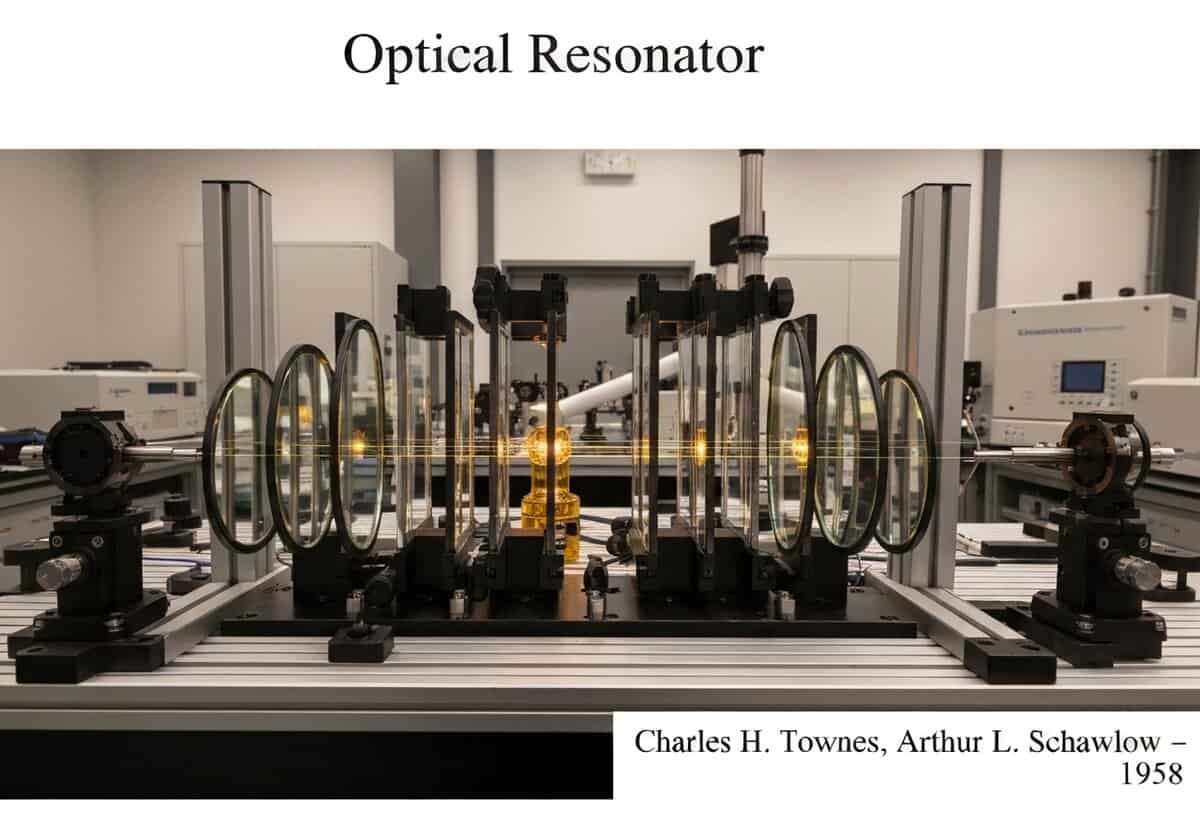
Optical resonator setup in laser physics laboratory with mirrors and gain medium.

(generated image for illustration only)

An optical resonator, or optical cavity, is an arrangement of mirrors that forms a standing wave cavity for light waves. In a laser, it surrounds the gain medium, providing positive feedback. Light from stimulated emission reflects back and forth, passing through the gain medium multiple times, leading to significant amplification and the formation of a coherent output beam.

The optical resonator is a critical component of most lasers, responsible for building up the light intensity and defining the properties of the output beam. The simplest and most common type is the Fabry-Pérot resonator, consisting of two parallel mirrors placed on either side of the gain medium. One mirror is a high reflector (nearly 100% reflectivity), while the other, the output coupler, is partially reflective (e.g., 99% reflectivity), allowing a portion of the light to escape as the laser beam.

As photons are generated by stimulated emission, they travel within the cavity. Those traveling along the axis between the mirrors are reflected back into the gain medium, stimulating further emission and amplifying the light. Photons not aligned with the axis are lost from the cavity. This process not only amplifies the light but also acts as a filter. Only light waves of specific frequencies, those that form a standing wave within the cavity (i.e., where the cavity length is an integer multiple of half the wavelength), are sustained. This resonant condition is what determines the longitudinal modes of the laser. The geometry of the mirrors (e.g., flat, concave) determines the stability of the resonator and the spatial profile (transverse modes) of the output beam, such as the fundamental Gaussian mode (TEM00).

UNESCO Nomenclature: 2210
– Optics

Type

Physical Device

Disruption

Foundational

Usage

Widespread Use

Precursors

  • fabry-pérot interferometer
  • microwave cavity resonators used in masers
  • principles of optical reflection and interference

Applications

  • laser construction
  • optical parametric oscillators
  • optical interferometers (e.g., Fabry-Pérot)
  • gravitational wave detectors like ligo
  • high-precision optical frequency standards

Patents:

  • US2929922A

Potential Innovations Ideas

  • micro-ring resonators for on-chip optical signal processing
  • photonic crystal cavities for ultra-low threshold lasers
  • unstable resonators for high-power, large-area lasers
  • optomechanical cavities for sensing minute forces
  • foldable cavity designs for compact, high-power lasers
  • active mirror systems that correct for thermal lensing in real-time
  • plasmonic nanocavities for single-molecule detection
  • chiral optical cavities for controlling chemical reactions
  • integrated optical cavities for quantum information processing
  • fiber-based ring resonators for gyroscopes and sensors
Related to: optical resonator, optical cavity, laser, Fabry-Pérot, mirrors, feedback, amplification, standing wave, laser modes, beam quality.

Historical Context

Optical Resonator

1950
1950
1957
1958
1960
1960
1960
1950
1950
1957
1957
1959-11
1960
1960
1960

(if date is unknown or not relevant, e.g. "fluid mechanics", a rounded estimation of its notable emergence is provided)

10th year anniversary

Full size images and downloads are only available, 100% free, for registered members.

> Login <