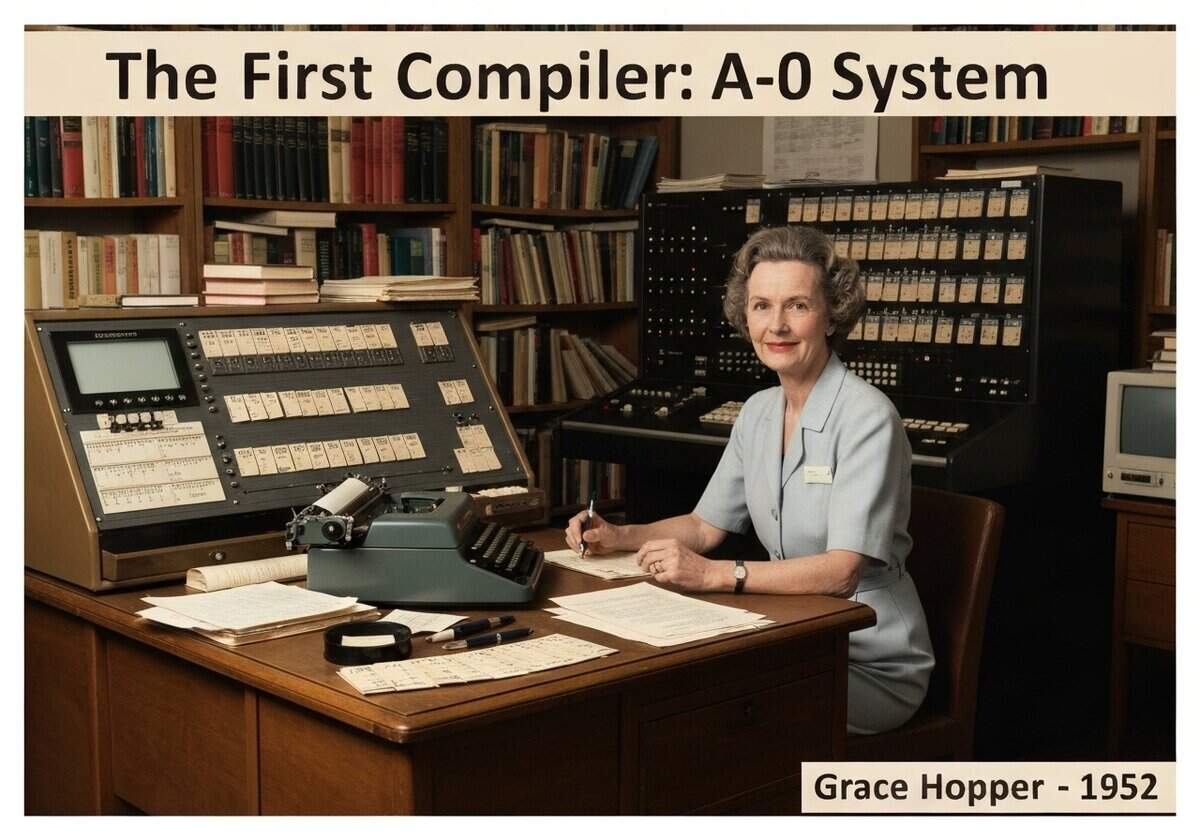
1952年にグレース・ホッパーによって開発されたA-0システムは、最初のコンパイラとして広く認識されています。これは、数学的記法で指定された一連のサブルーチンと引数を機械語に変換しました。これは、低レベルのアセンブリ言語からより高レベルで抽象的なプログラミング言語への移行における基礎的なステップであり、手作業によるコード変換という面倒なプロセスを自動化しました。A-0システムのような初期のプログラミング言語の研究は、今日使用されている高レベル言語へとつながりました。


(画像はイメージです)
1952年にグレース・ホッパーによって開発されたA-0システムは、最初のコンパイラとして広く認識されています。これは、数学的記法で指定された一連のサブルーチンと引数を機械語に変換しました。これは、低レベルのアセンブリ言語からより高レベルで抽象的なプログラミング言語への移行における基礎的なステップであり、手作業によるコード変換という面倒なプロセスを自動化しました。A-0システムのような初期のプログラミング言語の研究は、今日使用されている高レベル言語へとつながりました。

The A-0 System, developed for the UNIVAC I computer, functioned more like a modern linker or loader than a full コンパイラ as we understand it today. Its primary innovation was automation. Before A-0, programmers had to manually look up the addresses of subroutines from a library and patch them into their main program. This was a slow and highly error-prone process. Hopper’s system automated this by assigning a numeric code to each subroutine in a magnetic tape library.
The programmer would write a program as a sequence of these numeric codes and their arguments. The A-0 System would then read this sequence, look up the corresponding subroutines on the tape, and copy them to the correct locations in memory to form a complete, executable program. While it did not parse complex algebraic expressions or manage control flow structures like a modern compiler, it was the first piece of software that took a high-level specification and automatically generated a low-level executable. This ‘compilation’ of routines was a revolutionary concept that directly led to the development of more sophisticated languages and compilers, including Hopper’s own FLOW-MATIC, which in turn heavily influenced COBOL.
最初のコンパイラ:A-0システム
(日付が不明または関連性がない場合、例えば「流体力学」などでは、その注目すべき出現時期の概算値が提示されます。)

フルサイズの画像とダウンロードは、登録会員のみが100%無料で利用できます。
> ログイン <