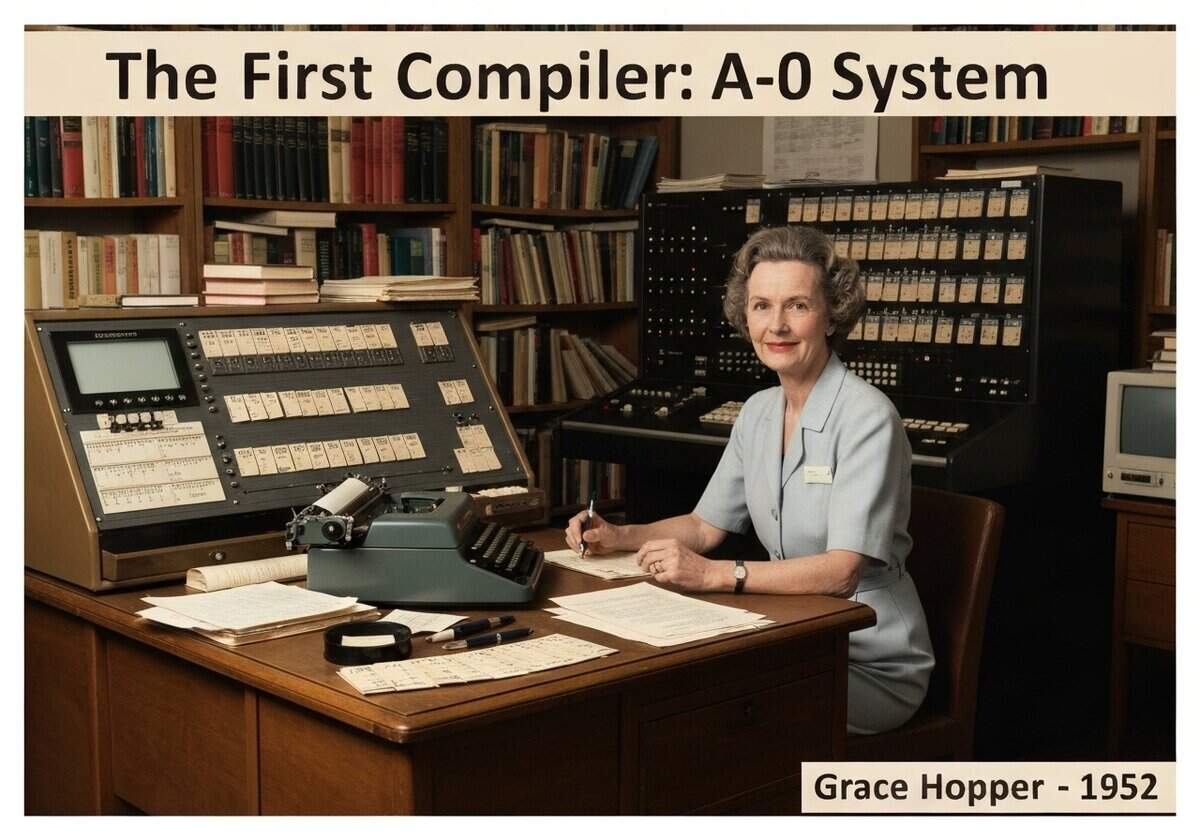
1952년 그레이스 호퍼가 개발한 A-O 시스템은 최초의 컴파일러로 널리 알려져 있습니다. 이 시스템은 수학적 표기법으로 지정된 일련의 서브루틴과 인수를 기계어로 변환했습니다. 이는 저수준 어셈블리 프로그래밍에서 고수준의 추상 프로그래밍 언어로 나아가는 데 중요한 발걸음이었으며, 수동 코드 변환이라는 고된 과정을 자동화했습니다. A-O 시스템과 같은 초기 프로그래밍 언어 연구는 오늘날 사용되는 고수준 언어의 탄생으로 이어졌습니다.


(설명을 위한 생성된 이미지입니다)
1952년 그레이스 호퍼가 개발한 A-O 시스템은 최초의 컴파일러로 널리 알려져 있습니다. 이 시스템은 수학적 표기법으로 지정된 일련의 서브루틴과 인수를 기계어로 변환했습니다. 이는 저수준 어셈블리 프로그래밍에서 고수준의 추상 프로그래밍 언어로 나아가는 데 중요한 발걸음이었으며, 수동 코드 변환이라는 고된 과정을 자동화했습니다. A-O 시스템과 같은 초기 프로그래밍 언어 연구는 오늘날 사용되는 고수준 언어의 탄생으로 이어졌습니다.

The A-0 System, developed for the UNIVAC I computer, functioned more like a modern linker or loader than a full 컴파일러 as we understand it today. Its primary innovation was automation. Before A-0, programmers had to manually look up the addresses of subroutines from a library and patch them into their main program. This was a slow and highly error-prone process. Hopper’s system automated this by assigning a numeric code to each subroutine in a magnetic tape library.
The programmer would write a program as a sequence of these numeric codes and their arguments. The A-0 System would then read this sequence, look up the corresponding subroutines on the tape, and copy them to the correct locations in memory to form a complete, executable program. While it did not parse complex algebraic expressions or manage control flow structures like a modern compiler, it was the first piece of software that took a high-level specification and automatically generated a low-level executable. This ‘compilation’ of routines was a revolutionary concept that directly led to the development of more sophisticated languages and compilers, including Hopper’s own FLOW-MATIC, which in turn heavily influenced COBOL.
최초의 컴파일러: A-0 시스템
(날짜를 알 수 없거나 관련이 없는 경우, 예를 들어 "유체역학"의 경우, 주목할 만한 등장 시기를 대략적으로 추정하여 제공합니다.)

고화질 이미지 및 다운로드는 등록된 회원에게만 100% 무료로 제공됩니다.
> 로그인 <