Product Design, Manufacturing & Innovation Resources
Lar » O primeiro compilador: Sistema A-0

O primeiro compilador: Sistema A-0

1952
  • Grace Hopper
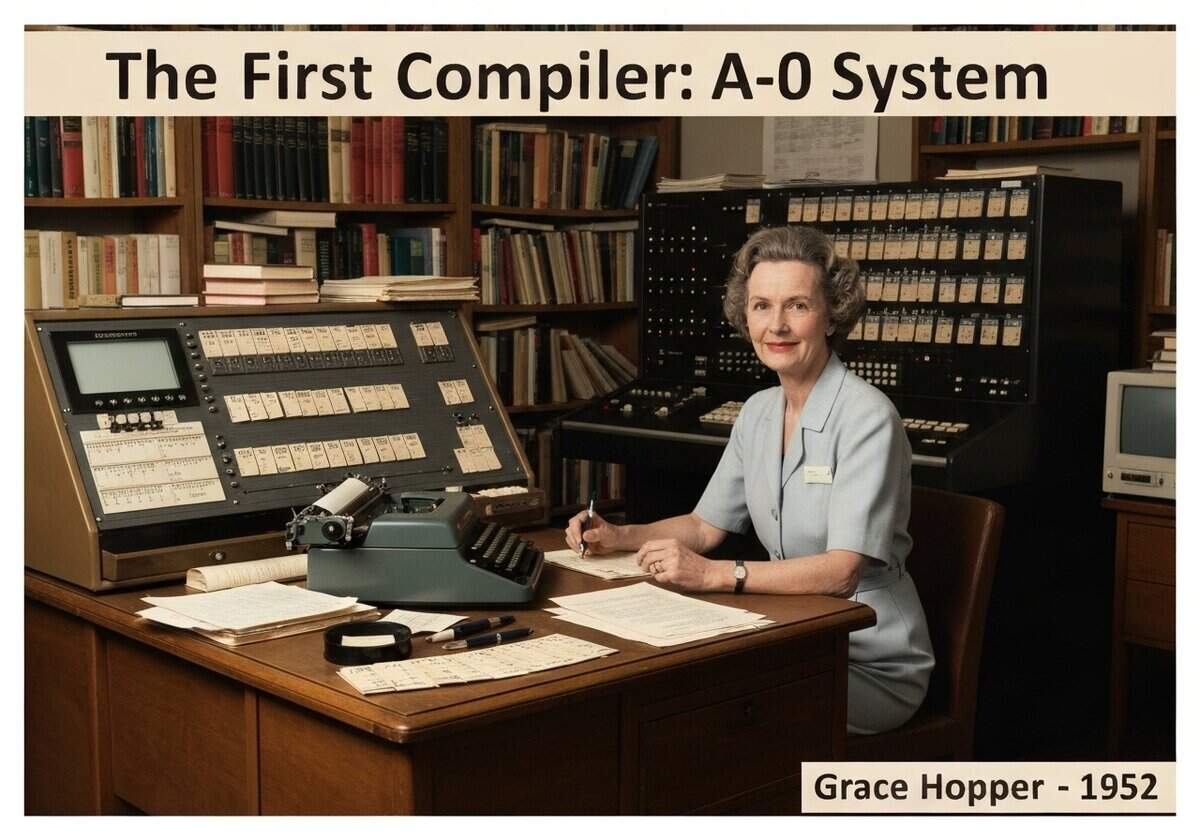
Grace Hopper working on the A-0 System compiler in a 1950s office.

(Imagem gerada apenas para fins ilustrativos)

O Sistema A-0, criado em 1952 por Grace Hopper, é amplamente considerado o primeiro sistema de rastreamento de contatos. compilador. It translated a sequence of subroutines and arguments, specified by a mathematical notation, into machine code. This was a foundational step in moving from low-level assembly programming to higher-level, more abstract programming languages, automating the tedious process of manual code translation. Early programming languages research, such as the A-0 System, liderado to the high-level languages used today.


The A-0 System, developed for the UNIVAC I computer, functioned more like a modern linker or loader than a full compilador as we understand it today. Its primary innovation was automation. Before A-0, programmers had to manually look up the addresses of subroutines from a library and patch them into their main program. This was a slow and highly error-prone process. Hopper’s system automated this by assigning a numeric code to each subroutine in a magnetic tape library.

The programmer would write a program as a sequence of these numeric codes and their arguments. The A-0 System would then read this sequence, look up the corresponding subroutines on the tape, and copy them to the correct locations in memory to form a complete, executable program. While it did not parse complex algebraic expressions or manage control flow structures like a modern compiler, it was the first piece of software that took a high-level specification and automatically generated a low-level executable. This ‘compilation’ of routines was a revolutionary concept that directly led to the development of more sophisticated languages and compilers, including Hopper’s own FLOW-MATIC, which in turn heavily influenced COBOL.

UNESCO Nomenclature: 1203
Ciência da Computação

Tipo

Software/Algoritmo

Interrupção

Revolucionário

Uso

Obsoleto

Precursores

  • Conceito de computadores com programa armazenado (arquitetura de von Neumann)
  • desenvolvimento de sub-rotinas e bibliotecas
  • A linguagem assembly como um primeiro passo acima do código de máquina
  • notação matemática para resolução de problemas

Aplicações

Patentes:

NA

Ideias de Inovação Potencial

  • ai-driven legacy code translators for extinct hardware
  • compilers that generate quantum circuit descriptions from classical code
  • domain-specific language compilers for biological sequence synthesis
  • self-modifying compilers that optimize their own codebase based on usage patterns
  • compilers that output verifiable, formally proven machine code for critical systems
  • natural language to executable code compilers for non-programmers
  • compilers that target neuromorphic hardware architectures
  • on-the-fly compiler generation for dynamically created languages
  • compilers that embed cryptographic proofs of origin within the binary
  • energy-aware compilers that optimize code for minimal power consumption on IoT devices
Relacionado a: Grace Hopper, sistema A-0, primeiro compilador, compilação, linguagem de alto nível, automação, história da programação, UNIVAC i, flow-matic, Cobol.

Contexto histórico

O primeiro compilador: Sistema A-0

1940
1950
1950
1952
1956
1960
1967
1940
1943
1950
1950
1953
1960
1960
1967

(Caso a data seja desconhecida ou irrelevante, por exemplo, "mecânica dos fluidos", é fornecida uma estimativa aproximada de seu surgimento notável)

10º ano aniversário

Imagens em tamanho real e downloads estão disponíveis apenas, 100% gratuitos, para membros registrados.