Product Design, Manufacturing & Innovation Resources
Maison » Ostéointégration des implants en titane

Ostéointégration des implants en titane

1965
  • Per-Ingvar Brånemark
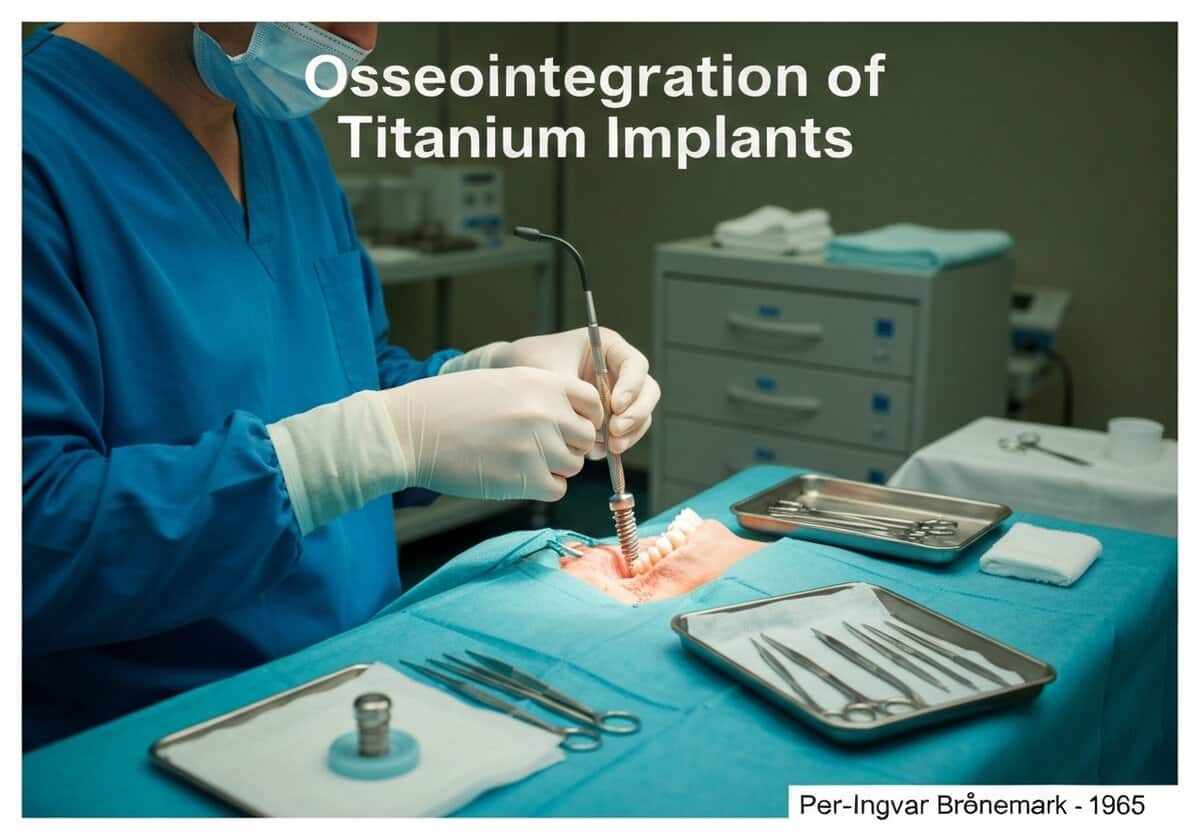
Mise en place chirurgicale d'un implant dentaire en titane démontrant l'ostéointégration en ingénierie biomédicale.

(Image générée à titre d'illustration uniquement)

L'ostéointégration est la connexion structurelle et fonctionnelle directe entre l'os vivant et la surface d'un implant artificiel porteur, généralement constitué de titaneDécouvert par Per-Ingvar Brånemark, ce phénomène se produit sans croissance de tissu mou fibreux à l'interface os-implant, créant ainsi un ancrage stable et durable pour les prothèses telles que les implants dentaires et les articulations artificielles.

The discovery of osseointegration was serendipitous. In the 1950s, Per-Ingvar Brånemark was studying blood flow in rabbit fibula using an optical chamber with a titane frame. When he tried to remove the chamber, he found the bone had grown so intimately into the titanium that it was impossible to separate. This led to the realization that titanium, unlike other materials, was not rejected by the body and could fuse directly with bone. The key to this process is the formation of a titanium dioxide layer on the implant’s surface upon exposure to air. This oxide layer is highly biocompatible and allows bone-forming cells, or osteoblasts, to attach and deposit new bone matrix directly onto the implant surface. For successful osseointegration, several conditions must be met: the implant must be made of a biocompatible material (like commercially pure titanium), it must be machined with a specific surface topography, it must be placed with minimal trauma to the bone, and it must remain immobile and unloaded during the initial healing period. This process has revolutionized dentistry and orthopedics, providing a stable foundation for replacing missing teeth and limbs with a high degree of success and longévité.

UNESCO Nomenclature: 3201
- Ingénierie biomédicale

Taper

Processus biologique

Perturbation

Révolutionnaire

Usage

Utilisation généralisée

Précurseurs

  • découverte du titane par William Gregor en 1791
  • développement de techniques chirurgicales stériles
  • progrès de la microscopie pour observer les interfaces tissu-implant
  • recherche sur la cicatrisation et la régénération osseuse

Applications

  • implants dentaires
  • prothèses auditives à ancrage osseux (BAHA)
  • prothèses de remplacement articulaire (hanche, genou)
  • prothèses d'amputation fixées directement sur l'os
  • prothèses cranio-faciales pour la reconstruction faciale

Brevets:

  • US4172320A

Idées d'innovations potentielles

  • implants à surface modifiée (par exemple, sablés, gravés à l'acide) pour accélérer l'ostéointégration
  • implants avec des surfaces nano-texturées pour guider la croissance cellulaire
  • capteurs ostéointégrés pour la surveillance de la tension et de la guérison osseuses
  • membres robotiques ostéointégrés avec interfaces neuronales
  • implants ostéointégrés à élution de médicament pour délivrer des facteurs de croissance
  • techniques d'ostéointégration pour la chirurgie de fusion vertébrale
  • Implants en titane poreux imprimés en 3D qui imitent la structure osseuse
  • implants à base de zircone comme alternative sans métal pour l'ostéointégration
  • protocoles de mise en charge immédiate pour implants dentaires basés sur une ostéointégration améliorée
  • ancrages ostéointégrés pour traitements orthodontiques
Related to: osseointegration, titanium, Per-Ingvar Brånemark, dental implant, bone integration, biocompatibilité, prosthesis, orthopedics, titanium dioxide, osteoblast.

Contexte historique

Ostéointégration des implants en titane

1960
1965
1970
1980
1980
1990
1960
1960
1969
1976-05-28
1980
1990

(si la date est inconnue ou non pertinente, par exemple « mécanique des fluides », une estimation arrondie de son émergence notable est fournie)

10e année anniversaire

Les images en pleine résolution et les téléchargements sont uniquement disponibles, et 100% gratuits, pour les membres inscrits.