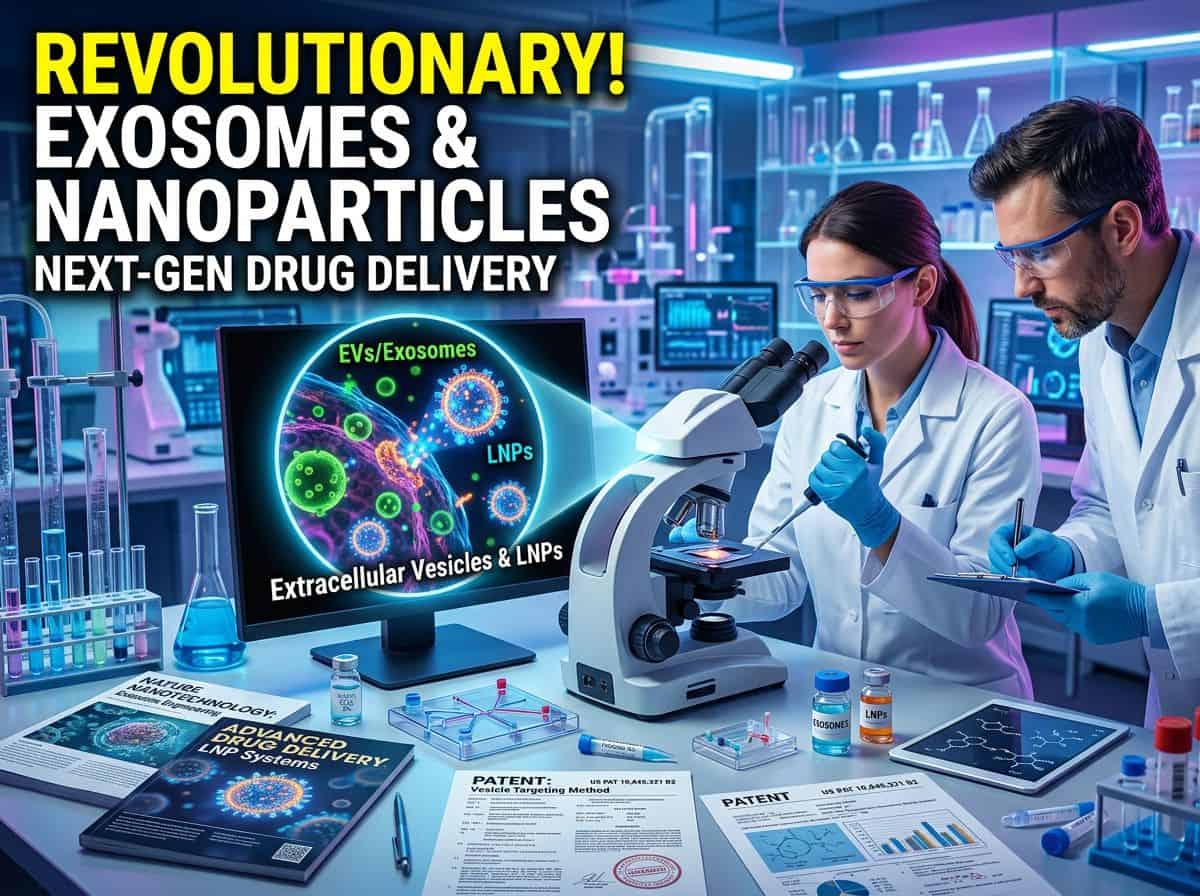
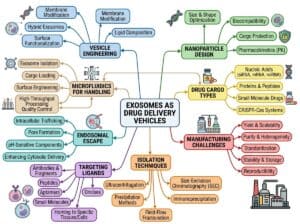
Exosomes are small extracellular vesicles, roughly 30 to 150 nanometers across, that cells release to carry proteins, lipids and nucleic acids to other cells. Researchers load them with drugs or RNA and use them as delivery vehicles. Their natural membrane gives low immunogenicity and an ability to cross some biological barriers. Synthetic carriers compete directly, above all lipid nanoparticles built around ionizable lipids.
Manufacturing is the open question. Yields from cell culture are low, isolation by ultracentrifugation scales poorly, and batch consistency is hard to prove. Tangential flow filtration, nanoparticle tracking analysis and better potency assays are being adopted to close the gap. Targeting ligands and endosomal escape determine whether a payload reaches its site of action. The entries below follow vesicle engineering, nanoparticle design and delivery to difficult tissues such as the brain.
Delivery is the hard part of most modern drugs, and this page follows carriers made from vesicles and lipids. Cargo payloads are on mRNA therapeutics, tumor targets on molecular oncology, and carrier materials on nanomaterials and biomaterials. Microscale handling is on microfluidics.
This is our latest selection of worldwide publications and patents in english on Exosome and Nanoparticle Drug Delivery, between many scientific online journals, classified and focused on exosome, extracellular vesicle, exosome drug delivery, exosome loading, engineered exosome, small extracellular vesicle, lipid nanoparticle, ionizable lipid, polymeric nanoparticle, liposome, nanoparticle drug delivery, targeted drug delivery, blood-brain barrier delivery, siRNA delivery, biodistribution, tangential flow filtration, nanoparticle tracking analysis, PEGylation, cell-derived vesicle and endosomal escape.
Methods for large-scale spheroids and extracellular vesicles production
Patent published on the 2026-11-19 in US under Ref US20260365958 by CORNING INC [US] (Haller Samantha Sophie Catherine [fr], Henry David [fr])
Abstract: A method for the production of spheroids and cellular byproducts of spheroids such as extracellular vesicles is provided. The method includes providing a bioreactor having a cavity for culturing cells; inserting cells into the cavity to form spheroids; and perfusing a cell culture medium through the cavity to culture the spheroids. The porous scaffold may be dissolvable or non-dissolvable, and the cells are seeded into the pores of the porous scaffold, where the cells aggregate in the pores of t[...]
Our summary: A method for producing spheroids and their byproducts, such as extracellular vesicles, is described. The process involves using a bioreactor to culture cells and form spheroids. Continuous perfusion allows for large-scale production and harvesting of spheroids and cell secretome elements.
spheroids, extracellular vesicles, bioreactor, cell culture
Patent
Cell compositions
Patent published on the 2026-11-19 in US under Ref US20260363270 by GIVAUDAN SA [CH] (Slack Jay Patrick [us], Mccluskey Thomas Scott [us], Rotman Stijn [ch], Gallo Elisa [ch], Vollenweider Sabine [ch], Gil Omer [ch])
Abstract: Non-human animal-derived cell composition comprising a plurality of non-human animal-derived cells, wherein the cells comprise at least one exogenous supplement comprised in a carrier selected from the group consisting of nanocarriers, nanoparticles, micelles, liposomes or vesicles is described. The cell composition is characterized by having improved organoleptic properties, such as an improved flavour, colour, texture or mouthfeel and/or having a meat like flavour. Methods of producing the sam[...]
Our summary: The content describes a non-human animal-derived cell composition with exogenous supplements in various carriers. It highlights improvements in organoleptic properties such as flavor and texture. Methods for production and applications in comestibles are also discussed.
cell composition, non-human animal-derived cells, exogenous supplement, organoleptic properties
Patent
Lipid nanoparticle production apparatus
Patent published on the 2026-11-19 in WO under Ref WO2026240198 by NGK CORP [JP] (Samuel Alexander [jp], Nomura Kazuki [jp])
Abstract: Provided is a lipid nanoparticle production apparatus with which it is possible to produce lipid nanoparticles having a prescribed particle diameter and particle size distribution. A cross-flow device 3100 mixes a solution of a dispersed phase and a solution of a continuous phase, and generates lipid nanoparticles that contain a target component therein and have a prescribed particle diameter. A permeation member 3130 for liquid-tightly partitioning a first flow passage 3110 and a second flow pa[...]
Our summary: The lipid nanoparticle production apparatus enables the creation of lipid nanoparticles with specific particle diameters and size distributions. It utilizes a cross-flow device to mix dispersed and continuous phase solutions. A permeation member with pores controls the flow and dispersion of the first solution into the second solution.
lipid nanoparticles, cross-flow device, permeation member, particle diameter
Patent
Biomolecule conjugated lipid nanoparticles
Patent published on the 2026-11-19 in AU under Ref AU2025270870 by SHANGHAI VITALGEN BIOPHARMA CO LTD [CN] (Zhao Xiaoping, Zhu Xi, Chen Hong, Ren Jiaming, Tian Shin-Shay)
Abstract: The present disclosure provides a biomolecule-conjugated lipid nanoparticle (LNP) and the method of preparing the biomolecule-conjugated LNP. Specifically, the present disclosure provides a nucleic acid delivery vector comprising a VHH-linker conjugate, wherein the VHH-linker conjugate comprises (a) a VHH, (b) a linker with a moiety Y and (c) a hinge, furthermore, the nucleic acid delivery vector comprises anchor-modified LNP, wherein the anchor-modified LNP comprises: (a) LNP; and (b) one or mo[...]
Our summary: The disclosure details a biomolecule-conjugated lipid nanoparticle (LNP) designed for nucleic acid delivery. It includes a VHH-linker conjugate and anchor-modified LNPs. The linkage between the linker and anchor fragment is facilitated by a bio-orthogonal click reaction.
Lipid nanoparticles, Biomolecule conjugation, Nucleic acid delivery, Bio-orthogonal click reaction
Patent
Lipid composition, method for producing lipid composition, and method for delivering active ingredient to cells
Patent published on the 2026-11-19 in AU under Ref AU2025265955 by FUJIFILM CORP [JP] (Nitabaru Tatsuya, Nakamura Naoto, Fukunaga Hirofumi, Saito Kengo, Hori Ritsuko)
Abstract: The present invention addresses the problem of providing: a lipid composition capable of delivering an active ingredient to cells with excellent efficiency; a method for producing the lipid composition; and a method in which the lipid composition is used and by which an active ingredient is delivered to cells. The present invention provides a lipid composition comprising an aggregate of lipid particles containing an ionizable lipid, a non-ionized lipid, and a lipid having a nonionic polymer, whe[...]
Our summary: The invention provides a lipid composition designed for efficient delivery of active ingredients to cells. It includes an aggregate of lipid particles with specific characteristics, such as size and composition. Additionally, a method for producing this lipid composition is described.
Lipid composition, active ingredient delivery, lipid particles, production method
Patent
Compositions based on a mixture of bioactive molecules and exosomes for use in the treatment of conditions requiring tissue repair and regeneration
Patent published on the 2026-11-19 in US under Ref US20260364111 by BIOMEDICAL RES S R L [IT] (Salvaggio Filippo [it])
Abstract: Topical or injection compositions for use in the treatment of conditions requiring tissue repair and regeneration in humans and animals include a mixture of bioactive molecules and exosomes. The mixture of bioactive molecules is isolated from colostrum.[...]
Our summary: Compositions utilize a mixture of bioactive molecules and exosomes for tissue repair and regeneration. These compositions can be applied topically or via injection in humans and animals. The bioactive molecules are derived from colostrum.
bioactive molecules, exosomes, tissue repair, colostrum
Patent
pH-responsive amphiphilic peptide nanofibers facilitate endosomal escape for cytosolic protein delivery
Published on 2026-06-16 by Tomonori Waku, Chikae Sakata, Tomoki Matsuda, Kotone Minato, Hiroyasu Takemoto, Kazuya Matsuo, Akio Kobori @NATURE
Abstract: Polymer Journal, Published online: 16 June 2026; doi:10.1038/s41428-026-01212-2We developed pH-responsive amphiphilic peptide nanofibers (NFs) that may facilitate cytosolic protein delivery by selectively destabilizing endosomal membranes. The NFs were based on β-sheet-forming peptides conjugated with oligoglutamic acid segments, and the number of Glu residues was varied to optimize pH-responsive activity. Optimized NFs showed strong membrane-destabilizing activity at mildly acidic pH but remai[...]
Our summary: The study presents pH-responsive amphiphilic peptide nanofibers designed to enhance cytosolic protein delivery. These nanofibers destabilize endosomal membranes at mildly acidic pH while remaining stable at neutral pH. When tested with ovalbumin in dendritic cells, they improved MHC class I presentation of the OVA-derived epitope.
pH-responsive, amphiphilic, peptide nanofibers, cytosolic delivery
Publication
Glioblastoma-Derived Extracellular Vesicles Modulate γδ T Lymphocytes Through a MIC-Dependent Mechanism
Published on 2026-02-03 by Micaela Rosato, Paula Saibene Vlez, Alejandra Infante Cruz, Matas A. Pibuel, Federico Fuentes, Mnica Vermeulen, Juan Iturrizaga, Pablo E. Espil, Silvia Berner, Gabriela V. Salamone, Carolina C. Jancic @MDPI
Abstract: Glioblastoma (GBM) is the most aggressive and common primary brain tumor, with a median survival of less than a year after diagnosis. γδ T lymphocytes are immune cells that can migrate to tumors and induce malignant cells’ apoptosis. Our previous in silico studies showed that higher γδ T-cell infiltration in GBM correlates with better patient survival, and in vitro experiments showed that GMB supernatants promote an antitumora[...]
Our summary: Glioblastoma-derived extracellular vesicles (EVs) modulate gamma delta T lymphocytes through a MIC-dependent mechanism. Increased CD69 expression, cytotoxicity, and cytokine production in T cells were observed following EV interaction. These findings offer insights for targeted immunotherapy development in glioblastoma patients.
Extracellular vesicles, Glioblastoma, Gamma delta T lymphocytes, Immunotherapy
Publication