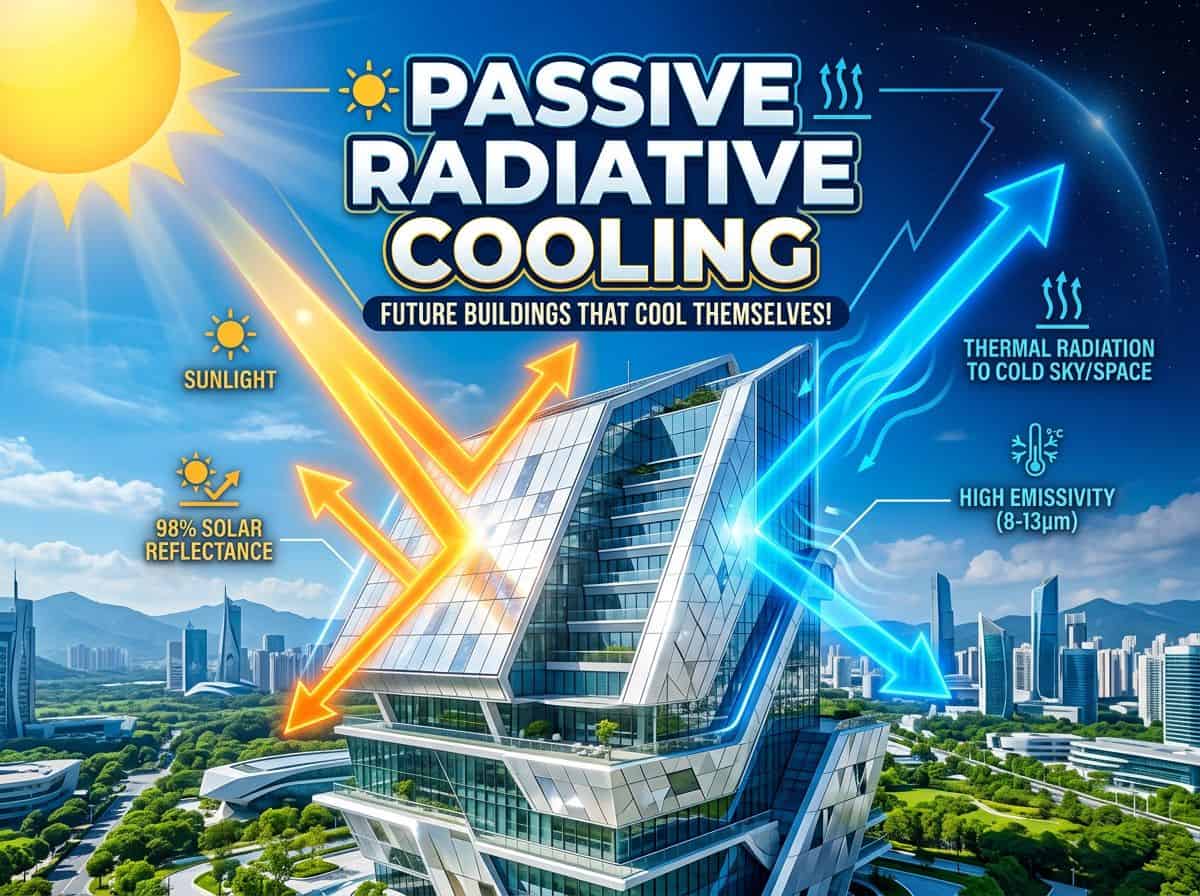
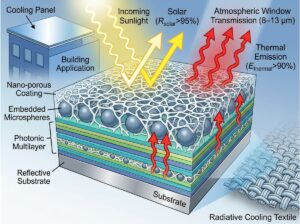
Passive radiative cooling sends heat to outer space through the atmospheric transparency window between 8 and 13 micrometers. A surface that reflects most sunlight and emits strongly in that band can stay below ambient air temperature, even under direct sun. No electricity or refrigerant is used. Practical designs include polymer films with embedded microspheres, porous coatings, photonic multilayers and cooling paints.
Performance in the field depends on humidity, cloud cover, wind and soiling, which all reduce the net cooling power. Typical values reach several tens of watts per square meter, so the technology complements air conditioning rather than replacing it. Manufacturing at roll scale, durable UV resistance and low cost decide market entry in roofs, building envelopes, textiles and vehicle cooling. The listings below follow materials, structures and demonstration projects.
Radiative cooling dumps heat to space through the atmospheric window, with no electricity. Photonic surfaces are on metamaterials and optics, heat buffering on thermal energy storage, and paint-like layers on surface coatings. Warming context is on climate change.
This is our latest selection of worldwide publications and patents in english on Passive Radiative Cooling, between many scientific online journals, classified and focused on radiative cooling, passive radiative cooling, daytime radiative cooling, sky radiative cooling, atmospheric window, solar reflectance, thermal emissivity, radiative cooling paint, radiative cooling film, cooling metamaterial, polymer photonic cooling, hierarchical porous cooling, cooling textile, building envelope cooling, subambient cooling, radiative cooler, spectrally selective emitter, cool roof, retroreflective cooling and passive cooling.
Cooling systems and methods with radiative cooling
Patent published on the 2026-11-19 in US under Ref US20260371534 by TRANE INT INC [US] (Varghese Zubin [in], Rohith Balegundi L [in], Subrahmanya Praveena Alangar [in])
Abstract: Methods and systems for cooling conditioned spaces (e.g., data centers) are provided. [0000] The cooling system includes a radiative cooling component disposed outside of the housing and including a radiative cooling surface configured to provide radiative cooling directly or indirectly to the working fluid of the internal cooling component, and a thermally coupling component thermally connecting the internal cooling component to the radiative cooling component to transfer heat from the working [...]
Our summary: This content discusses cooling systems utilizing radiative cooling methods for conditioned spaces like data centers. It describes a system with an external radiative cooling component and a thermally coupling component. The system aims to enhance cooling efficiency by transferring heat from the internal cooling component.
radiative cooling, cooling systems, thermally coupling, conditioned spaces
Patent
Coating with temperature-regulating capabilities, production method and use of same
Patent published on the 2026-11-19 in WO under Ref WO2026240642 by PINTURAS BEREL S A DE C V [MX] (Rocha Cedillo César [mx], Cano Valdez Andres [mx])
Abstract: The present invention relates to an easy-to-apply temperature-regulating coating formulated from nanoparticles, said nanoparticles of the coating of the present invention being integrated into a highly durable polymer base. The essential components, such as the nanoparticles and the polymer matrix, are combined to provide the paint with unique values, thereby optimising solar reflectance using a specific value (TSR) and providing precise colorimetric coordinates that ensure aesthetic and functio[...]
Our summary: The invention describes a temperature-regulating coating made from nanoparticles in a durable polymer base. It optimizes solar reflectance and maintains aesthetic uniformity while significantly lowering surface temperatures. This coating is suitable for various industries, enhancing energy efficiency and sustainability.
temperature-regulating, nanoparticles, polymer matrix, energy efficiency
Patent
Passive Radiative Cooling Film for Antennas
Patent published on the 2026-11-12 in US under Ref US20260360963 by 3M INNOVATIVE PROPERTIES CO [US] (Hebrink Timothy J [us], Broddner Pontus S B [se], Baetzold John P [us], Dehn Derek J [us], Hill Charles A [us])
Abstract: A cooling film for use in passively cooling an antenna includes an antisoiling layer secured to a first major surface of a reflective microporous layer. The reflective microporous layer comprises a first fluoropolymer and is diffusely reflective of electromagnetic radiation over a majority of wavelengths in the range of 400 to 2500 nanometers. The film can also include an infrared-absorptive layer secured to a second major surface of the film opposite the first major surface, and the infrared-ab[...]
Our summary: The cooling film is designed for passive cooling of antennas. It consists of a reflective microporous layer and an optional infrared-absorptive layer. The film can be shaped into a three-dimensional structure and is secured to the antenna for effective thermal management.
Passive cooling, Antenna, Reflective microporous layer, Infrared-absorptive layer
Patent
Directional chi-grid mid-infrared rectenna energy-harvesting tile
Patent published on the 2026-11-12 in US under Ref US20260361129 by WASHBURN JONATHAN [US] (Washburn Jonathan [us])
Abstract: A directional mid-infrared rectenna energy-harvesting tile directly converts incident thermal radiation into DC electrical power. The tile includes a chi-grid array of unit cells disposed on a substrate. A plurality of the unit cells include phi-spiral antennas configured to receive mid-infrared thermal radiation and produce antenna-induced signals at feedpoints. Metal-insulator-metal tunnel diodes are electrically coupled at or near the feedpoints and rectify the antenna-induced signals by quan[...]
Our summary: The directional mid-infrared rectenna tile converts thermal radiation into DC power. It features a chi-grid array with phi-spiral antennas and metal-insulator-metal tunnel diodes for rectification. The tile is suitable for various applications, including building and wearable systems.
rectenna, energy-harvesting, mid-infrared, chi-grid
Patent
Processing method for an anti-corrosion coated steel–plastic composite pipe
Patent published on the 2026-11-09 in LU under Ref LU606249 by SHAANXI YAMEI NEW MAT CO LTD [CN] (Yu Changhui [cn], Liu Xianhai [cn])
Abstract: The present invention discloses a processing method for an anti-corrosion coated steel–plastic composite pipe, comprising the following steps: Pipe pretreatment; epoxy anti-corrosion primer coating; preparation of a radiative cooling coating; application of the radiative cooling coating and formation of a micro/nano structure; composite molding of an inner plastic layer; and post-treatment and inspection. By utilizing the characteristics of high solar reflectance and high infrared emissivity o[...]
Our summary: The invention details a method for processing an anti-corrosion coated steel-plastic composite pipe. It includes steps for pretreatment, coating with epoxy primer, and applying a radiative cooling layer. This process enhances durability and thermal performance, extending the lifespan of the pipe in extreme conditions.
anti-corrosion, composite pipe, radiative cooling, epoxy primer
Patent
Techniques for mapping total solar reflectance to coatings
Patent published on the 2026-11-05 in US under Ref US20260348848 by PPG IND OHIO INC [US] (Alvarez Nava Saul Daniel [mx], Olivares Lecona Jose Alberto [mx], Houdault Sebastien Francois Bernard [mx], Choreno Garcia Juan Francisco [mx])
Abstract: The present disclosure relates generally to coatings and more particularly to techniques for mapping total solar reflectance to coatings. A computer for mapping total solar reflectance to coatings receives, through a computer interface, a set of color coordinates from a coating. The computer system searches, a coating database for one or more coatings that conform with the set of color coordinates. The computer system then retrieves from the coating database, in association with each of the one [...]
Our summary: This disclosure presents techniques for mapping total solar reflectance to coatings. A computer system processes color coordinates to find matching coatings in a database. It retrieves and displays total solar reflectance values associated with those coatings.
total solar reflectance, coatings, computer mapping, color coordinates
Patent
Research Progress of Porous Radiative Cooling Films Based on Phase Separation Method
Published on 2026-01-30 by Shicheng Lu, Youliang Cheng, Mengyao Li, Jing Chen, Changqing Fang, Xingbo Yao, Changxue Cao, Jiamin Fan @MDPI
Abstract: In recent years, against the backdrop of increasingly prominent global climate change and environmental issues, high-efficiency cooling technologies and energy-saving materials have become key research focuses. Radiative cooling, which reflects sunlight and emits thermal radiation into outer space, enables passive cooling without energy consumption. The phase separation method has emerged as a promising approach for fabricating porous daytime radiative cooling materials, attracting extensive res[...]
Our summary: This review discusses the preparation methods and structural design of porous radiative cooling films using the phase separation method. It highlights the advantages of this approach, including cost-effectiveness and scalability. The potential applications of these films in green buildings, personal thermal management, and food preservation are also explored.
Porous Films, Radiative Cooling, Phase Separation, Energy Efficiency
Publication
Full-Load Thermal–Hydraulic Optimization of Spent Nuclear Fuel Storage Vaults
Published on 2026-01-28 by Seyed Majid Bigonah Ghalehsari, Yu Zhao, Heng Zhou, Tianyi Zhao @MDPI
Abstract: The increasing use of nuclear energy, a reliable baseload power with minimal greenhouse gas emissions, makes managing the heat of dry storage for spent nuclear fuel (SNF) a key engineering issue. Our research indicates that strong heat layers form in standard setups, with over 40% of the vault exceeding 85 °C when airflow stops. A staggered cask setup with outlets on both sides and a 0° inlet yielded the best results, exhibiting the lowest standardized temperature (&a[...]
Our summary: This research focuses on optimizing thermal and hydraulic conditions in spent nuclear fuel storage vaults. A staggered cask arrangement with dual outlets significantly reduces temperatures, enhancing safety and efficiency. Recommendations include utilizing both active and passive cooling methods to improve system sustainability.
thermal optimization, spent nuclear fuel, heat transfer, HVAC design
Publication