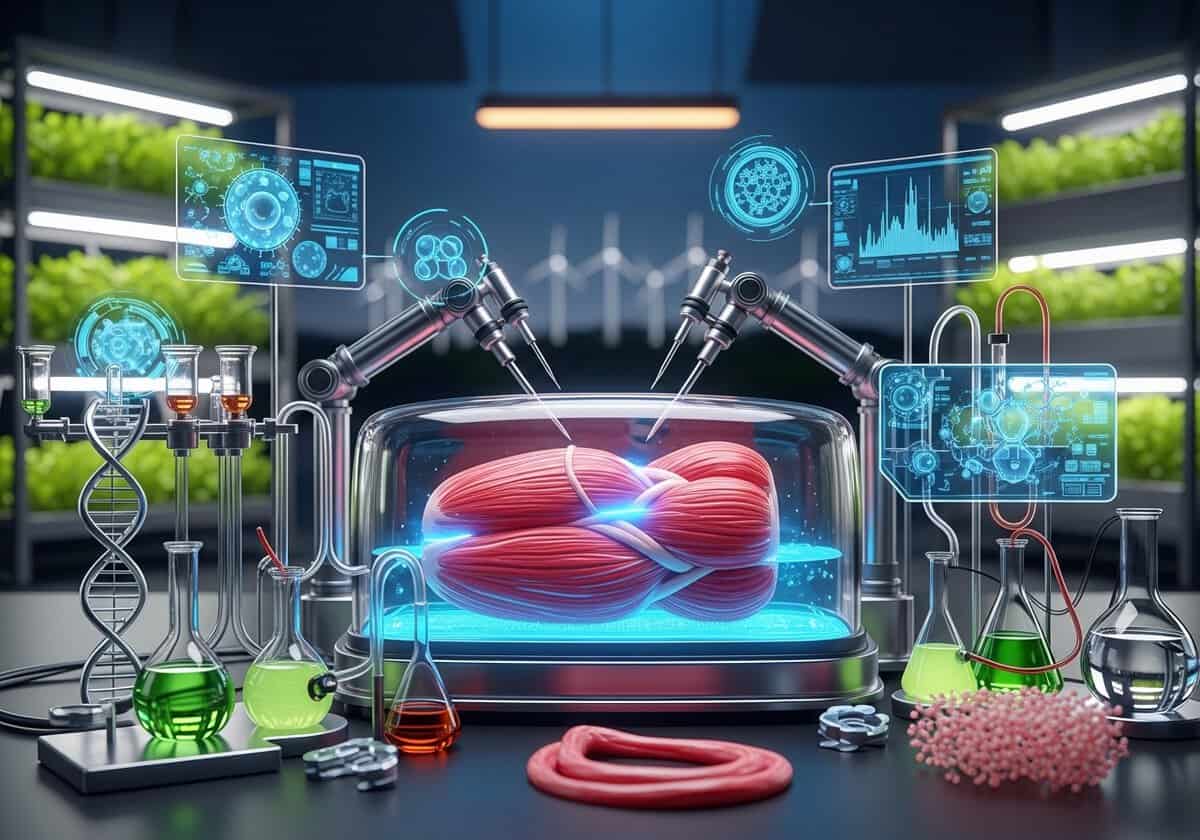

La viande cultivée en laboratoire consiste à cultiver des cellules musculaires animales dans des environnements contrôlés afin de produire des tissus comestibles sans recourir à l'élevage conventionnel. Ce domaine intègre la biologie cellulaire, l'ingénierie tissulaire et les techniques de bioprocédés pour optimiser la prolifération et la différenciation cellulaires, ainsi que le développement de supports de culture permettant de reproduire la texture et la saveur de la viande traditionnelle. Les innovations portent sur les milieux de culture sans sérum, la conception de bioréacteurs évolutifs et les matériaux de support comestibles afin d'améliorer l'efficacité de la production et la qualité des produits. La collection suivante présente des publications scientifiques récentes et des technologies brevetées détaillant les avancées en matière de développement de lignées cellulaires, d'optimisation des bioprocédés, d'attributs sensoriels, de considérations réglementaires et d'évaluations de durabilité, autant d'éléments essentiels à la commercialisation des produits de viande cultivée.
La viande cultivée consiste à faire pousser des cellules musculaires en dehors de l'animal. Le génie cellulaire est en plein essor. biologie synthétique, échafaudages sur biomatériauxet la formation de tissus sur bio-impressionLes arguments climatiques en faveur de cette technologie sont testés sur analyse du cycle de vie.
Ceci est notre dernière sélection de publications et brevets mondiaux en anglais sur la viande cultivée en laboratoire, parmi de nombreuses revues scientifiques en ligne, classées et axées sur la viande cultivée en laboratoire, la viande de culture, la viande à base de cellules, la viande in vitro, la viande bio-ingénierie, le bioréacteur de viande cultivée, la culture de cellules musculaires, la production de viande à partir de cellules souches, la prolifération cellulaire dans la viande, l'échafaudage pour viande cultivée, les milieux sans sérum, la culture de myoblastes, la différenciation cellulaire dans la viande, la viande cultivée en laboratoire, l'échafaudage de tissu de viande, l'agriculture cellulaire, la viande cultivée, la texture de la viande cultivée, la saveur de la viande cultivée, la technique d'expansion cellulaire, le bioprocédé de viande, la mise à l'échelle de la viande cultivée, l'échafaudage comestible et la méthode de récolte des cellules.
Publication : pas de nouvelles récentes sur ce sujet particulier. Veuillez essayer la recherche manuelle approfondie dans la base de données des publications dont le lien figure juste au-dessus.
Methods and compositions for cell culture on heterogeneous scaffolds
Patent published on the 2026-11-19 in US under Ref US20260365986 by UNIV CALIFORNIA [US] (Rowat Amy [us], Kawecki Nora Stephanie [us], Braybrook Siobhan Ariel [us], Norris Sam [us])
Abstract: Embodiments of the invention describe a cultured meat or food product with more desirable flavor and texture, as well as methods and compositions for producing the same. Certain embodiments are directed to methods of producing a stiffer, structured surfaces or scaffolds that mimic the extracellular matrix (ECM) and support the growth of myotubes that are interspersed with a scaffold component supporting fat cells (adipocytes) in vitro.[...]
Our summary: This invention focuses on producing cultured meat products with improved flavor and texture. It describes methods for creating scaffolds that mimic the extracellular matrix to support myotube and adipocyte growth. The scaffolds are designed to have stiffer, structured surfaces for enhanced cell culture.
cell culture, heterogeneous scaffolds, cultured meat, extracellular matrix
Patent
Bioreactor systems and methods for the use thereof
Patent published on the 2026-11-12 in AU under Ref AU2025256970 by INTACTIS BIO CORP [US] (Rodriguez-Granrose Daniel Isaac, Xiadani Dana, Deroo David)
Abstract: Provided herein are methods for manufacturing and using engineered tissues. The methods and compositions described herein may be useful for biocomputing, regenerative medicine, non-clinical trials, or cellular agriculture.[...]
Our summary: The content discusses bioreactor systems and methods for manufacturing engineered tissues. It highlights applications in biocomputing and regenerative medicine. Additionally, it addresses potential uses in non-clinical trials and cellular agriculture.
Bioreactor, engineered tissues, regenerative medicine, biocomputing
Patent
Ectopic cellular growth factor expression for low-cost production of cell-cultured foods
Patent published on the 2026-11-12 in US under Ref US20260357214 by TUFTS COLLEGE [US] (Kaplan David L [us], Stout Andrew [us])
Abstract: The present disclosure relates to cultured tissue, methods for production of self-sufficient modified cells for producing cultured tissue. Further, the disclosure provides methods of generating cultured meat products without exogenous addition of growth hormones.[...]
Our summary: This disclosure focuses on producing cultured tissue through ectopic cellular growth factor expression. It outlines methods for creating self-sufficient modified cells for cultured meat production. Additionally, it emphasizes generating cultured meat without the use of external growth hormones.
Ectopic expression, cell-cultured foods, tissue production, modified cells
Patent
Mammalian induced pluripotent stem cells
Patent published on the 2026-11-12 in WO under Ref WO2026234668 by YISSUM RESEARCH DEVELOPMENT CO OF THE HEBREW UNIVERSITY OF JERUSALEM LTD [IL] (Buganim Yossi [il], Orzech Dana [il], Lavon Neta [il], Molotski-Handelman Natali [il])
Abstract: The present invention provides methods of producing mammalian induced pluripotent stem cells (iPSCs) comprising introducing a novel combination of reprogramming factors into mammalian somatic cells. Also disclosed herein are a plurality of mammalian iPSCs and somatic cells, such as bovine cells, produced by the methods of the present invention and their use in producing cultured food product, particularly cultured meat.[...]
Our summary: The invention describes methods for producing mammalian induced pluripotent stem cells using a novel combination of reprogramming factors. It includes various mammalian iPSCs and somatic cells, specifically bovine cells, produced through these methods. The application of these cells is focused on generating cultured food products, especially cultured meat.
iPSCs, reprogramming factors, somatic cells, cultured meat
Patent
Use of sinapic acid to improve cell adhesion to scaffolds
Patent published on the 2026-11-12 in WO under Ref WO2026233926 by UNIV GENT [BE] (Geurs Indi [be], Grootaert Charlotte [be], Van Camp John [be])
Abstract: The present invention relates to the usage of specific compounds such as sinapic acid in order to improve the adhesion of structures such as myoblasts to scaffolds such as soy protein- or canola protein isolate scaffolds. In addition the present invention further discloses the composition and structure of specific scaffolds which are useful in -among others- cultured meat production.[...]
Our summary: The invention utilizes sinapic acid to enhance myoblast adhesion to protein isolate scaffolds. It details the composition and structure of these scaffolds. The application is particularly relevant for cultured meat production.
sinapic acid, cell adhesion, scaffolds, cultured meat production
Patent
Systems and methods for coordinating manufacturing of cells for patient-specific immunotherapy
Patent published on the 2026-11-05 in US under Ref US20260351372 by IOVANCE BIOTHERAPEUTICS INC [US] (Vogt Frederick G [us], Lam Binh [us], Chang Jennifer [us], Repaczki-Jones Ramona [us])
Abstract: A method for coordinating the manufacturing of an expanded cell therapy product for a patient may include receiving a cell order request to expand the cell therapy product for the patient; generating a patient-specific identifier or cell order identifier associated with the cell order request; and initiating a process to expand the cell therapy product from at least some of a solid tumor obtained from the patient. If acceptance parameters for the expansion cell therapy product do not meet certai[...]
Our summary: The method coordinates the manufacturing of expanded cell therapy products for patients. It involves generating identifiers for cell orders and initiating expansion from patient-specific solid tumors. If expansion parameters fail to meet criteria, re-evaluation and rescheduling of treatment events occur.
cell therapy, immunotherapy, manufacturing coordination, patient-specific
Patent