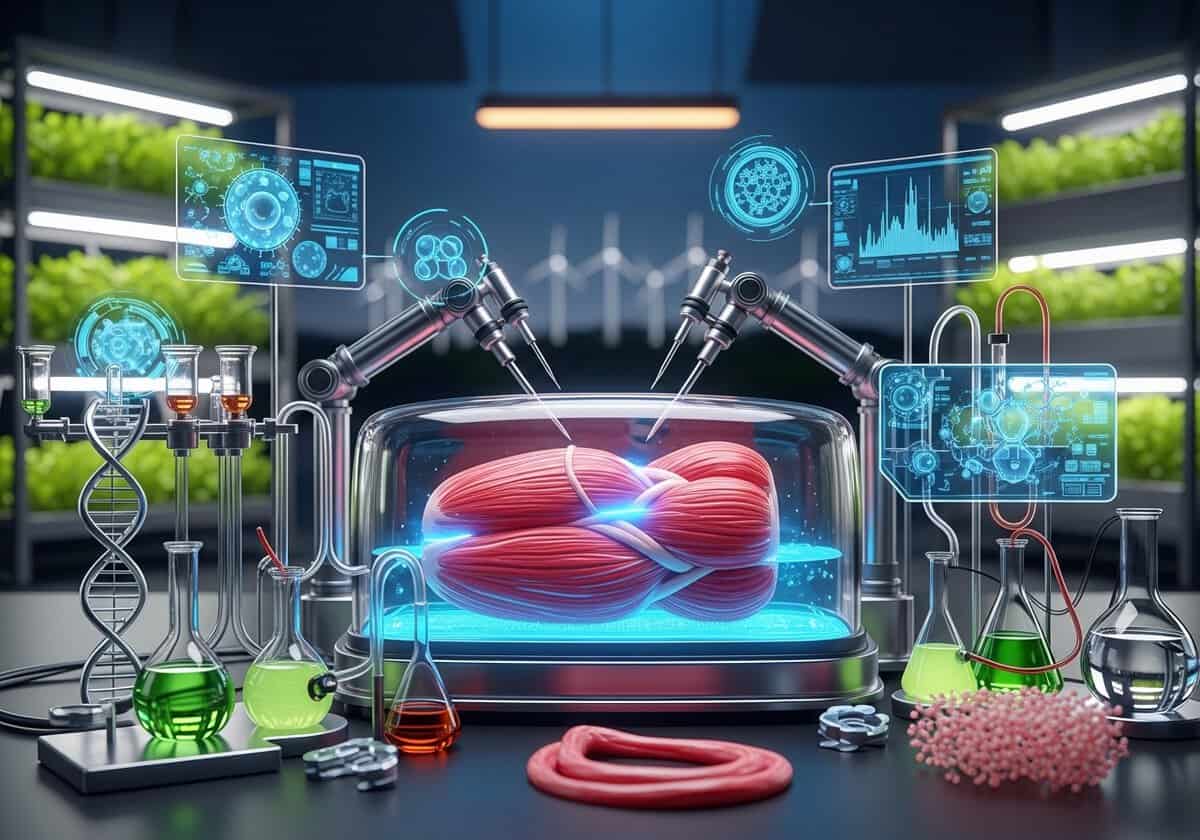

Lab-grown meat involves the cultivation of animal muscle cells in controlled environments to produce edible tissue without conventional livestock farming. This domain integrates cellular biology, tissue engineering, and bioprocessing techniques to optimize cell proliferation, differentiation, and scaffold development for replicating the texture and flavor of traditional meat. Innovations focus on serum-free culture media, scalable bioreactor designs, and edible scaffold materials to enhance production efficiency and product quality. The following collection presents recent scientific publications and patented technologies detailing advancements in cell line development, bioprocess optimization, sensory attributes, regulatory considerations, and sustainability assessments critical to the commercialization of cultured meat products.
这是我们最新精选的全球英文实验室培育肉出版物和专利,涵盖了众多科学在线期刊,并对实验室培育肉、培养肉、细胞基肉、体外肉、组织工程肉、培育肉生物反应器、肌肉细胞培养、干细胞肉生产、肉中细胞增殖、培养肉支架、无血清培养基、成肌细胞培养、肉中细胞分化、实验室培育肉、肉组织支架、细胞农业、培育肉、培养肉质地、培养肉风味、细胞扩增技术、肉类生物加工、培养肉规模化、可食用支架和细胞收获方法等主题进行了分类和重点介绍。
Publication: no recent news on this particular topic. Please try the extensive manual search in the Publication Database linked just above.
A method of preparation of 13c labeled biomolecules
Patent published on the 2026-07-29 in EP under Ref EP4782547 by UNIV PARDUBICE [CZ] (Holcapek Michal [cz], Rousar Tomas [cz], Bacova Jana [cz], Smid Lenka [cz], Jirasko Robert [cz], Peterka Ondrej [cz], Lasko Zuzana [cz])
Abstract: The present invention provides a method for preparation of fully 13C isotopically labeled biomolecules or biomolecules having a predetermined 13C isotopic labeling by biosynthesis in a mammalian cell line, which comprises the following steps:a) providing a mammalian cell line capable of growing in serum-free media;b) culturing the cell line obtained in step b) in a serum-free medium containing: fully 13C isotopically labeled amino acids or 13C isotopically labeled amino acids, fully 13C isotopic[...]
Our summary: A method for preparing 13C labeled biomolecules is described. It involves culturing a mammalian cell line in serum-free media with 13C isotopically labeled nutrients. The resulting biomolecules can be used as internal standards in various research fields.
13C labeling, biomolecules, biosynthesis, mammalian cell line
Patent
Cacao cell agglomerates and methods of agglomerating the cacao cells
Patent published on the 2026-07-23 in WO under Ref WO2026155937 by CARGILL INC [US] (Lykomitros Dimitrios [us], Lim Chinkee Illanza [us], Mccubbin Thomas Andrew [ch], Wright Christopher John [ch], Pastor Alejandro Halpern [ch])
Abstract: A method of processing cellular biomass, e.g., cell culture cacao cells, by cellular agriculture is disclosed. A fluidized bed dryer is used to dry and agglomerate the cellular biomass. The process includes classifying the cell agglomerates to generate optimum sized cell agglomerates to increase the uniformity of the agglomerates. The cellular biomass can be fermented prior to agglomeration. The process also includes roasting the agglomerates. Compositions with the roasted agglomerates and cocoa[...]
Our summary: The method processes cacao cell biomass using a fluidized bed dryer for agglomeration. It includes classifying agglomerates for optimal size and uniformity. Fermentation and roasting of the agglomerates enhance the final cocoa products.
Cacao, Agglomeration, Cellular Agriculture, Fluidized Bed Dryer
Patent