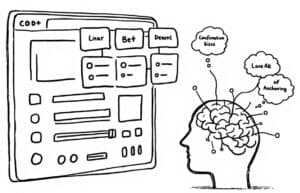
Level 2 focuses on evidence-based usability testing and psychological insights to enhance interface design and decision-making.
Knowing the vocabulary of an interface is not the same as knowing whether it works, and Level 2 supplies the testing methods that prove it, along with the psychology that explains the result. It covers formative and summative usability testing, the cognitive biases and behavioral techniques that shape how a user reads a screen or a control, and the manipulative patterns, from persuasive nudging to what the industry now calls enshittification, that separate ethical influence from exploitation.
This level serves an engineer or product developer who already ships interfaces and now needs to prove, with evidence rather than opinion, that a design decision improves task completion or reduces error. It matters most for teams building safety-relevant interfaces, where a misread control has real consequences, and for product developers negotiating a design change against a stakeholder who prefers personal taste over tested behavior. Manufacturers see lower field error rates, and product developers gain an argument in design reviews that data, not preference, can support.
The Concepts & Tools to Learn in this Course:
These are the bodies of knowledge that will be assessed in the test below:
Formative versus summative usability studies
Cognitive bias catalogue applied to design
Cognitive science techniques in engagement and games design, part one
Cognitive science techniques in engagement and games design, part two
Data-driven and statistical techniques in games and marketing design
Nudge marketing and behavioral influence
Enshittification as a design failure pattern
Communication pitfalls on professional platforms
Red teaming applied to interface and behavioral assumptions
The Dantzig Effect and problem framing in innovation
Structured user interview technique
Persona construction methodology
Customer journey mapping
Think-aloud protocol in usability testing
A/B testing statistics and sample size calculation
System Usability Scale scoring
Card sorting for information architecture validation
Eye-tracking and attention-mapping basics
Dark pattern taxonomy and ethical design boundaries
Post-release behavioral analytics interpretation
Our Suggested Readings
The list below is a special selection of our original articles, tools and methodologies available on this site.
Tip: the big dot at the start of each title indicates if that post/article has already been read ( ● ), or not ( ○ ). Refresh the page if necessary.
Tip: the reading progress is recorded either in a cookie (if you are not logged in or no account created), or in your site profile. Use the later to be sure not to loose your progression.
As soon as you start a given article, your progress will be indicated on top of each page to help you finish and move on to the next.
Note: for this particular course, articles can be read in any order.
After you are familiar with the lectures above, so as having done your own readings, we recommend attending the Exam below.
The test consists of 20 questions in random order, out of many more, to insure novelty each time. Each completely correct answer gets you 10 points. You get a full correction at the end of the test.
If the course has different levels, the current test does not include questions of lower levels, making it … hardthat level!
radio-buttons: only 1 correct answer must be selected
check-boxes: 1 or several answers must be checked (with strict all-good-or-nothing grading logic)
Tip: mouse over “Hint” to get an advise for the response.
Only innovation.world members can see it below and attend it.