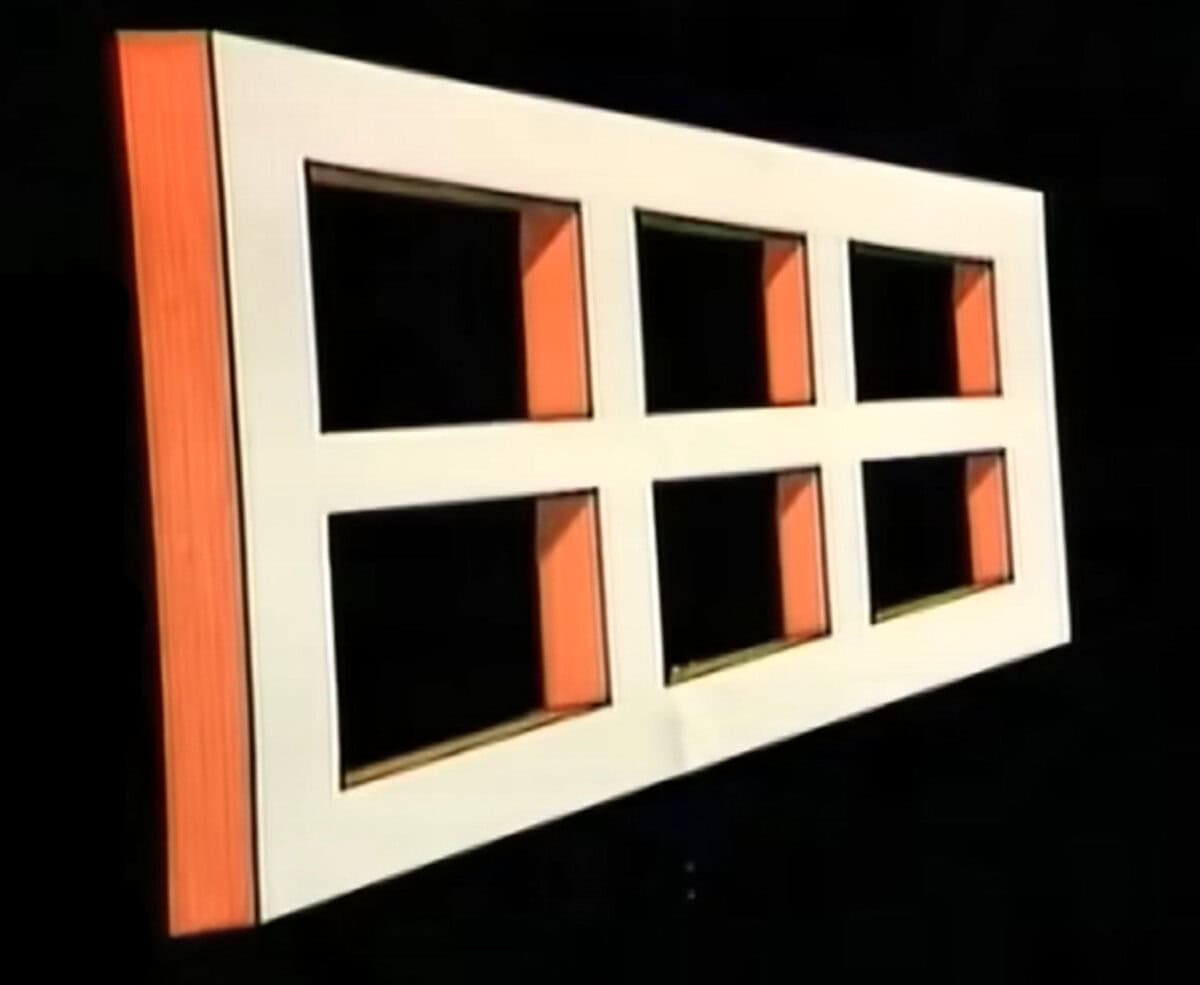
The Ames window is a classic optical illusion, created by the American scientist Adelbert Ames Jr. in the 1940s. It is a trapezoid-shaped window, with one vertical side visibly taller than the other, painted with window panes, shadows and sometimes a cross-bar. When it rotates around its vertical axis, it doesn’t appear to turn all the way round. Instead, the viewer sees it oscillate back and forth, swinging like a pendulum through roughly 90 to 180 degrees. At certain points in the rotation, the window can even appear to change shape or to rotate in the opposite direction from its real motion, and a rod threaded through it may seem to pass through the glass or to bend and fly apart from the frame.
The best part is the part with the ruler in the middle, physically crossing the window, at least for the brain: the brain has to find a “solution” between a rotating part -the ruler- and a part just oscillating -at least it thinks so-, so they intersect.
The fundamental cause is that the retinal image alone is ambiguous. A trapezoid seen from an angle can be the projection of many different real shapes, so the brain must infer depth and orientation from assumptions it has built through experience. Here, the brain assumes the window is a normal rectangle, and that the larger side must be closer. The perspective cues baked into the painted shape and shadows reinforce this. When the window turns and the shorter side is actually nearer, the retinal image is in conflict with the assumption. The visual system resolves it by reversing the perceived depth, so the window seems to rotate the wrong way or to stop and reverse.
The fundamental lesson is that perception is not a passive recording of the world but an active, unconscious inference, a best guess built from prior expectations. Ames used this and his other demonstrations, such as the Ames room (see below), to argue that what we see depends as much on what we have learned to expect as on the light reaching our eyes: