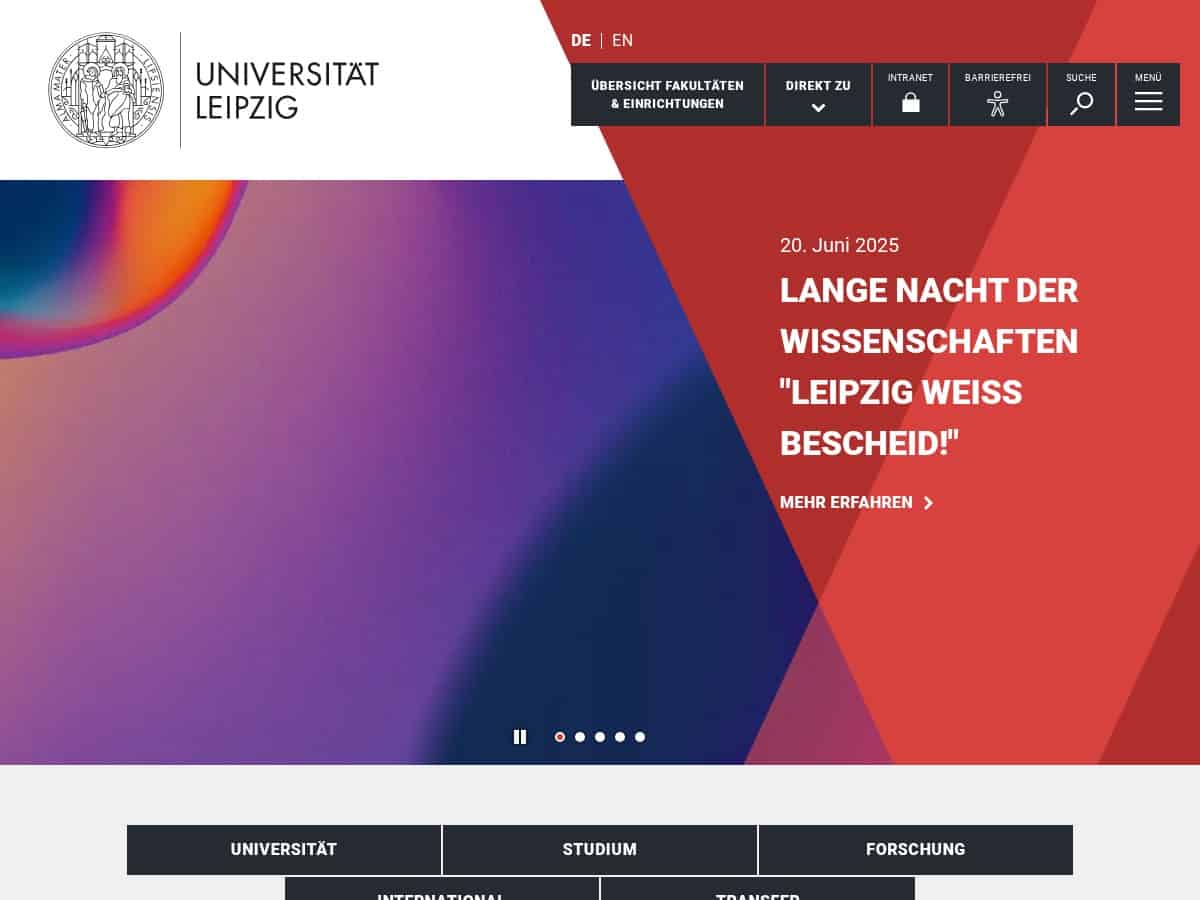
On 2 December 1409 Leipzig University was officially founded, after German-speaking professors and students had left Prague earlier that year. It is one of the oldest universities in Germany.
The political history of the twentieth century left its mark: in 1953 the East German government renamed it Karl-Marx-Universität, and the original name Universität Leipzig returned in 1991. The university is a comprehensive one with 14 faculties spanning, among others, theology, law, medicine, veterinary medicine, chemistry, physics and earth sciences, life sciences, philology and sport science.
More than 29,000 students are enrolled and the university employs more than 5,000 staff. Among the people linked to it is Werner Heisenberg, who was affiliated with Leipzig University when he was awarded the Nobel Prize in Physics for 1932. The campus lies in the city centre of Leipzig rather than on the edge of town.
Domains taught:
AI and Machine Learning, Astroscience, Bioengineering, Bioinformatics, Chemistry, Computer Vision, Data Analytics, Ecology and Sustainability, Fluid Dynamics, Geotechnics, Life Sciences, Manufacturing, Materials, Mathematics, Mechanical Engineering, Microbiology and Genetics, Nanotechnologies, Optics, Physics, Process Control, Signal Processing, Software Engineering, Statistics, Structural Engineering, Telecommunications, Thermodynamics
Diplomas*:
Bachelor, Doctor, Master
Status:
Public
Partnerships:
Historic university with a rich academic tradition. Collaborations with research institutes in Leipzig (Max Planck, Helmholtz).
Research:
Solid state physics and materials science, Biochemistry and molecular biology, Environmental science and biodiversity, AI and data science.
Famous Alumnis:
Werner Heisenberg (Nobel laureate, faculty), Gustav Hertz (Nobel laureate, alumnus)
International recognition**:
Number of staff***:
5000
Current students***:
30000
Foreign students***:
10%
Cumulative former students***:
N/A
Pros
One of Germany’s oldest universities, strong in basic sciences, located in a vibrant city.
Cons
Engineering faculties are not its primary focus.
Best For
Historic comprehensive university with strong programs in physics, chemistry, life sciences, and computer science.
Universität zu Köln combines physics, mathematics, chemistry and geosciences, a large public comprehensive university.
Most Similar Schools Abroad
University of Vienna (Austria) is a public comprehensive university covering law, humanities, natural sciences and social sciences.
University of Copenhagen in Denmark lists health and medical sciences and natural sciences, an old public university in a capital city.
Universiteit Utrecht (Netherlands) is a public university with earth sciences, life sciences and chemistry.
University of Helsinki, Finland, is a public university with atmospheric science, life sciences and computer science.
Universität Zürich in Switzerland is a public university teaching natural sciences, mathematics and computational subjects.
*our own picks (our criteria: a mix between domains, diploma delivered, reputation and size), but obviously too many criteria for an apple-to-apple ranking.
FAQ
When and how did Leipzig University begin?
It was founded on 2 December 1409 after German-speaking scholars departed from Prague. Its early history is closely tied to that exodus.
Why was it called Karl-Marx-Universität?
The East German government gave it that name in 1953. The name Universität Leipzig was restored in 1991 following reunification.
How many faculties does it have?
There are 14, including Law, Medicine, Veterinary Medicine, Theology, Chemistry, Life Sciences, Education and Sport Science. The faculties are listed on the official website.
How large is the student body?
More than 29,000 students study there, and over 5,000 people work at the university. The facts-and-figures page on the official site carries current figures.
Which Nobel laureate is tied to Leipzig?
Werner Heisenberg was at Leipzig University when he received the Nobel Prize in Physics for 1932, which was awarded in 1933.
Where is the campus?
It is in the centre of Leipzig, with historic buildings near the centre. Applicants can find admission rules and fees on the official study pages of uni-leipzig.de.
Artificial Intelligence (AI), Biodiversity, Chemistry, Environmental Engineering, Physics, Sustainable Development
*: without any judgment of the quality, readers are strongly encouraged to check the official status of the exact diploma envisioned as many universities have a mix of recognized diplomas, not recognized, “co-delivered,” “equivalent to”, “some pathways” (…), can change over time, and can be named differently from one country to another.
**: international reputation: is based on some criteria that do not mean much in some domains or specialties (number of researchers, of scientific publications, on budget ….). Our approximate 1-4 scale:
known locally
known locally and internationally
is listed in some of the world university’s classifications
is listed among the 20 firsts in some of world university’s classifications
***: estimated numbers, based on online sources and/or feedbacks. The numbers can vary greatly depending on school organisation (ex.: school is part of a group, it employs internal staff or external consultants or has public staff without employing them …). Refer to all the links provided to have accurate and updated numbers.
Innovation.world is not affiliated with this school/university. We recommend to contact them directly on their website for any special request.
To complete or correct any information here or share your opinion, please comment below or > send us a direct message <.