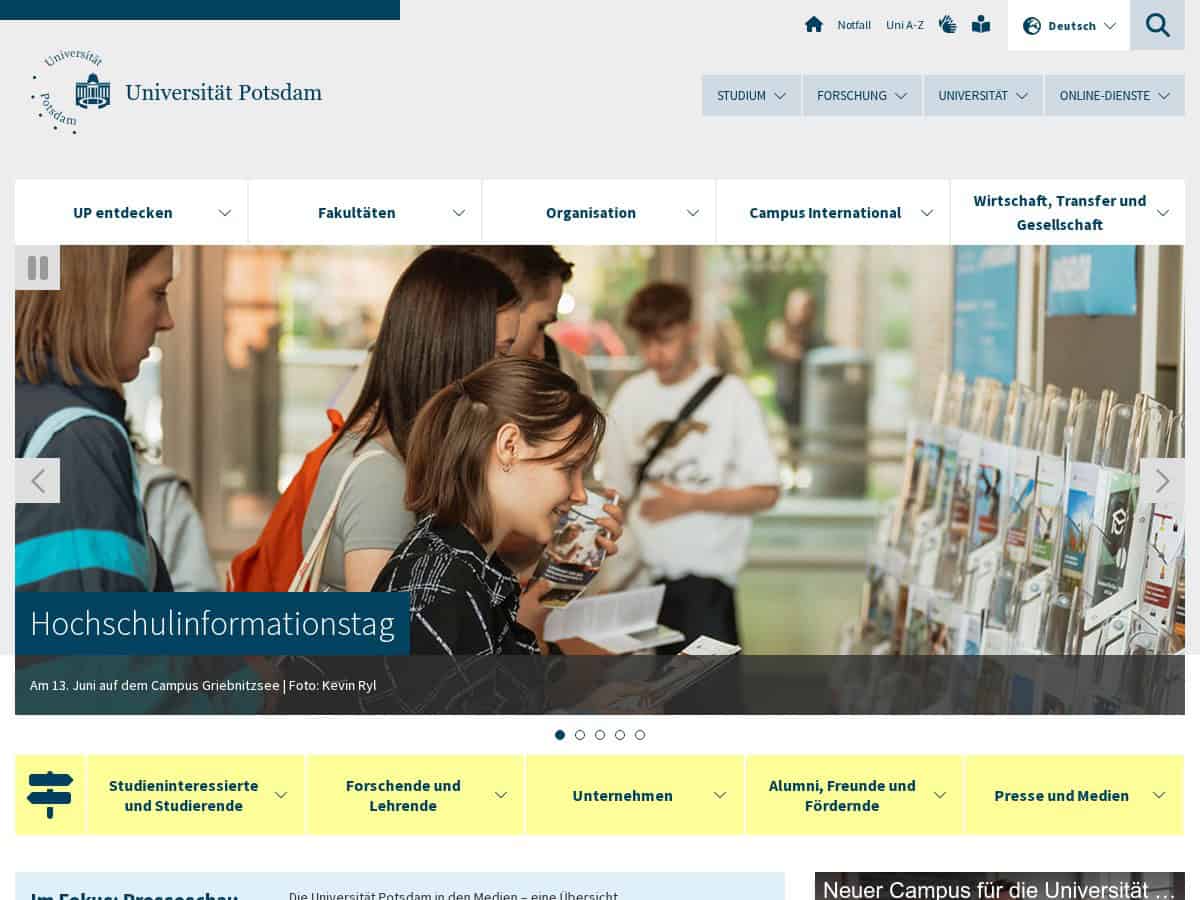
Universität Potsdam is spread over three campuses in Potsdam, Brandenburg: Am Neuen Palais, Golm and Griebnitzsee. Each site houses different faculties.
The university was founded in 1991, by bringing together earlier institutions in the town, among them the Karl Liebknecht College of Education. Today it has seven faculties (in German: Juristische, Philosophische, Humanwissenschaftliche, Wirtschafts- und Sozialwissenschaftliche, Mathematisch-Naturwissenschaftliche, Digital Engineering and Gesundheitswissenschaften Brandenburg): law, arts (Philosophische Fakultät), human sciences, economics and social sciences, mathematics and natural sciences, digital engineering, and health sciences (a joint Brandenburg faculty).
Around 19,600 to 19,700 students were enrolled in the winter semesters of 2024/25 and 2025/26. Dozens of professorships are held jointly with non-university research institutions in the region. Applicants and researchers can find current degree programmes, language requirements and application dates on the university’s official English pages.
Domains taught:
AI and Machine Learning, Astroscience, Bioengineering, Bioinformatics, Chemistry, Computer Vision, Data Analytics, Ecology and Sustainability, Electrical and Electronics, Fluid Dynamics, Geotechnics, Life Sciences, Manufacturing, Materials, Mathematics, Mechanical Engineering, Microbiology and Genetics, Nanotechnologies, Optics, Physics, Process Control, Signal Processing, Software Engineering, Statistics, Structural Engineering, Telecommunications, Thermodynamics
Diplomas*:
Bachelor, Doctor, Master
Status:
Public
Partnerships:
Located in the research landscape of Potsdam-Berlin. Collaborations with Max Planck, Fraunhofer, and Helmholtz institutes.
Research:
Geosciences and climate dynamics, Cognitive science and AI, Nanoscience and materials physics, Bioinformatics and systems biology.
Famous Alumnis:
N/A
International recognition**:
Number of staff***:
2000
Current students***:
21000
Foreign students***:
10%
Cumulative former students***:
N/A
Pros
Modern university with a strong research focus in specific science areas, located in a historic city near Berlin.
Cons
Less focused on traditional engineering disciplines.
Best For
Public university with strong programs in earth sciences, cognitive sciences, data science, physics, and chemistry.
Universität Leipzig is a public university with Physics & Earth Sciences, Chemistry & Mineralogy and Life Sciences & Bioinformatics, a close match for Potsdam's natural-science profile.
Universität Hamburg, public, is listed for Climate & Earth System Science, Physics & Nanoscience and Informatics & Data Science.
Freie Universität Berlin is a public university in Berlin, neighbouring Potsdam, with Physics & Chemistry, Biology & Life Sciences and Mathematics & Computer Science.
Humboldt-Universität zu Berlin, also public and in Berlin, covers Physics & Chemistry, Life Sciences & Agriculture and Mathematics & Computer Science.
Universität Bremen is a public university in Bremen focused on Marine & Environmental Sciences, Materials Science & Production Engineering and Computer Science & Digital Media.
Most Similar Schools Abroad
King Abdullah University of Science and Technology (Saudi Arabia) is a public research university for Biological and Environmental Science and Computer and Mathematical Sciences.
University of California, Santa Barbara (United States) is public and lists Physics, Materials, Engineering, Environmental Science and Marine Science.
University of Oulu (Finland) is a public university with Wireless Communications, Steel Research and Environmental Science.
Roskilde University (Denmark) is a public university built on interdisciplinary studies, social sciences and environmental science.
*our own picks (our criteria: a mix between domains, diploma delivered, reputation and size), but obviously too many criteria for an apple-to-apple ranking.
FAQ
Where are the campuses of Universität Potsdam?
There are three: Am Neuen Palais, Golm and Griebnitzsee. All lie in the city of Potsdam in Brandenburg.
When was the university founded?
It was founded in 1991. It grew out of earlier institutions in Potsdam, including the Karl Liebknecht College of Education.
How is the university organised?
It has seven faculties, including law, human sciences, economics and social sciences, mathematics and natural sciences, and digital engineering. A joint faculty for health sciences in Brandenburg completes the list.
How many students does it have?
About 19,600 to 19,700 students were enrolled in the winter semesters of 2024/25 and 2025/26.
Does it cooperate with outside research institutes?
Yes, many professorships are appointed jointly with non-university research institutions. This is a distinguishing feature of research in the Potsdam area.
Which faculty is at which campus?
Golm, Am Neuen Palais and Griebnitzsee host different faculties. Check the university's campus pages for the exact allocation of institutes.
How can international students find admission details?
The English-language pages of the university and its international office list programmes, language requirements and deadlines. Requirements vary by degree, so rely on those pages.
*: without any judgment of the quality, readers are strongly encouraged to check the official status of the exact diploma envisioned as many universities have a mix of recognized diplomas, not recognized, “co-delivered,” “equivalent to”, “some pathways” (…), can change over time, and can be named differently from one country to another.
**: international reputation: is based on some criteria that do not mean much in some domains or specialties (number of researchers, of scientific publications, on budget ….). Our approximate 1-4 scale:
known locally
known locally and internationally
is listed in some of the world university’s classifications
is listed among the 20 firsts in some of world university’s classifications
***: estimated numbers, based on online sources and/or feedbacks. The numbers can vary greatly depending on school organisation (ex.: school is part of a group, it employs internal staff or external consultants or has public staff without employing them …). Refer to all the links provided to have accurate and updated numbers.
Innovation.world is not affiliated with this school/university. We recommend to contact them directly on their website for any special request.
To complete or correct any information here or share your opinion, please comment below or > send us a direct message <.