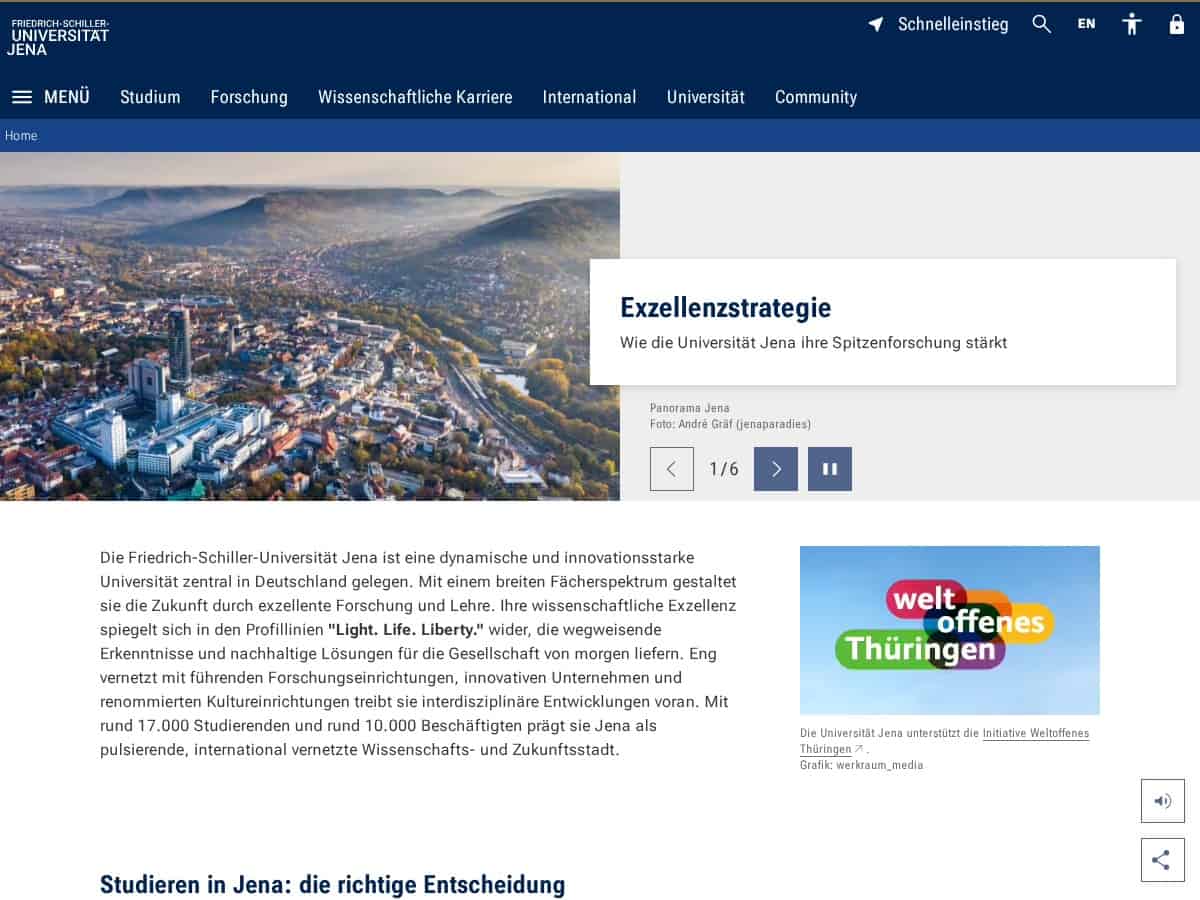
Jena, a city in Thuringia on the river Saale, is home to a university that dates its foundation to 1558. It carries the name of the poet and dramatist Friedrich Schiller and is a public university.
The university’s best-known period came in the late eighteenth century, under Duke Charles Augustus, the patron of Johann Wolfgang von Goethe, from 1787 to 1806. In those years Jena was described as the academic centre of Germany, and philosophers including Schelling held professorships there, helping to make the university central to German idealism.
Today the university has more than 16,000 students and offers a wide spread of subjects. The city around it has long been a centre of optical and precision instruments and glass products, with a pharmaceutical industry and several biotechnology and microelectronics firms. Programme lists, admission rules and the profile of research are described on the university’s official website.
Domains taught:
Aerospace, AI and Machine Learning, Astroscience, Automation, Bioengineering, Bioinformatics, Chemistry, Computer Vision, Data Analytics, Ecology and Sustainability, Electrical and Electronics, Engineering, Fluid Dynamics, Life Sciences, Manufacturing, Materials, Mathematics, Mechanical Engineering, Microbiology and Genetics, Nanotechnologies, Optics, Physics, Process Control, Robotics, Signal Processing, Software Engineering, Statistics, Structural Engineering, Telecommunications, Thermodynamics
Diplomas*:
Bachelor, Doctor, Master
Status:
Public
Partnerships:
Strong collaborations with optics industry (Zeiss, Jenoptik) and research institutes (Max Planck, Leibniz, Fraunhofer) in Jena.
Research:
Optical engineering and photonics, Biophysics and materials science, Microbial communication and biodiversity, Gravitational and quantum theory.
Famous Alumnis:
Ernst Abbe, Carl Zeiss (associated), Friedrich Schiller (taught)
International recognition**:
Number of staff***:
2500
Current students***:
17000
Foreign students***:
10%
Cumulative former students***:
N/A
Pros
Excellence in optics and photonics, strong research in life sciences and physics, historic university in a City of Science”.”
Cons
Located in Jena (Thuringia).
Best For
Research university renowned for optics, photonics, physics, and life sciences.
Universität Leipzig is a public university in Leipzig with physics, earth sciences, chemistry and mineralogy, a close neighbour in eastern Germany.
Martin-Luther-Universität Halle-Wittenberg is a public university in Halle (Saale) combining biosciences and pharmaceutical sciences with materials science.
Universität Greifswald is a public university with physics, material science and biochemistry in the north-east.
Università degli Studi di Siena (Italy) is a public university in Siena covering life sciences and environmental sciences.
*our own picks (our criteria: a mix between domains, diploma delivered, reputation and size), but obviously too many criteria for an apple-to-apple ranking.
FAQ
What year does Jena date its foundation to?
The university dates its foundation to 1558. Its full name today is Friedrich Schiller University Jena.
Where is Jena?
Jena is a city in Thuringia, in east-central Germany, on the Saale river to the east of Weimar. The university is the city's main educational institution.
Which thinkers are linked to the university?
Friedrich Wilhelm Joseph von Schelling held a professorship at Jena in the years when the university was seen as Germany's academic centre. The period under Duke Charles Augustus, patron of Goethe, was the high point of the university.
How many students study at Jena?
More than 16,000 students are enrolled, according to the university's own description. Figures differ slightly between sources and years.
What industries are located around Jena?
The city is described as a major centre for optical and precision instruments and glass products. There are also pharmaceutical, biotechnology and microelectronics firms.
Is the university public?
The directory lists it as a public university. Tuition conditions for degree programmes are explained by the university.
How can I find programmes taught in English?
The university's English website lists degree programmes and admission requirements. Applicants should check the specific programme page for language requirements.
*: without any judgment of the quality, readers are strongly encouraged to check the official status of the exact diploma envisioned as many universities have a mix of recognized diplomas, not recognized, “co-delivered,” “equivalent to”, “some pathways” (…), can change over time, and can be named differently from one country to another.
**: international reputation: is based on some criteria that do not mean much in some domains or specialties (number of researchers, of scientific publications, on budget ….). Our approximate 1-4 scale:
known locally
known locally and internationally
is listed in some of the world university’s classifications
is listed among the 20 firsts in some of world university’s classifications
***: estimated numbers, based on online sources and/or feedbacks. The numbers can vary greatly depending on school organisation (ex.: school is part of a group, it employs internal staff or external consultants or has public staff without employing them …). Refer to all the links provided to have accurate and updated numbers.
Innovation.world is not affiliated with this school/university. We recommend to contact them directly on their website for any special request.
To complete or correct any information here or share your opinion, please comment below or > send us a direct message <.