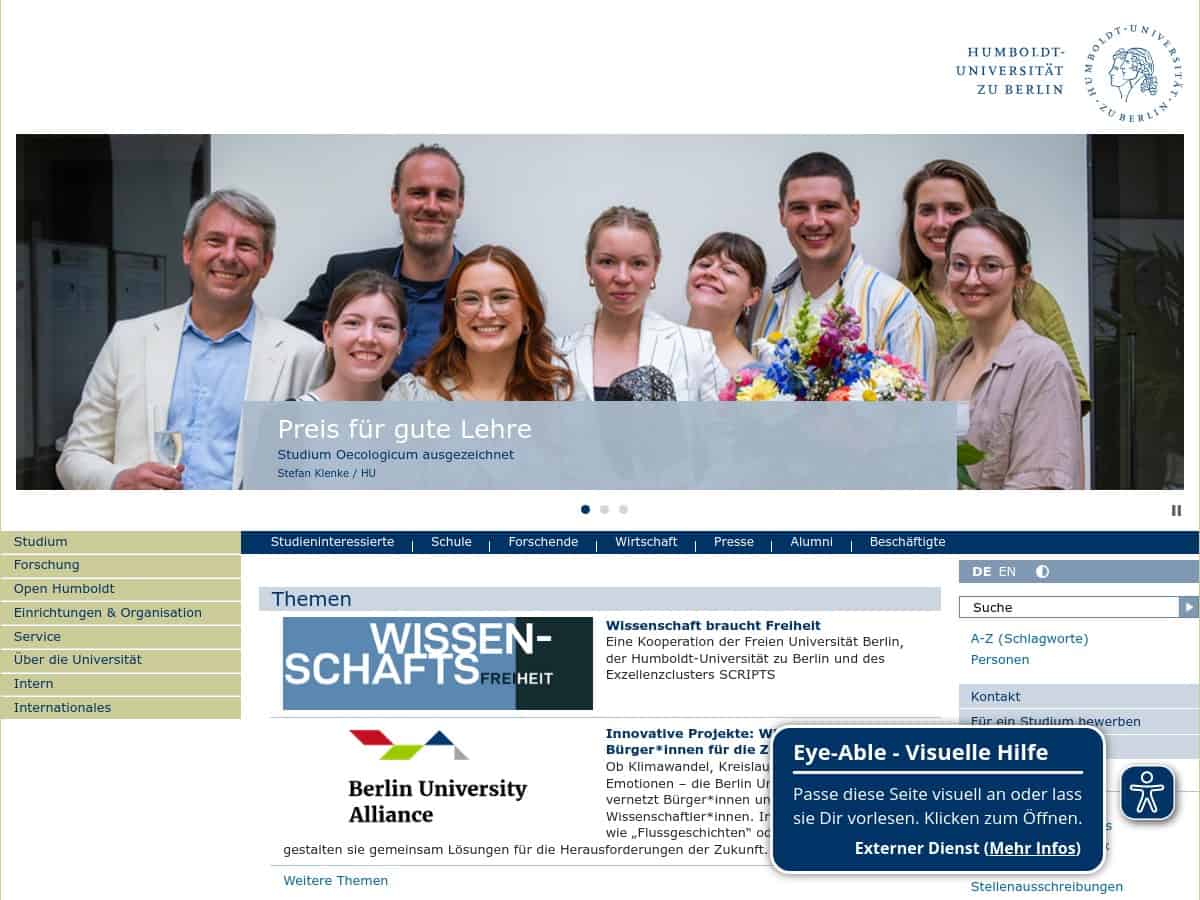
Founded in 1810 by Wilhelm von Humboldt, HU Berlin is a prestigious public research university with a strong tradition in humanities, social sciences, medicine, and natural sciences (physics, chemistry, biology, mathematics, computer science).
Humboldt-Universität zu Berlin was founded in 1810 by the Prussian reformer Wilhelm von Humboldt and opened under the name University of Berlin. It has about 35,000 students and 4,500 staff, and roughly one student in five comes from abroad. The main building on Unter den Linden was a palace of Prince Heinrich, and the university still sits opposite the Opera and the State Library in the historic centre.
Humboldt’s idea was that research and teaching should be unified, and that students should take part in scholarship from the start. This model influenced universities across Europe and North America. Hegel, Schopenhauer, Albert Einstein, Max Planck and Robert Koch taught or worked here, and Karl Marx, the Brothers Grimm and Otto von Bismarck are among its notable names. After 1945 the university was in East Berlin, and it took its present name in 1949.
Today it is strong in the humanities, social sciences, law, economics, mathematics, physics, computer science and life sciences. The Adlershof science campus in the south-east combines natural sciences with research institutes and technology companies, and the medical faculty, the Charité, is shared with the Freie Universität. The Grimm Centre, a modern library, is among the largest in Germany.
HU Berlin is a University of Excellence as part of the Berlin University Alliance with FU Berlin, TU Berlin and Charité. Public universities in Berlin charge no tuition for most students, but a semester contribution of a few hundred euros includes a regional transport ticket. Most bachelor’s programmes are in German, and a growing number of master’s programmes are in English.
Berlin is cheaper than Munich or Hamburg but rents have risen sharply. The city offers a large cultural scene, many start-ups and a large international community. The library system is spread over several sites, and the Grimm Centre stays open late for students preparing for exams.
Domains taught:
Agriculture, AI and Machine Learning, Astroscience, Bioengineering, Bioinformatics, Chemistry, Computer Vision, Data Analytics, Ecology and Sustainability, Fluid Dynamics, Life Sciences, Manufacturing, Materials, Mathematics, Mechanical Engineering, Microbiology and Genetics, Nanotechnologies, Optics, Physics, Process Control, Signal Processing, Software Engineering, Statistics, Structural Engineering, Telecommunications, Thermodynamics
Diplomas*:
Bachelor, Doctor, Master
Status:
Public
Partnerships:
Member of German U15, NeurotechEU. Historic university with numerous Nobel laureates.
Research:
Theoretical physics & Quantum science, Molecular biology & Genetics, Sustainable agriculture & Resource management, AI & Data science, Optical sciences.
Famous Alumnis:
Over 50 Nobel laureates including Albert Einstein, Max Planck, Erwin Schrödinger.
International recognition**:
Number of staff***:
4500
Current students***:
35000
Foreign students***:
20%
Cumulative former students***:
N/A
Pros
Historic and prestigious university, strong in basic sciences and mathematics, located in central Berlin.
Cons
Traditional academic structure, engineering options are limited.
Best For
Historic university renowned for its contributions to science, particularly physics, chemistry, and life sciences.
Anyone who wants a second school in the same country with a similar spread of astroscience, bioinformatics and nanotechnologies can consider Freie Universität Berlin, and it covers geotechnics as well, and has almost the same size, at about 33,000 students.
Think of Julius-Maximilians-Universität Würzburg when astroscience, bioinformatics and nanotechnologies is the priority: it teaches at the same levels, namely bachelor's, master's and doctoral, and is slightly smaller, at about 27,000 students against roughly 35,000 here.
Universität zu Köln shares the core fields of this institution, namely astroscience, bioinformatics and nanotechnologies; it is slightly larger, at about 48,000 students against roughly 35,000 here, and is also a public institution.
Ruprecht-Karls-Universität Heidelberg offers a comparable education in astroscience, bioinformatics and nanotechnologies: it runs the same bachelor's, master's and doctoral programmes, and covers geotechnics as well.
Universität Leipzig overlaps with this institution on astroscience, bioinformatics and nanotechnologies, so the two are easy to compare, and it teaches at the same levels, namely bachelor's, master's and doctoral, and covers geotechnics as well.
Most Similar Schools Abroad
Students considering a move abroad can look at Jagiellonian University in Poland, where astroscience, bioinformatics and nanotechnologies also form the core, and it is slightly larger, at about 40,000 students against roughly 35,000 here, and is also a public institution.
If this university is on your list for astroscience, bioinformatics and nanotechnologies, University of Warsaw in Poland deserves a comparison, because it teaches at the same levels, namely bachelor's, master's and doctoral, and covers geotechnics as well.
Nankai University, based in China, is built around astroscience, bioinformatics and nanotechnologies much like this institution, and it is also a public institution, and runs the same bachelor's, master's and doctoral programmes.
Université de Genève, in Switzerland, takes a similar route through astroscience, bioinformatics and nanotechnologies; it is also a public institution, and teaches at the same levels, namely bachelor's, master's and doctoral.
Students considering a move abroad can look at Universität Zürich in Switzerland, where astroscience, bioinformatics and nanotechnologies also form the core, and it is slightly smaller, at about 28,000 students against roughly 35,000 here, and is also a public institution.
*our own picks (our criteria: a mix between domains, diploma delivered, reputation and size), but obviously too many criteria for an apple-to-apple ranking.
FAQ
Where is HU Berlin?
The main building is at Unter den Linden 6 in the centre of Berlin. The science campus is at Adlershof.
When was it founded?
In 1810 by Wilhelm von Humboldt.
How large is it?
About 35,000 students and 4,500 staff.
What is the Humboldtian model?
A university concept that unites research and teaching and involves students in scholarship from the start.
Who taught at the university?
Hegel, Schopenhauer, Albert Einstein, Max Planck and Robert Koch were among them.
What is HU Berlin known for?
Humanities, social sciences, law, economics, mathematics, physics and computer science.
What is the Berlin University Alliance?
A partnership of HU Berlin, FU Berlin, TU Berlin and Charité that holds the Excellence University status.
Is there tuition?
Public universities in Berlin charge no tuition for most students. A semester contribution applies and includes a regional transport ticket. Check the current tariff.
In which language are courses taught?
Mostly in German at bachelor level, with a growing number of master's programmes in English.
Is Berlin affordable?
It is cheaper than Munich or Hamburg, but rents have risen sharply.
*: without any judgment of the quality, readers are strongly encouraged to check the official status of the exact diploma envisioned as many universities have a mix of recognized diplomas, not recognized, “co-delivered,” “equivalent to”, “some pathways” (…), can change over time, and can be named differently from one country to another.
**: international reputation: is based on some criteria that do not mean much in some domains or specialties (number of researchers, of scientific publications, on budget ….). Our approximate 1-4 scale:
known locally
known locally and internationally
is listed in some of the world university’s classifications
is listed among the 20 firsts in some of world university’s classifications
***: estimated numbers, based on online sources and/or feedbacks. The numbers can vary greatly depending on school organisation (ex.: school is part of a group, it employs internal staff or external consultants or has public staff without employing them …). Refer to all the links provided to have accurate and updated numbers.
Innovation.world is not affiliated with this school/university. We recommend to contact them directly on their website for any special request.
To complete or correct any information here or share your opinion, please comment below or > send us a direct message <.