For Manufacturing: the Japanese Lean terms are must-know vocabulary in manufacturing or quality as these have no direct equivalent and are used as-is in an industrial context.
There are a variety of Japanese manufacturing lean terms, but we list here a shortlist of Japanese terms to know in Lean Sigma, and more generally in any plant, product, or process improvement. Not for a show-off attitude, but because these are usually more concise and dedicated than their translation equivalent; and simply because there ARE commonly used lean terms in western industries by now.
Japanese Lean Terms
Kaizen
A key vocabulary to start the Lean terms list is Kaizen meaning literally
Kaizen “Change for the good” = improvement
or “change for the better”. All Lean activities are aimed at this continuous Kaizen. It emphasizes continuous improvement in all areas of business. Kaizen is based on the idea that small, incremental changes can lead to big results over time. The goal of kaizen is to eliminate waste and improve efficiency in all aspects of the manufacturing process.
Kaizen is a team-based approach that relies on the collective input of workers to identify and implement improvements. This bottom-up approach to problem-solving ensures that everyone in the organization has a vested interest in the success of the company and that improvements are based on the real needs of those who are doing the work. This approach helps to ensure that waste is constantly being removed from the manufacturing process. The Lean manufacturing production methodology focuses on minimizing waste in all forms, including overproduction, defects, inventory, motion, and waiting time as seen in Mudas hereafter.
Kaizen is a key component of Lean manufacturing, as it provides a mechanism for continual improvement that can be quickly implemented and adapted as new problems and opportunities arise as seen below with the other lean terms.
Kanban
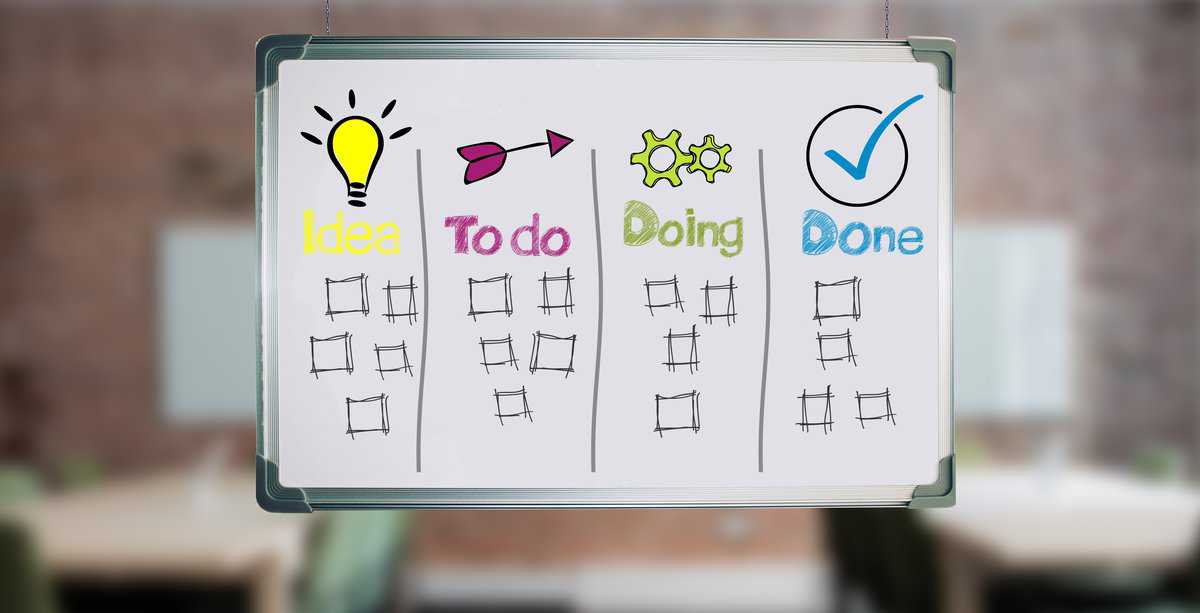
Kanban, with its Japanese word meaning 8220;sign8220; ou 8220;billboard”, é um tool que helps para visualize the process, its current state, and its targets, e more generally to schedule and optimize o flow of trabalhar in a lean e just–em–time (JIT) manufacturing.
Um kanban geralmente assume a forma de quadros muito visuais onde o trabalho em process é represented por cards que são moved along o line as the work progresses, such as:
-
- Kanban boards para track trabalhar em progress e visualize o flow of trabalhar. This pode help identify bottlenecks e areas para improvement when cards get stuck and/or empty slots appear
- Kanban sheets to manage inventory levels. This pode help ensure que materials são available when needed, in a pull organization, e help reduce waste.
- Kanban para schedule produção para help ensure que trabalhar é flowing smoothly e que deadlines são met
- Kanban boards to track quality by identifying issues early e ensuring que products meet customer expectations
Dica: as with project scorecards, or sprint or scrum boards, be very visual: use a mix of simple shapes (square, circles, triangle) and easy codificação por cores to convey the message.
Dica: it must be located close to the worker (in the Gemba, see below) and have sufficient free space nearby to permit very quick daily team meetings in front of it
Anyone just passing by, even unfamiliar with the process, must see the state and the ongoing challenge in the blink of an eye
Gemba

Gemba is a Japanese Lean term that means “the real place.” In lean manufacturing, Gemba is the place where the value is added to the product. This could be the factory floor, the office for a service, or any other place where useful work for the customer is performed.
The goal of lean is to eliminate waste in all forms, and Gemba is where waste is most likely to occur. By identifying and eliminating waste at the source, lean manufacturing strives to create a more efficient and effective workplace.
Muda
From 無駄 = “Useless”, by extension waste or unnecessary work. In Lean manufacturing, muda is used to refer to waste that occurs when workers are performing
any tasks que do não add value para o product ou service
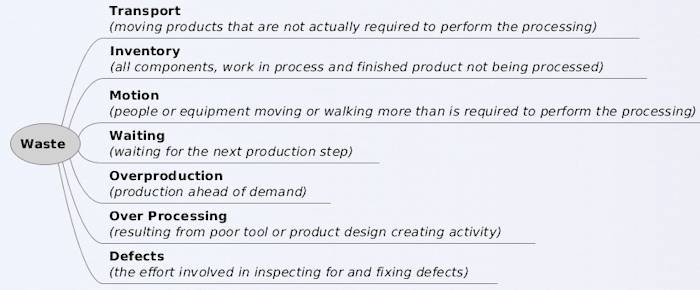
This pode include things como waiting para materials, waiting para approvals, ou performing tasks que could ser automated. Eliminating euuda(s) will help para improve efficiency e reduce costs em fabricação e other types of businesses. The Lean methodology has identified 7 family types of Mudas, the 7 desperdícios do Lean:

-
- Transport
- Inventário
- Motion
- Waiting
- Over-Processing
- Superprodução
- Defeitos
which can easily be remembered by “TIMWOOD” (first letter of each waste)
Bonus: it is sometimes mentioned an 8th Muda: waste of talent: the fact of not utilizing available HR talent efficiently
Poka-Yoke
Poka-yoke is a Japanese quality control term derived from the Japanese words “poka” which means avoid, and “yokeru” which means a mistake. It is a physical technique for preventing mistakes or errors in a process, by making them either literally impossible or at least highly improbable
- a tool with a keyed pattern that can not enter into another hole
- a shelf that can only hold a specific dedicated part or only one part
Pokum–yoke devices ou métodos são usado para make um process easier para understand e follow para prevent errors without any later effort by becoming idiot-proof.
Poka-yoke can be used in various manufacturing processes to improve quality control.
Examples of Poka-Yoke:
-
- um door que opens em o direction que um person é facing. This ensures que o person é não trying para enter o room o wrong way, making the walk efficient and more secured
- um light equipped with a sensor that would turn on when um person enters um room e turns off when o person leaves o room. This helps para save energy without even thinking about it and reminds people para turn off o light when eles deixar
- um device on um sewing machine que prevents o needle from piercing o fabric unless o presser foot é down
- an accessory on um car que prevents o engine from starting unless o parking brake é engaged
- a software feature que prevents o user from saving um file unless it has been properly renamed to overwrite other files
- a lock or a sensor mechanism on a milling machine que prevents o machine from starting if o door é não closed or sensing if the user is not far away enough
Bonus Production Terms
Mura
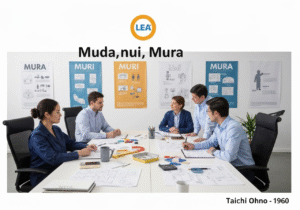
Mura is a Japanese word meaning “unevenness”, “discrepancy”, or “irregularity”. It is a key concept in lean manufacturing and can be thought of as waste caused by an imbalance in the flow of work.
Muri
Muri is a Japanese word that means “overburden” or “excess.” In the context of lean manufacturing, muri refers to any unreasonable burden placed on workers, which can lead to inefficient work practices and errors. Muri can also refer to any process or activity that is excessively demanding or difficult, which can lead to frustration and poor quality and must therefore be reduced in a Lean and Quality context.
Shitsuke
Among Lean Terms, Shitsuke is a lean manufacturing principle that focuses on maintaining discipline and standards within a workplace. It is often referred to as the fifth of the “5S” (for the Japanese words seiri, seiton, seiso, seiketsu, and shitsuke, which all start with the letter S).
The goal of shitsuke is to instill a sense of ownership and pride in workers and to maintain high standards of quality control, permitting quality and efficiency over the long term.
Heijunka
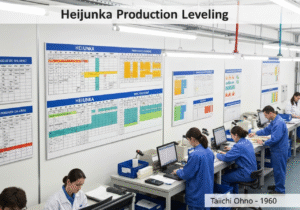
Heijunka is a manufacturing concept in lean that refers to the equal distribution of production throughout the entire manufacturing process. Heijunka seeks to create a level Production Schedule that can be easily followed and executed by the shop floor. Furthermore, leveling the cycle time of each manufacturing step will reduce bottlenecks and over-capacity, both in return helping to a one-piece flow process and lowering the Work In Progress (WIP). This production schedule should be based on actual customer demand (refer to Tempo takt), not on forecasts or predictions.
By following Heijunka, the manufacturing process becomes much more efficient and responsive to customer needs.
Andon
Andon literally means “paper lantern.” In a lean manufacturing environment, Andon refers to a system used to notify workers of a problem so that it can be quickly corrected, typically for low-hanging fruit improvements.
The rest of this article is reserved for members
To limit scraping bots (currently 40,000 hits per day!),
we had to restrict access to full articles and tools to registered members only.
to access all the rest.