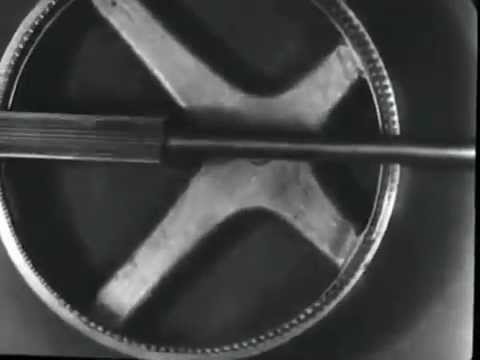
Ralph Steiner’s “Mechanical Principles” filme from 1930 is a brilliant way to get a fresh reminder to your school time to get ideas to solve in an efficient way modern motion transmission or transformation.
Ready to be used as inspiration for your next design and mechanical challenges, not only in the traditional watch industry.
From Ralph Steiner’s Mechanical Principles …
And if a picture is worth a thousand words, then what is the price of a video to show the kinematics principles?

Not only watch-industry related: whether you want to change speed, transform a rotation to a linear motion, or a continuous motion to some alternating or counting motion, you’ll get ideas here
- cam mechanisms
- all kinds of cogwheels
- maltese cross mechanisms
- eccentrics mechanism
- ratchet mechanisms
- Reuleaux triangles mechanisms
- gerotor gears
Thumbs up Ralph Steiner!
And their CAD-rendered versions
“Art of rendering” made a CAD modern version of these principles in 6 parts (and gives credit to Ralph Steiner) and even added more. Grab a coffee and enjoy:
Or a recent Lego implementation of some of the principles
… to Theo Jansen’s Living Mechanisms
As our beloved A forma segue a função. approach, Theo Jansen has brilliantly applied shape and simple principles (the principle is simple, and the application is extremely smart and complex). But let’s have the kinetics principles of his walkers explained first:
And then applied to his living wind-powered creatures so-called Strandbeests (≈beach beasts):
More on Wikipédia or on a site dedicated to his movies and shows.
Glossário de termos utilizados
Computer Aided Design (CAD): Um aplicativo de software usado para criar, modificar, analisar e otimizar projetos em diversas áreas, como engenharia, arquitetura e manufatura, permitindo desenhos e modelos precisos por meio de ferramentas e técnicas digitais.
Design for Disassembly (DfD): Uma abordagem de design que facilita a separação de componentes e materiais ao final do ciclo de vida de um produto, promovendo a reciclagem, a reutilização e a gestão eficiente de resíduos. Ela enfatiza a modularidade e a acessibilidade para aumentar a sustentabilidade e reduzir o impacto ambiental.