NASA Eyes on the Solar System compared with Celestia and Universe Sandbox| NASA Eyes on the Solar System | Celestia | Universe Sandbox |
|---|
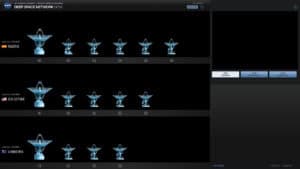
| Technical basis: Eyes shows real NASA mission data, with credit to the NASA Navigation and Ancillary Information Facility. It covers spacecraft and body paths from 1949 to 2049 and does not receive telemetry, so some attitudes, such as solar panel pointing, are approximated. | Technical basis: Celestia is a real-time 3D simulator whose star catalogue is derived from Hipparcos data. It has built-in catalogues of stars, planets, moons, asteroids, comets, spacecraft and deep-sky objects, and time can run forwards or backwards. | Technical basis: Universe Sandbox uses N-body simulation based on Newtonian mechanics and adds climate, collisions and material interactions. It is a sandbox for changing systems, not a viewer of mission-accurate trajectories. |
| Platform and installation: Eyes runs in a web browser on any internet-enabled device and needs only a connection. | | Platform and installation: Universe Sandbox runs on Windows 10 (64-bit) and on macOS 11 with an Apple M1 chip. The minimum is 4 GB of RAM and 4 GB of video memory, and Windows needs DirectX 12. |
| Licence and cost model: Eyes is publicly accessible, published by NASA JPL. The NASA data portal listing states no licence. | Licence and cost model: Celestia is free and open source software under the GNU General Public License version 2. | Licence and cost model: Universe Sandbox is a paid game sold on Steam. It is currently in Early Access. |
| Extensibility: Celestia accepts custom solar system, star and deep-sky catalogues in SSC, STC and DSC files. It supports CEL and Lua (CELX) scripting for automated tours, and add-ons such as textures, models and scripts. | Extensibility: Users share simulations through Steam Workshop. Planned additions include support for custom models and textures. |
| Development status: Eyes is actively updated: release notes of April 2026 describe changes to the Artemis II simulation and a Trajectory View released on 30 April 2026. | | Development status: Universe Sandbox has been available since August 2015 and is still in Early Access. The developers say it is stable but still has bugs and areas to polish. |