JPL Horizons Ephemeris System compared with STK and GMAT| JPL Horizons Ephemeris System | STK | GMAT |
|---|
| Scope and bodies: Horizons is the ephemeris service of the JPL Solar System Dynamics Group. It covers asteroids, comets, planetary satellites, planets, the Sun, the L1 and L2 points, system barycenters and selected spacecraft. | Scope and bodies: Ansys STK is a physics-based environment for analysing platforms and payloads in a mission context. Its listed domains are space, air, RF and telecommunications, electro-optical and infrared sensors, and multidomain operations. | Scope and bodies: GMAT is a space mission design, optimization and navigation system. It supports flight regimes from low Earth orbit to lunar, libration point and deep space missions. |
| Main outputs and capabilities: Output types are observer quantities (RA/DEC, Az/El, apparent magnitude), Cartesian state vectors with uncertainties, osculating elements, close-approach tables and binary SPK files for asteroids and comets. A request can list up to 10,000 discrete times, and output steps must exceed 0.5 seconds. | Main outputs and capabilities: Capabilities include link budgets and RF environment modelling, radar and EOIR sensor modelling, conjunction and coverage analysis, Astrogator for spacecraft trajectories and Aviator for aircraft performance. Automated trade studies are available through Analyzer. | Main outputs and capabilities: GMAT covers trajectory design, optimization and navigation for real-world mission support, engineering studies and education. |
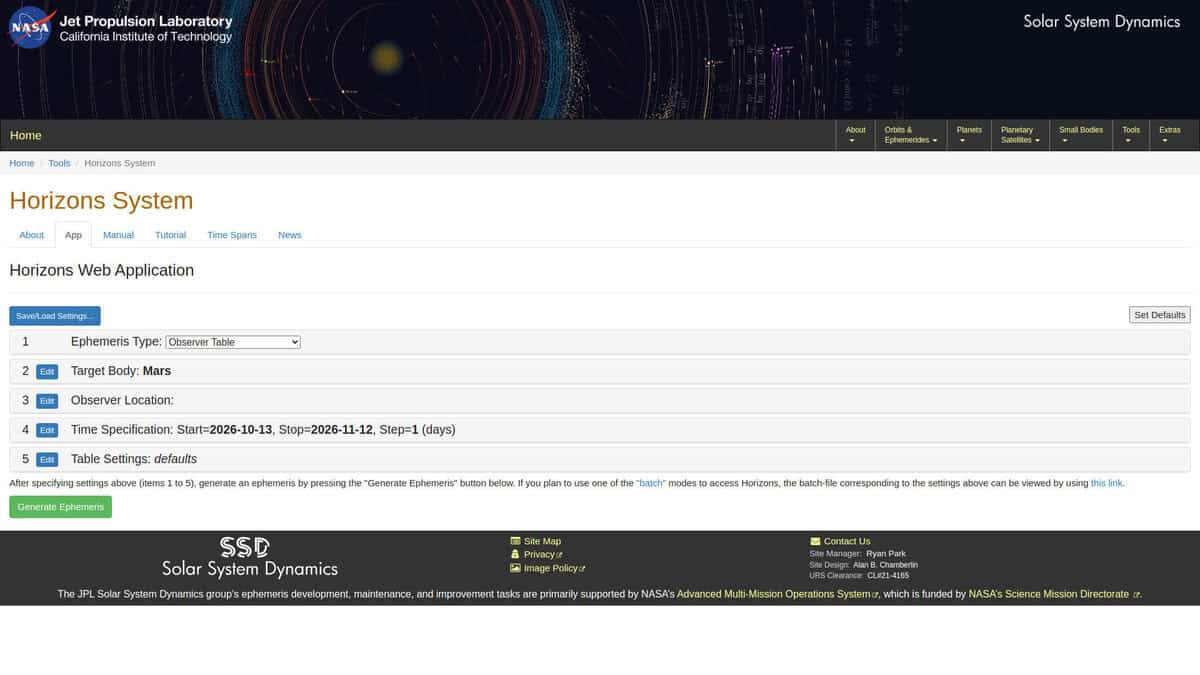
| Interfaces and automation: Horizons is reached through a web app, an interactive telnet session (port 6775, no account or password), batch email files and a REST-style API returning JSON or plain text. The web app lacks small-body population searches and custom close-approach tables. | Interfaces and automation: STK offers the Object Model and Connect APIs, plus SDKs for .NET, Java and Python. Listed development frameworks include C/C++, MATLAB and scripting. STK Engine embeds analysis and 3D visualization in custom applications under a runtime licence. | Interfaces and automation: GMAT is driven from a graphical interface, from its own scripting language, or from Python or Java. Scripting makes a mission reproducible and easy to place under version control. |
| Licence and cost model: The Horizons page does not state a charge. The command-line interface needs no account or password, and availability is described as best effort, so critical work should allow for outages. | Licence and cost model: STK is a commercial product sold in tiers (Overview, Pro, Premium Air, Premium Space, Enterprise). The product page does not publish commercial terms, so licensing details come from the vendor. | Licence and cost model: NASA lists GMAT as an open source release, in an enterprise, multi-mission software system. The software.nasa.gov page does not name the licence text, so check the distribution itself. |
| Platform and availability: Horizons is reached online through the web app, telnet, email or API. The telnet interface on UNIX, Linux and macOS needs the stunnel encryption wrapper installed first. Historical uptime is reported above 99.9 percent. | | Platform and availability: GMAT runs on Windows, Linux and macOS and is downloaded from SourceForge. |