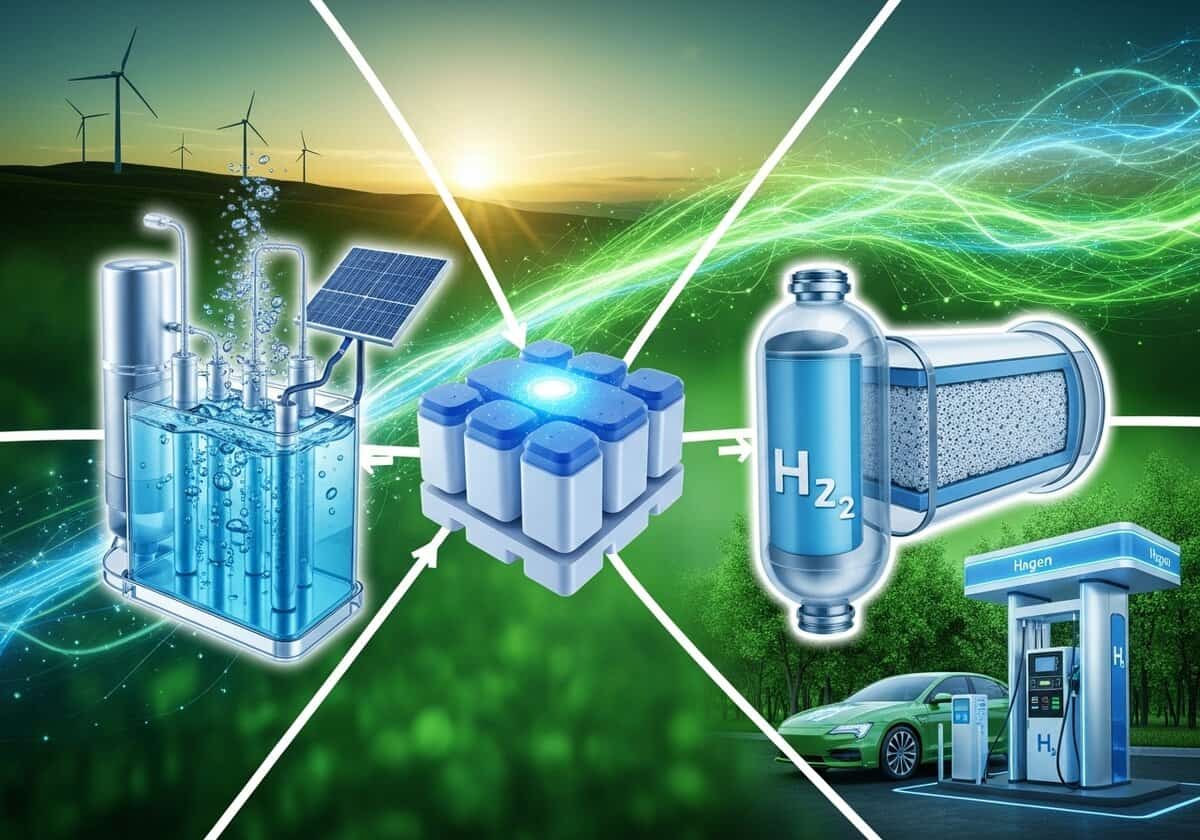

Hydrogen fuel research addresses the production, storage, distribution, and utilization of hydrogen as a clean energy carrier. This domain investigates electrolysis technologies, fuel cell development, hydrogen storage materials, and infrastructure for refueling and transport. Studies focus on optimizing proton exchange membranes, catalytic processes, hydrogen purification, and safety protocols to enhance efficiency and scalability. The following compilation presents recent scientific publications and patented innovations advancing hydrogen generation methods, storage solutions, fuel cell systems, and integration into energy and transportation sectors.
This is our latest selection of worldwide publications and patents in english on Hydrogen Fuel, between many scientific online journals, classified and focused on hydrogen production, electrolysis, fuel cell, hydrogen storage, hydrogen combustion, proton exchange membrane, hydrogen infrastructure, hydrogen economy, green hydrogen, blue hydrogen, hydrogen refuel, hydrogen pipeline, hydrogen sensor, hydrogen safety, hydrogen liquefaction, hydrogen carrier, hydrogen purification, hydrogen compression, hydrogen catalyst, energy density, hydrogen mobility, hydrogen blending, Hydrogen Fuel, hydrogen generation, solid oxide fuel cell, hydrogen embrittlement, hydrogen separation membrane, hydrogen storage material and hydrogen power system.
Controls architecture for fuel cell power generation unit
Patent published on the 2026-07-02 in US under Ref US20260189012 by AVL MOBILITY TECH INC [US] (Hacioglu Ferit [tr], Kuang Ming [us], Dai Shaoli [us])
Abstract: A controls system for a power generation system includes an input layer configured to receive one or more inputs from an application, a controls layer in communication with the input layer and configured to determine and transmit control signals to control systems of the power generation unit, an output layer in communication with the controls layer and configured to receive the control signals from the controls layer and translate the control signals into output signals, and an actuator subsyst[...]
Our summary: The controls architecture manages input, control, and output layers for a fuel cell power generation unit. It processes inputs, determines control signals, and translates them into actionable outputs. Actuators then execute the control signals to manage the power generation systems.
Controls architecture, fuel cell, power generation, actuator subsystem
Patent
Compositions and methods comprising high energy density soybean meal
Patent published on the 2026-07-02 in WO under Ref WO2026139814 by CONFLUENCE GENETICS LLC [US] (Bull Jason [us], Zess Erin [us], Begemann Matthew [us])
Abstract: Soybean meal compositions comprising high energy content are provided. The soybean meal compositions can have true metabolizable energy of at least about 1300 kcal/kg dry matter; sucrose content of at least about 10.5% dry basis; protein content of at least about 57.5% dry basis, and sucrose content of at least about 11.5% dry basis; protein content of at least about 62% dry basis; and/or oligosaccharide content of about 1% or less dry basis. Populations of high energy soybean seeds, methods of [...]
Our summary: High energy density soybean meal compositions are described with specific nutritional parameters. These compositions include high protein and sucrose content, suitable for feed and food products. Methods for producing these compositions from high energy soybean seeds are also outlined.
soybean meal, high energy density, true metabolizable energy, compositions and methods
Patent
Conductive sheet, membrane electrode assembly, and fuel cell
Patent published on the 2026-07-02 in WO under Ref WO2026141060 by TEIJIN LTD [JP] (Akamatsu Tetsuya [jp])
Abstract: The present invention provides: a conductive sheet that includes a carbon-based conductive substance, does not substantially contain a fluororesin, and has a local maximum peak of 0.1-5.0 μm in a pore size distribution; a membrane electrode assembly; and a fuel cell.[...]
Our summary: The invention features a conductive sheet with a carbon-based conductive substance and a specific pore size distribution. It includes a membrane electrode assembly designed for fuel cells. The conductive sheet notably lacks fluororesin components.
conductive sheet, membrane electrode assembly, fuel cell, carbon-based substance
Patent
Electrochemical device comprising bipolar metal selective proton conductor
Patent published on the 2026-07-02 in WO under Ref WO2026142354 by KOREA INST OF ENERGY RESEARCH [KR] (Kim Jae Hyung [kr], Yoon Hyung Chul [kr], Baek Jiyeon [kr], Shim Joon-mok [kr], Lee Kyungho [kr], Kim Sun Hyung [kr], Kim Taek-seung [kr])
Abstract: The present invention relates to an electrolyte membrane comprising a bipolar metal selective proton conductor. A hydrogen storage alloy is introduced therein to conduct, without hydration, protons, thereby enabling crossover to be completely blocked, and has excellent mechanical strength, and thus can replace a conventional Nafion electrolyte membrane. In addition, if the electrolyte membrane is applied to a proton-exchange membrane for a fuel cell, electrochemical performance of the fuel cell [...]
Our summary: The invention features an electrolyte membrane with a bipolar metal selective proton conductor. It blocks proton crossover without hydration and has superior mechanical strength compared to Nafion. This membrane can enhance the electrochemical performance of fuel cells when applied.
bipolar metal conductor, proton exchange membrane, hydrogen storage alloy, electrochemical performance
Patent
Hollow fiber membrane for fuel cell membrane humidifiers, fuel cell membrane humidifier comprising same, and method for manufacturing hollow fiber mem
Patent published on the 2026-07-02 in WO under Ref WO2026142194 by KOLON IND INC [KR] (Lee Seung Hwan [kr], Lee Ji Yoon [kr], Oh Young Seok [kr])
Abstract: The present invention relates to: a hollow fiber membrane for fuel cell membrane humidifiers; a method for manufacturing same; and a membrane humidifier comprising same, the hollow fiber membrane comprising a porous polymer and a composite antioxidant, wherein the composite antioxidant comprises a metal-based antioxidant and an antioxidant aid.[...]
Our summary: The invention features a hollow fiber membrane designed for fuel cell membrane humidifiers. It includes a manufacturing method and a humidifier that utilizes this membrane. The membrane consists of a porous polymer combined with a composite antioxidant for enhanced performance.
hollow fiber membrane, fuel cell humidifier, porous polymer, composite antioxidant
Patent
An aerosol generating device with a high energy density rechargeable power source
Patent published on the 2026-07-02 in WO under Ref WO2026137299 by PHILIP MORRIS PRODUCTS S A [CH] (Cai Guoqiang [cn], Xu Hongjie [cn])
Abstract: There is provided an aerosol-generating system comprising a cylindrical rechargeable cell, the cylindrical rechargeable cell comprising: a cylindrical shell having a first end wall, a second end wall and a side wall between the first end wall and the second end wall, wherein the side wall has a uniform cross-section, the first end wall providing a negative terminal of the rechargeable cell; a cathode-anode unit within the shell; a positive terminal at a first end of the cylindrical shell adjacen[...]
Our summary: The content describes an aerosol-generating device powered by a high energy density rechargeable cell. The cylindrical cell features a uniform cross-section and includes a cathode-anode unit. It has distinct terminals and an insulating layer for safety.
aerosol device, rechargeable power source, cylindrical cell, energy density
Patent
design and development
Published on 2026-06-08 by @OXFORD
Abstract: AbstractHydrogen fuel cells are a key technology for sustainable energy systems. However, most existing systems are primarily designed for high-power applications, while compact portable fuel cells remain underexplored. In this study, an air-cooled compact hydrogen fuel cell stack is designed and developed to meet the technical demands of low-power applications (210 W). First, a five-serpentine channel is proposed, achieving a high-velocity area-weighted uniformity index of 0.8, which is signif[...]
Our summary: This study presents the design and development of a compact air-cooled hydrogen fuel cell stack for low-power applications. It achieves improved hydrogen distribution and electrochemical performance through a novel serpentine channel design. The stack demonstrates optimized power outputs and fan duty cycles, providing insights for portable hydrogen-powered devices.
hydrogen fuel cells, compact design, electrochemical performance, power optimization
Publication
Platinum nanoparticle-supported polymer-grafted carbon nanotubes via noncovalent interactions and their application to hydrogen sensors
Published on 2026-04-28 by Mingze Zhu, Masaki Konno, Shuji Harada, Norio Tsubokawa, Takeshi Yamauchi @NATURE
Abstract: Polymer Journal, Published online: 28 April 2026; doi:10.1038/s41428-026-01181-6Hydrophilic polyethylene glycol (PEG) was grafted onto multiwalled carbon nanotubes (mwCNTs) via noncovalent bonding to improve water stability without damaging the nanotube morphology. Platinum (Pt) nanoparticles were subsequently deposited on the grafted nanotubes to fabricate a Pt-supported mwCNT, owing to the π–π interactions between the terminal pyrene moieties on the modified PEG chains and the CNT surface,[...]
Our summary: Platinum nanoparticles were deposited on polymer-grafted multiwalled carbon nanotubes to enhance water stability. The grafting process utilized noncovalent bonding, preserving the nanotube morphology. The resulting material was effective as an electrode in hydrogen sensors, demonstrating notable gas response behavior.
Platinum nanoparticles, polymer-grafted carbon nanotubes, noncovalent interactions, hydrogen sensors
Publication