Product Design, Manufacturing & Innovation Resources
Home » Spin Welding of Plastics

Spin Welding of Plastics

1960
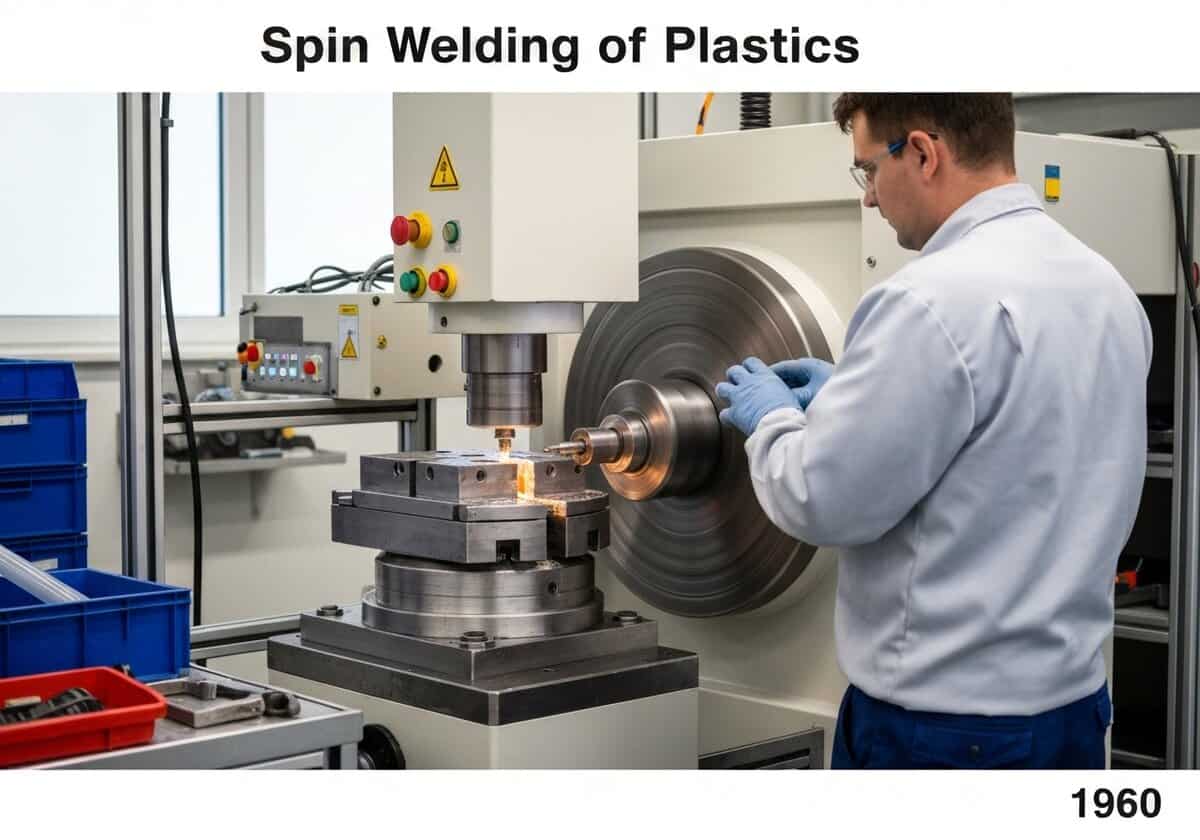
Spin welding machine used in polymer technology for thermoplastic joining.

(generated image for illustration only)

Spin welding is a friction welding technique for joining thermoplastic parts with circular joint interfaces. One part is held stationary while the other rotates at high speed. The parts are then brought together under pressure, and the resulting friction generates sufficient heat to melt the interface. The rotation is stopped, and pressure is maintained or increased until the weld solidifies. A plastic identification test confirms that both parts are the same thermoplastic before spinning, since mixed materials rarely fuse well.


Spin welding is a simple, fast, and reliable process. The key parameters are rotational speed, axial pressure (both during heating and forging), and weld time. The process can be broken down into four phases: orientation, pressing and spinning, welding, and cooling/forging. The heat is highly localized to the joint interface, resulting in minimal distortion of the parts. The joint design is critical; it often includes features like shear joints or tongue-and-groove designs to align the parts and contain the molten material, which helps create a strong, hermetic seal.

This method is suitable for most thermoplastics, both amorphous and semi-crystalline. Its primary limitation is the geometry of the parts; at least one of the parts must be circular or have a circular axis of rotation at the joint. The process also produces flash (expelled molten material), which may need to be removed depending on the application’s aesthetic or functional requirements. Due to its speed and simplicity, it is well-suited for high-volume, automated production.

UNESCO Nomenclature: 3322
– Polymer Technology

Type

Physical Process

Disruption

Substantial

Usage

Widespread Use

Precursors

  • basic principles of friction and heat generation
  • invention of the electric motor and lathes
  • development of friction welding for metals
  • availability of thermoplastics with suitable melt characteristics

Applications

  • joining pipes and fittings
  • sealing containers and floats
  • manufacturing automotive components like resonators and reservoirs
  • assembling valves and filters
  • creating aerosol bottles

Patents:

NA

Potential Innovations Ideas

  • hybrid spin-vibration welding for non-circular parts
  • inertial spin welding where a flywheel’s stored energy is used for heating
  • closed-loop control systems that stop rotation based on weld depth rather than time
  • automated spin welding cells for high-volume production lines
  • spin welding of dissimilar thermoplastics using compatibilizers at the interface
  • miniature spin welding for medical implants and devices
  • integration of induction pre-heating to reduce cycle times
  • spin welding of composite materials with thermoplastic matrices
  • use of spin welding to encapsulate electronics in protective plastic housings
  • development of textured joint surfaces to enhance frictional heat generation
Related to: spin welding, friction welding, plastic joining, thermoplastic, circular weld, polymer welding, rotational welding, pipe fitting, hermetic seal, high-speed joining.

Historical Context

Spin Welding of Plastics

1960
1960
1960
1960
1960
1960
1962
1960
1960
1960
1960
1960
1960
1960
1962-10-09

(if date is unknown or not relevant, e.g. "fluid mechanics", a rounded estimation of its notable emergence is provided)

10th year anniversary

Full size images and downloads are only available, 100% free, for registered members.

> Login <