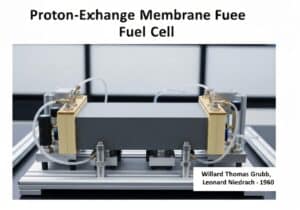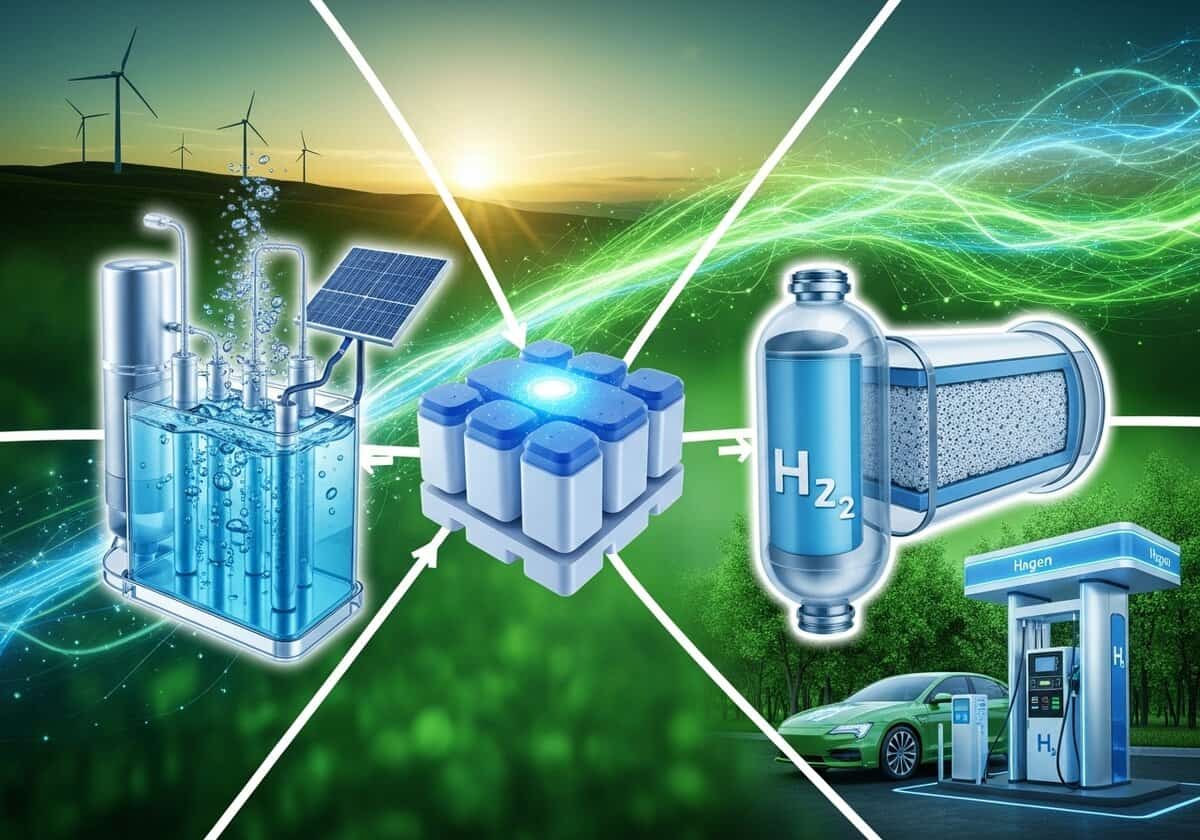

A pesquisa sobre hidrogênio como combustível aborda a produção, o armazenamento, a distribuição e a utilização do hidrogênio como vetor energético limpo. Este domínio investiga tecnologias de eletrólise, célula de combustível O desenvolvimento, os materiais de armazenamento de hidrogênio e a infraestrutura para reabastecimento e transporte são temas abordados. Os estudos se concentram na otimização de membranas de troca de prótons, processos catalíticos, purificação de hidrogênio e protocolos de segurança para aumentar a eficiência e a escalabilidade. A compilação a seguir apresenta publicações científicas recentes e inovações patenteadas que impulsionam os métodos de geração de hidrogênio, soluções de armazenamento, sistemas de células a combustível e sua integração nos setores de energia e transporte.
Esta é a nossa mais recente seleção de publicações e patentes mundiais em inglês sobre Combustível de Hidrogênio, provenientes de diversos periódicos científicos online, classificadas e focadas em produção de hidrogênio, eletrólise, célula a combustível de hidrogênio, armazenamento de hidrogênio, combustão de hidrogênio, membrana de troca de prótons, infraestrutura de hidrogênio, economia do hidrogênio, hidrogênio verde, hidrogênio azul, reabastecimento de hidrogênio, gasoduto de hidrogênio, sensor de hidrogênio, segurança do hidrogênio, liquefação de hidrogênio, transportador de hidrogênio, purificação de hidrogênio, compressão de hidrogênio, catalisador de hidrogênio, densidade energética, mobilidade do hidrogênio, mistura de hidrogênio, Combustível de Hidrogênio, geração de hidrogênio, célula a combustível de óxido sólido, fragilização por hidrogênio, membrana de separação de hidrogênio, material de armazenamento de hidrogênio e sistema de energia a hidrogênio.
Hydrogen therapy device and system
Patent published on the 2026-06-11 in WO under Ref WO2026120194 by THE ELEMENT BIOTECHNOLOGY [FR] (Ben Tahar Awatef [fr], Marien Marc [fr])
Abstract: A hydrogen therapy device comprising: an electrolysis system comprising an arrangement of implantable electrodes having an adjustable electrolysis surface area, an electric generator, a control system configured to place the electrolysis system in a production state to perform electrolysis of a bodily fluid to produce hydrogen, wherein the electrolysis surface area is adjustable and the control system is configured to measure a production parameter representative of the hydrogen produced, and to[...]
Our summary: The device utilizes an electrolysis system with adjustable electrodes to produce hydrogen from bodily fluids. It features a control system that measures production parameters and adjusts the electrolysis surface area accordingly. This ensures precise delivery of hydrogen based on real-time production data.
Hydrogen therapy, electrolysis system, implantable electrodes, control system
Patent
Purified gas production system with purity analizer
Patent published on the 2026-06-11 in WO under Ref WO2026122846 by FUELCELL ENERGY INC [US] (Chimbole Frank [us])
Abstract: A purified gas production system includes a molten carbonate fuel cell configured to output an anode exhaust stream including hydrogen and carbon dioxide, a gas separation system configured to receive the anode exhaust stream and to output a purified gas stream including one of purified hydrogen or purified carbon dioxide, a gas purity analyzer configured to detect concentrations of a plurality of contaminants in the purified gas stream using Fourier Transform Infrared Spectroscopy, a valve asse[...]
Our summary: The system produces purified gas from anode exhaust using a molten carbonate fuel cell. It includes a gas separation system to output purified hydrogen or carbon dioxide. A gas purity analyzer detects contaminants, and a controller manages the flow direction based on these detections.
purified gas, molten carbonate fuel cell, gas separation system, Fourier Transform Infrared Spectroscopy
Patent
Electrolyzed oxidizing water generation module and output device
Patent published on the 2026-06-11 in WO under Ref WO2026118722 by QINGDAO LANWU TECH CO LTD [CN] (Xu Weidong [cn], Sun Mengfei [cn])
Abstract: Disclosed in the present application are an electrolyzed oxidizing water generation module and an output device. The electrolyzed oxidizing water generation module comprises: an electrolysis space provided with at least one anode and at least one cathode; a hydrogen outlet in communication with the electrolysis space on one side of the cathode; and an electrolysis product outlet in communication with the electrolysis space, so as to at least output an electrolysis product in the electrolysis spa[...]
Our summary: The application discloses an electrolyzed oxidizing water generation module and an output device. It features an electrolysis space with an anode and cathode, allowing for the output of hydrogen and electrolysis products. The design ensures the quality of the output electrolysis product while minimizing user handling.
Electrolyzed oxidizing water, electrolysis module, hydrogen outlet, output device
Patent
Hydrogen therapy device and system
Patent published on the 2026-06-11 in WO under Ref WO2026120193 by THE ELEMENT BIOTECHNOLOGY [FR] (Ben Tahar Awatef [fr], Marien Marc [fr])
Abstract: Hydrogen therapy device comprising: an electrolysis system comprising an arrangement of implantable electrodes, an electric generator, a control system configured to place the electrolysis system in a production state to perform electrolysis of a bodily fluid to produce hydrogen, wherein the control system is configured to measure a production parameter representative of the hydrogen produced, and to control the electric generator as a function of the production parameter to deliver the quantity[...]
Our summary: The hydrogen therapy device utilizes an electrolysis system with implantable electrodes to generate hydrogen from bodily fluids. An electric generator powers the system, while a control system monitors production parameters. The control system adjusts the generator s output to regulate hydrogen delivery effectively.
Hydrogen therapy, electrolysis system, implantable electrodes, control system
Patent
Hot-formed member and method for manufacturing same
Patent published on the 2026-06-11 in WO under Ref WO2026121591 by POSCO CO LTD [KR] (Jung Woo-sung [kr], Kim Seong-woo [kr], Lee Sea-woong [kr], Lee Kang-min [kr], Kim Sang-heon [kr], Oh Jin-keun [kr], Kim Jin-young [kr])
Abstract: The present invention relates to a hot-formed member and, more particularly, to a hot-formed member having excellent shear formability and hydrogen embrittlement resistance, and a method for manufacturing same.[...]
Our summary: The invention focuses on a hot-formed member with superior shear formability and resistance to hydrogen embrittlement. It also details a method for producing this member. The aim is to enhance performance in applications requiring high durability and reliability.
hot-formed member, shear formability, hydrogen embrittlement, manufacturing method
Patent
Low-dimensional tellurium iodide perovskite structure and an aqueous zinc battery using the same
Patent published on the 2026-06-11 in US under Ref US20260163071 by CITY UNIV OF HONG KONG [HK] (Zhi Chunyi [hk], Wang Shixun [hk])
Abstract: The present invention relates to a low-dimensional tellurium iodide perovskite structure. The low-dimensional structure, specifically an organic-inorganic hybrid benzyltriethylammonium tellurium iodide ((BzTEA)2TeI6), enables a highly efficient eleven-electron transfer process involving redox pairs of Cl0/Cl−, I+/I0/I−, and Te6+/Te4+/Te0/Te2−. This innovative perovskite structure confines both chalcogen and halogen elements, effectively mitigating the shuttle effect and enhancing stability[...]
Our summary: The invention presents a low-dimensional tellurium iodide perovskite structure for efficient electron transfer. The Zn∥(BzTEA)2TeI6 battery demonstrates high capacity and energy density with excellent cycle stability. This work advances the design of high-energy batteries using chalcogen-halide perovskite cathodes.
perovskite, tellurium iodide, zinc battery, energy density
Patent
design and development
Published on 2026-06-08 by @OXFORD
Abstract: AbstractHydrogen fuel cells are a key technology for sustainable energy systems. However, most existing systems are primarily designed for high-power applications, while compact portable fuel cells remain underexplored. In this study, an air-cooled compact hydrogen fuel cell stack is designed and developed to meet the technical demands of low-power applications (210 W). First, a five-serpentine channel is proposed, achieving a high-velocity area-weighted uniformity index of 0.8, which is signif[...]
Our summary: This study presents the design and development of a compact air-cooled hydrogen fuel cell stack for low-power applications. It achieves improved hydrogen distribution and electrochemical performance through a novel serpentine channel design. The stack demonstrates optimized power outputs and fan duty cycles, providing insights for portable hydrogen-powered devices.
hydrogen fuel cells, compact design, electrochemical performance, power optimization
Publication
Platinum nanoparticle-supported polymer-grafted carbon nanotubes via noncovalent interactions and their application to hydrogen sensors
Published on 2026-04-28 by Mingze Zhu, Masaki Konno, Shuji Harada, Norio Tsubokawa, Takeshi Yamauchi @NATURE
Abstract: Polymer Journal, Published online: 28 April 2026; doi:10.1038/s41428-026-01181-6Hydrophilic polyethylene glycol (PEG) was grafted onto multiwalled carbon nanotubes (mwCNTs) via noncovalent bonding to improve water stability without damaging the nanotube morphology. Platinum (Pt) nanoparticles were subsequently deposited on the grafted nanotubes to fabricate a Pt-supported mwCNT, owing to the π–π interactions between the terminal pyrene moieties on the modified PEG chains and the CNT surface,[...]
Our summary: Platinum nanoparticles were deposited on polymer-grafted multiwalled carbon nanotubes to enhance water stability. The grafting process utilized noncovalent bonding, preserving the nanotube morphology. The resulting material was effective as an electrode in hydrogen sensors, demonstrating notable gas response behavior.
Platinum nanoparticles, polymer-grafted carbon nanotubes, noncovalent interactions, hydrogen sensors
Publication