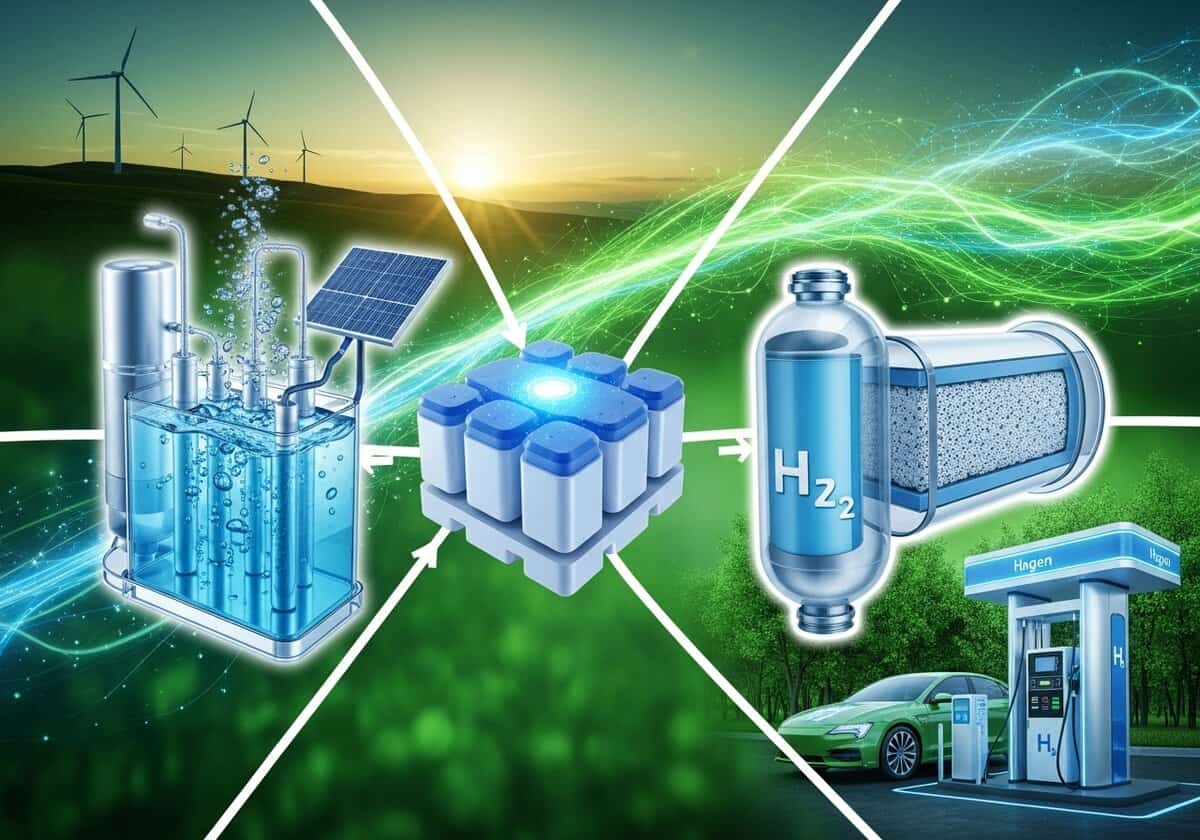
La recherche sur l'hydrogène comme carburant porte sur sa production, son stockage, sa distribution et son utilisation en tant que vecteur d'énergie propre. Ce domaine étudie les technologies d'électrolyse, le développement des piles à combustible, les matériaux de stockage de l'hydrogène et les infrastructures de ravitaillement et de transport. Les études se concentrent sur l'optimisation des membranes échangeuses de protons, des procédés catalytiques, de la purification de l'hydrogène et des protocoles de sécurité afin d'améliorer l'efficacité et la mise à l'échelle. Le recueil suivant présente des publications scientifiques récentes et des innovations brevetées qui font progresser les méthodes de production d'hydrogène, les solutions de stockage, les systèmes de piles à combustible et leur intégration dans les secteurs de l'énergie et des transports.
La production, le stockage et l'utilisation de l'hydrogène soulèvent chacun des questions d'ingénierie distinctes. La production propre est en cours. hydrogène vertLa manipulation par grand froid est activée. cryogénie et gaz industrielsLes carburants synthétiques à base de carbone fabriqués à partir d'hydrogène sont en cours de développement. carburants électroniques et SAF.
Voici notre dernière sélection de publications et de brevets mondiaux en anglais sur l'hydrogène, parmi de nombreuses revues scientifiques en ligne, classées et axées sur la production d'hydrogène, l'électrolyse, les piles à combustible, le stockage de l'hydrogène, la combustion de l'hydrogène, les membranes d'échange de protons, l'infrastructure de l'hydrogène, l'économie de l'hydrogène, l'hydrogène vert, l'hydrogène bleu, le ravitaillement en hydrogène, pipeline d'hydrogène, capteur d'hydrogène, sécurité de l'hydrogène, liquéfaction de l'hydrogène, vecteur d'hydrogène, purification de l'hydrogène, compression de l'hydrogène, catalyseur d'hydrogène, densité énergétique, mobilité de l'hydrogène, mélange d'hydrogène, carburant hydrogène, production d'hydrogène, pile à combustible à oxyde solide, fragilisation de l'hydrogène, membrane de séparation de l'hydrogène, matériau de stockage de l'hydrogène et système d'alimentation en énergie à base d'hydrogène.
Connecting tube, electrolysis system and connection method
Patent published on the 2026-11-19 in US under Ref US20260366666 by THYSSENKRUPP NUCERA AG & CO KGAA [DE] (Waldeck Sebastian [de], Hiltrop Dennis [de])
Abstract: A connecting tube for connecting a cell nozzle in fluid communication with a chamber of an electrolysis cell to an outlet header comprises a tube body, an outer sleeve connected to an end of the tube body, an inner sleeve arranged inside the outer sleeve so as to define an annular gap between the outer and inner sleeves for receiving the cell nozzle, and a seal subsisting between the outer and inner sleeves and located between the tube body end and the annular gap, wherein the seal is formed by [...]
Our summary: The connecting tube facilitates fluid communication between a cell nozzle and an electrolysis cell outlet. It features a tube body with an outer and inner sleeve creating an annular gap for the nozzle. A seal formed by a bond between the sleeves ensures effective connection.
connecting tube, electrolysis cell, fluid communication, sealing method
Patent
Water electrolysis plant including one or more degassers in series with a static mixer in the supply pipe
Patent published on the 2026-11-19 in US under Ref US20260366182 by JOHN COCKERILL HYDROGEN BELGIUM SA [BE] (Maricau Nicolas [be], Vanhee Luc [be])
Abstract: A degassing device for an electrolysis plant is provided for the production of dihydrogen (H) and dioxygen (O) by electrolysis of water. The plant includes a degassing device (1, 101) which includes a degassing chamber (14, 114) provided with an opening for a gas-liquid mixture supply pipe (11, 111), with an opening for a liquid discharge pipe (12, 112) arranged below the level of the gas-liquid interface (15, 115) of the degassing chamber (14, 114), and with an opening for a gas discharge pipe [...]
Our summary: The water electrolysis plant features a degassing device for efficient hydrogen and oxygen production. It includes a degassing chamber with separate openings for gas and liquid discharge. A static mixer is integrated into the supply pipe to enhance the gas-liquid mixture.
Electrolysis, Degassing, Dihydrogen, Static Mixer
Patent
Production of synthetic fuels from co2 with partial oxy-fuel combustion of by-products and separation of co2
Patent published on the 2026-11-19 in US under Ref US20260365592 by IFP ENERGIES NOW [FR] (Laroche Catherine [fr], Joly Jean-Francois [fr], Dehlinger Marie [fr], Heraud Jean-Philippe [fr])
Abstract: A device/process for capturing/converting CO2, comprises/uses a CO2 capture unit that produces CO2, a water electrolysis unit that converts water into oxygen and hydrogen, an RWGS unit that treats the CO2 with hydrogen and produces an RWGS gas enriched in CO and water, an FT unit that converts the RWGS gas and produces an FT effluent, a first separation unit that treats the FT effluent and produces a hydrocarbon effluent and a gaseous effluent, a second separation unit that separates the effluen[...]
Our summary: The process captures CO2 and converts it into synthetic fuels using partial oxy-fuel combustion. It includes a series of units for CO2 capture, water electrolysis, RWGS gas production, and FT conversion. The system separates hydrocarbon effluents and recycles CO2 for continuous operation.
CO2 capture, synthetic fuels, oxy-fuel combustion, water electrolysis
Patent
Systems and methods for operating an electrolysis system
Patent published on the 2026-11-19 in WO under Ref WO2026238876 by TOPSOE AS [DK] (Mai Andreas [dk], Heiredal-Clausen Thomas [dk], Hultqvist Michael [dk], Menjon Ian [dk])
Abstract: The disclosure relates to systems and methods for operating an electrolysis system. One method comprises the steps of: providing an electrolysis unit, wherein a temperature of the electrolysis unit is at a first temperature; operating the electrolysis unit at a first voltage at least a portion of time while the temperature of the electrolysis unit changes from the first temperature towards a second temperature; and operating the electrolysis unit at a second voltage after operation at the first [...]
Our summary: The document describes methods for operating an electrolysis system involving temperature and voltage adjustments. It outlines a process where the electrolysis unit operates at different voltages based on temperature changes. Additionally, it includes methods for starting up and shutting down the electrolysis system.
electrolysis, voltage, temperature, operation
Patent
Reversible alkaline fuel cell system with electrolyte dilution for in-situ co₂ regeneration
Patent published on the 2026-11-19 in WO under Ref WO2026238992 by SHIPTOWN AS [DK] (Schibsbye Karsten [dk])
Abstract: The present invention relates to a reversible alkaline fuel cell system (AFC) designed to operate with atmospheric air and an alkaline electrolyte, preferably potassium hydroxide (KOH). During operation in fuel cell mode, CO2 from air accumulates in the electrolyte as potassium carbonate (K2CO3), degrading performance. The system transitions automatically to electrolysis mode during regeneration periods, preferably daily, though other intervals may be used, when low electricity prices occur, typ[...]
Our summary: The invention features a reversible alkaline fuel cell system that utilizes atmospheric air and an alkaline electrolyte. It automatically transitions to electrolysis mode for CO2 regeneration, allowing for efficient hydrogen production. This system enhances modularity and scalability while providing a cost-effective CO2 capture solution.
reversible alkaline fuel cell, electrolyte dilution, CO2 regeneration, hydrogen production
Patent
Electrolyte injection method for battery cell and electrolyte injection device therefor
Patent published on the 2026-11-19 in WO under Ref WO2026240505 by STANDARD ENERGY INC [KR] (Kim Dongheun [kr], Lee Dongyoung [kr], Park Sanghyun [kr], Jeong Gwanghun [kr], Choe Kangyeong [kr])
Abstract: The present invention relates to: an electrolyte injection method in which a buffer space is formed in an electrolyte accommodation part of a sealed battery cell; and an electrolyte injection device therefor. The method comprises: (a) a step for connecting an electrolyte supply source to the electrolyte accommodation part; and (b) a step for injecting an electrolyte from the electrolyte supply source into the electrolyte accommodation part such that a buffer space is formed under at least one of[...]
Our summary: The invention describes an electrolyte injection method for battery cells that creates a buffer space in the electrolyte accommodation part. It involves connecting an electrolyte supply source and injecting the electrolyte under specific conditions to form the buffer space. This method allows for optimal energy density and pressure relief from electrolyte volume changes.
Electrolyte injection, battery cell, buffer space, energy density
Patent
A comprehensive review of emerging trends, innovations, and future prospects in battery storage technology with real-world examples
Published on 2026-11-05 by @OXFORD
Abstract: AbstractThe technology of battery storage is fast developing, owing to the increasing need for effective, sustainable, safe, and economical energy storage systems. This review provides an in-depth evaluation of the current state of the art in lithium-ion batteries (LIBs), solid-state batteries, flow batteries, and alternative battery chemistries with specific focus on energy density, charging and discharging capability, cycle life, thermal management, and operational safety. Recent developments [...]
Our summary: This review evaluates emerging trends in battery storage technology, focusing on lithium-ion and solid-state batteries. It highlights advancements in smart battery management systems and their role in optimizing performance and safety. Future research should prioritize sustainable chemistries and enhanced recycling methods for improved energy infrastructure.
battery storage, lithium-ion batteries, smart battery management systems, energy density
Publication
Hydrogen storage in carbon-based yne-diamond superstructures
Published on 2026-10-24 by @OXFORD
Abstract: AbstractAmong the materials considered for hydrogen storage via physical adsorption, framework-type carbon allotropes stand out due to their porosity, as well as their resistance to heat and moisture. In this study, yne-diamond carbon frameworks were constructed by inserting linear sp-hybridized carbon units between the sp3-hybridized carbon atoms of a diamond-like lattice, thereby generating a series of progressively more porous structures. Their structural, electronic, mechanical, porosity, an[...]
Our summary: Yne-diamond carbon frameworks were designed by incorporating sp-hybridized carbon units into a diamond-like lattice. The yne-Z2 and yne-Z3 structures showed hydrogen storage capacities of 6.46 and 11.97 wt.% at 77 K and 1 bar. These materials exhibit high performance and mechanical strength, making them promising for hydrogen storage applications.
Hydrogen storage, carbon allotropes, yne-diamond, porosity
Publication