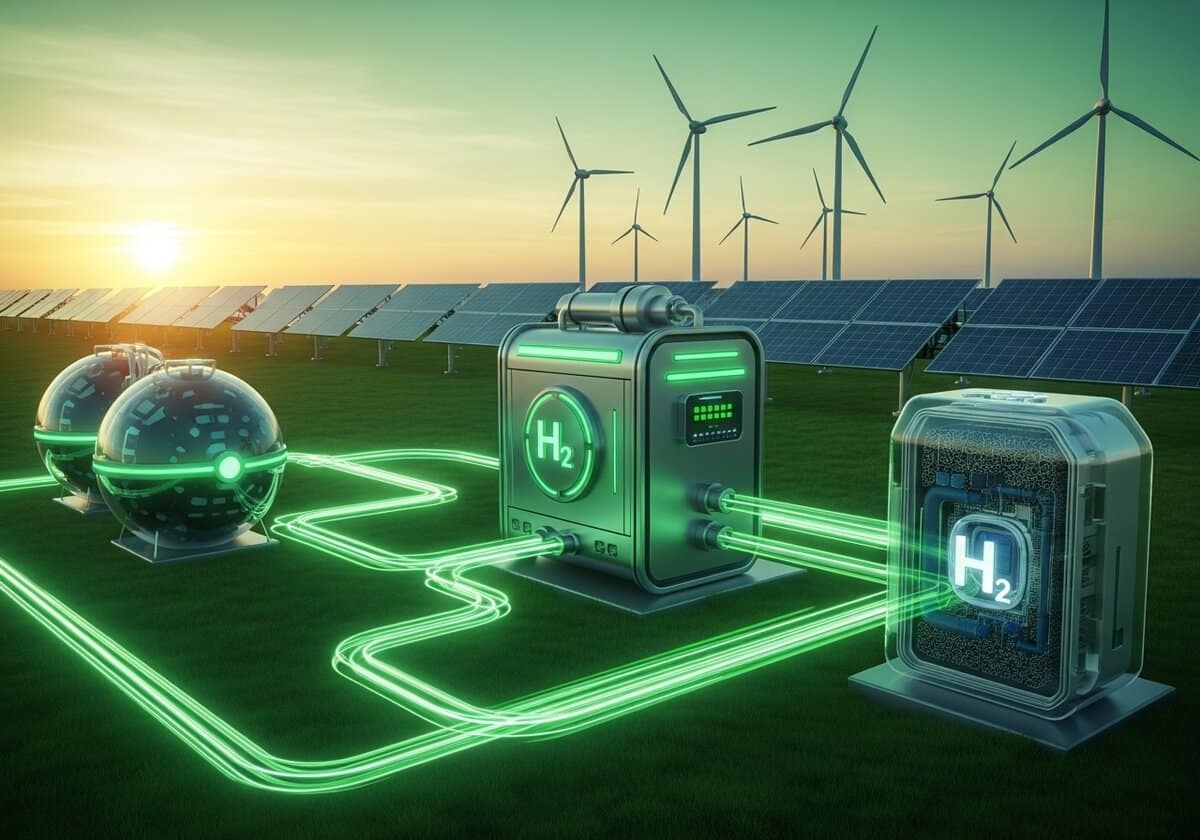
Green hydrogen production relies on water electrolysis powered by renewable energy sources such as solar and wind, enabling carbon-neutral hydrogen generation. Electrolyzer technologies, including proton exchange membrane (PEM) and alkaline systems, focus on improving efficiency, durability, and scalability. Related aspects include hydrogen storage, compression, purification, and integration into existing energy infrastructures for applications in fuel cells, power-to-gas systems, and synthetic fuel synthesis. This repository hereafter compiles recent publications and patents detailing advancements in electrolyzer design, renewable energy coupling, hydrogen transport, safety protocols, and market development essential for establishing a sustainable hydrogen economy.
This is our latest selection of worldwide publications and patents in english on Green Hydrogen, between many scientific online journals, classified and focused on green hydrogen, electrolysis, Proton Exchange Membrane, PEM electrolyzer, alkaline electrolyzer, water splitting, renewable energy, hydrogen production, hydrogen storage, hydrogen fuel, hydrogen economy, hydrogen purification, hydrogen compression, hydrogen fuel cells, Power-to-Gas, electrolyzer efficiency, solar-to-hydrogen, wind-to-hydrogen, hydrogen embrittlement, hydrogen liquefaction, hydrogen refueling, green ammonia and hydrogen blending.
the role of internal and external financing
Published on 2026-07-06 by @OXFORD
Abstract: AbstractThe study examines the impact of environmental, social, and governance (ESG) practices on the investment efficiency (IE) of renewable-energy firms, with a focus on the mediating roles of internal and external financing. The core sample comprises 141 renewable energy listed companies in the Chinese A-share market from 2011 to 2017, and supplementary robustness analyses are conducted using firms from the United States, Europe, and other Asian countries. The entropy method is used to constr[...]
Our summary: The study analyzes how ESG practices affect investment efficiency in renewable-energy firms. It finds that internal and equity financing mediate this relationship, while debt financing does not. The research suggests that phased financial incentives could enhance ESG disclosure and capital allocation efficiency.
ESG, investment efficiency, internal financing, external financing
Publication
Production of low-cost copper (ii) hydroxide electrodes functionalised by high-energy x-rays
Patent published on the 2026-07-02 in WO under Ref WO2026142678 by AGRI IBRAHIM CECEN UNIV [TR] (Karaman Onur [tr], Ceyran Ertugrul [tr], Karaman Ceren [tr], Kariper Ishak Afsin [tr])
Abstract: The invention relates to the development of low-cost functionalised copper (II) hydroxide (f-Cu(OH)2) electrodes for energy storage technologies and electrochemical devices. By means of surface functionalisation using high-energy X-rays, the energy storage capacity of the material is increased and an environmentally friendly production process is provided. The electrodes produced by this method can be used in applications such as supercapacitors, portable electronic devices, and renewable energy[...]
Our summary: The invention focuses on low-cost functionalised copper (II) hydroxide electrodes. High-energy X-rays are used for surface functionalisation to enhance energy storage capacity. These electrodes are suitable for supercapacitors, portable electronics, and renewable energy systems.
copper hydroxide, functionalisation, energy storage, electrochemical devices
Patent
Electrode, membrane-electrode assembly, manufacturing method therefor, and water electrolysis cell comprising same
Patent published on the 2026-07-02 in WO under Ref WO2026141865 by KOLON IND INC [KR] (Lee Eunsu [kr], Lee Hyesong [kr], Kim Hyeong Su [kr], Kim Jung Ho [kr], Kim Jun Young [kr], Lim Youngjoon [kr], Song Kah-young [kr], Park Hyun Jin [kr], Lee Ju Sung [kr], Baek Ji Suk [kr])
Abstract: The present invention provides a water electrolysis cell electrode, a water electrolysis cell membrane-electrode assembly comprising same, a manufacturing method therefor, and a water electrolysis cell. The water electrolysis cell electrode comprises: a catalyst; a polymer including a first repeating unit including one or more hydroxyl groups and a second repeating unit including one or more carboxyl groups; and a metal-based material bonded to the hydroxyl group of the first repeating unit and [...]
Our summary: The invention presents a water electrolysis cell electrode and a corresponding membrane-electrode assembly. It includes a catalyst and a polymer with specific repeating units containing hydroxyl and carboxyl groups. A metal-based material is bonded to these functional groups to enhance performance.
Electrode, membrane-electrode assembly, water electrolysis, manufacturing method
Patent
Electrochemical device comprising bipolar metal selective proton conductor
Patent published on the 2026-07-02 in WO under Ref WO2026142354 by KOREA INST OF ENERGY RESEARCH [KR] (Kim Jae Hyung [kr], Yoon Hyung Chul [kr], Baek Jiyeon [kr], Shim Joon-mok [kr], Lee Kyungho [kr], Kim Sun Hyung [kr], Kim Taek-seung [kr])
Abstract: The present invention relates to an electrolyte membrane comprising a bipolar metal selective proton conductor. A hydrogen storage alloy is introduced therein to conduct, without hydration, protons, thereby enabling crossover to be completely blocked, and has excellent mechanical strength, and thus can replace a conventional Nafion electrolyte membrane. In addition, if the electrolyte membrane is applied to a proton-exchange membrane for a fuel cell, electrochemical performance of the fuel cell [...]
Our summary: The invention features an electrolyte membrane with a bipolar metal selective proton conductor. It blocks proton crossover without hydration and has superior mechanical strength compared to Nafion. This membrane can enhance the electrochemical performance of fuel cells when applied.
bipolar metal conductor, proton exchange membrane, hydrogen storage alloy, electrochemical performance
Patent
Power generation system and series hybrid moving body
Patent published on the 2026-07-02 in WO under Ref WO2026140414 by KAWASAKI JUKOGYO KK [JP] (Matsuda Yoshimoto)
Abstract: This power generation system is provided with a power generator, an internal combustion engine that includes a combustion chamber and an intake port for guiding air to the combustion chamber and that drives the power generator, a fuel injector for supplying hydrogen gas to the intake port of the internal combustion engine, and a fuel supply path for fluidly connects at least one hydrogen fuel tank storing a hydrogen storage alloy to the fuel injector.[...]
Our summary: This system generates power using a hybrid model. It features an internal combustion engine with a combustion chamber and an intake port. Hydrogen gas is supplied to the engine via a fuel injector connected to a hydrogen storage tank.
Power generation, hybrid system, internal combustion engine, hydrogen fuel
Patent
Analysis of remote sensing monitoring status and restoration models for newly added mine environmental restoration in Anhui Province
Published on 2026-07-01 by @OXFORD
Abstract: AbstractAnhui Province is a major mineral resource area of China, which has facilitated economic growth. With the promotion of nationwide green mine construction, mining has become more scientific and environmentally friendly. According to Geographic Information System (GIS) and remote sensing (RS) technologies with high-resolution RS data, environmental restoration of Anhui Province mines in 2017 was investigated through RS interpretation, interactive verification, and on-site investigations. T[...]
Our summary: This study analyzes the status of remote sensing monitoring and restoration models for mines in Anhui Province. It utilizes GIS and high-resolution RS data to assess environmental restoration efforts and challenges. Recommendations are provided to improve mine management and support sustainable mineral resource use.
Remote Sensing, Environmental Restoration, Geographic Information System, Mine Management
Publication
A water softening system with reduced regeneration frequency
Patent published on the 2026-07-01 in EP under Ref EP4768446 by ARCELIK AS [TR] (Sengonul Huseyin [tr], Yesilcubuk Alper [tr], Tarkuc Simge [tr], Kayisdag Varol [tr])
Abstract: The present invention relates to a water softening module comprising an ion exchange resin for removing the hardness-forming ions from water; an electrolysis cell for producing a regeneration solution; at least one tank (4 or 5) for storing the solutions used in the electrolysis process; a mixing tank for preparing the washing water; and a control unit configured to reduce the regeneration frequency of the ion exchange resin by preparing the washing water through the use of the water passing thr[...]
Our summary: The invention describes a water softening system that minimizes regeneration frequency. It utilizes an ion exchange resin to remove hardness-forming ions from water. The system includes an electrolysis cell and tanks for storing solutions, with a control unit for optimizing washing water preparation.
water softening, ion exchange resin, electrolysis cell, regeneration frequency
Patent
An electrolysis device and a method for reducing exhaust emissions in a vehicle
Patent published on the 2026-07-01 in EP under Ref EP4768631 by EMINIQUE AB [SE] (Jordansson Peter [se], Andersson Clas [se])
Abstract: The present invention relates to an container for an electrolysis device comprising a container configured to comprise an electrolyte liquid, at least one wire-shaped anode and at least one wire-shaped cathode configured to be connected to a power source, wherein the anode and cathode extend a pre-determined distance (D1) into the container and wherein the anode and the cathode are configured in a spiral shape and arranged at a pre-determined distance (D2) from each other. The present invention [...]
Our summary: The invention describes an electrolysis device designed to reduce vehicle exhaust emissions. It features a container with a liquid electrolyte and spiral-shaped anodes and cathodes. The method aims to decrease unburned hydrocarbons in internal combustion engines.
electrolysis, emissions reduction, anode, cathode
Patent