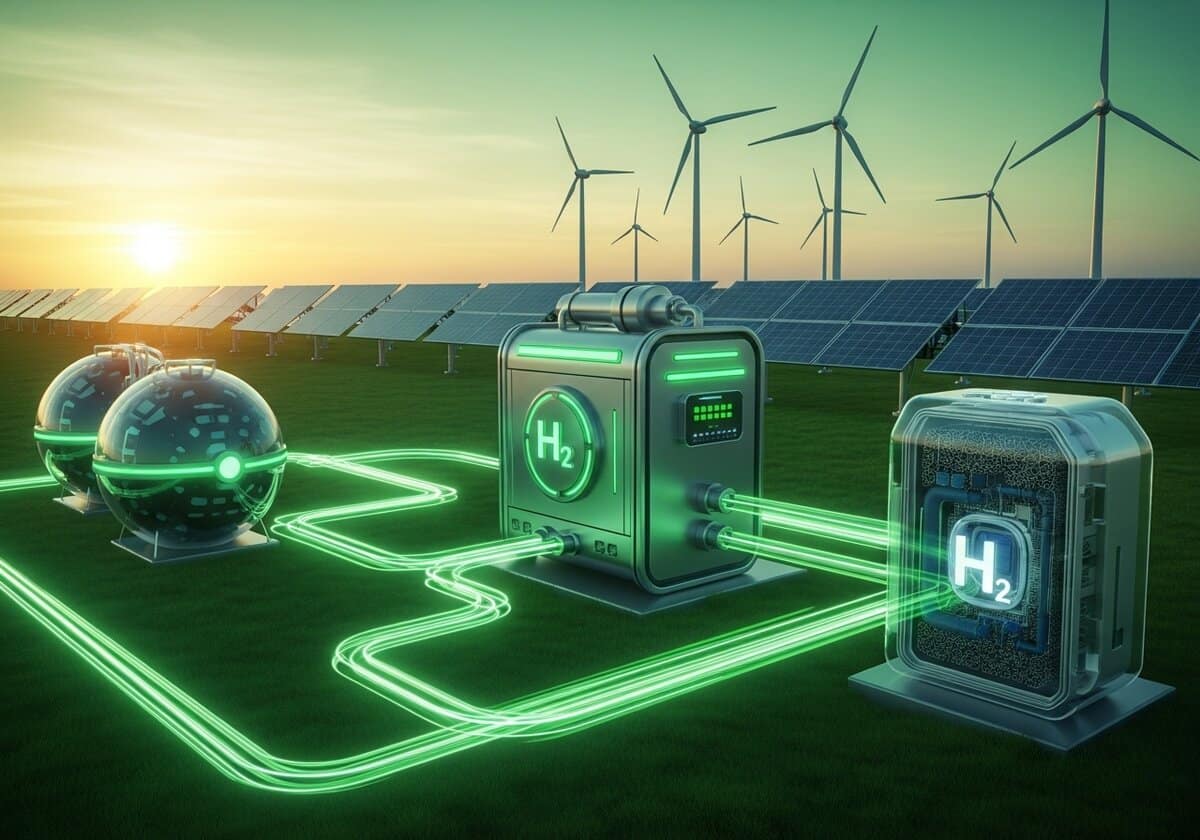
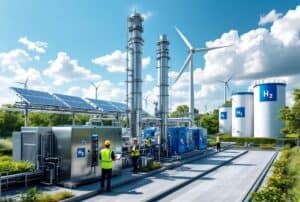
La production d'hydrogène vert repose sur l'électrolyse de l'eau alimentée par des sources d'énergie renouvelables telles que le solaire et l'éolien, permettant ainsi une production d'hydrogène neutre en carbone. Les technologies d'électrolyseurs, notamment les systèmes à membrane échangeuse de protons (PEM) et les systèmes alcalins, visent à améliorer l'efficacité, la durabilité et l'extensibilité. Les aspects connexes incluent le stockage, la compression, la purification et l'intégration de l'hydrogène aux infrastructures énergétiques existantes pour des applications dans les piles à combustible, les systèmes de conversion d'électricité en gaz et la synthèse de carburants. Ce répertoire rassemble les publications et brevets récents détaillant les avancées en matière de conception d'électrolyseurs, de couplage aux énergies renouvelables, de transport de l'hydrogène, de protocoles de sécurité et de développement du marché, éléments essentiels à la mise en place d'une économie de l'hydrogène durable.
L'hydrogène vert est produit par électrolyse de l'eau grâce à de l'électricité renouvelable. Le panorama plus large des carburants est disponible sur carburant à hydrogène, dérivés liquides sur carburants électroniques et SAF, et le côté carbone sur captage direct de l'airL'approvisionnement des électrolyseurs dépend de panneaux solairesLe stockage et la manutention sont assurés par gaz industriels.
Voici notre dernière sélection de publications et de brevets mondiaux en anglais sur l'hydrogène vert, parmi de nombreuses revues scientifiques en ligne, classées et axées sur l'hydrogène vert, l'électrolyse, la membrane échangeuse de protons, l'électrolyseur PEM, l'électrolyseur alcalin, la séparation de l'eau, l'énergie renouvelable, la production d'hydrogène, le stockage de l'hydrogène, l'hydrogène carburant, l'économie de l'hydrogène, la purification de l'hydrogène, la compression de l'hydrogène, les piles à combustible à hydrogène, le Power-to-Gas, l'efficacité de l'électrolyseur, la conversion de l'énergie solaire en hydrogène, la conversion de l'énergie éolienne en hydrogène, la fragilisation de l'hydrogène, la liquéfaction de l'hydrogène, le ravitaillement en hydrogène, l'ammoniac vert et le mélange d'hydrogène.
Connecting tube, electrolysis system and connection method
Patent published on the 2026-11-19 in US under Ref US20260366666 by THYSSENKRUPP NUCERA AG & CO KGAA [DE] (Waldeck Sebastian [de], Hiltrop Dennis [de])
Abstract: A connecting tube for connecting a cell nozzle in fluid communication with a chamber of an electrolysis cell to an outlet header comprises a tube body, an outer sleeve connected to an end of the tube body, an inner sleeve arranged inside the outer sleeve so as to define an annular gap between the outer and inner sleeves for receiving the cell nozzle, and a seal subsisting between the outer and inner sleeves and located between the tube body end and the annular gap, wherein the seal is formed by [...]
Our summary: The connecting tube facilitates fluid communication between a cell nozzle and an electrolysis cell outlet. It features a tube body with an outer and inner sleeve creating an annular gap for the nozzle. A seal formed by a bond between the sleeves ensures effective connection.
connecting tube, electrolysis cell, fluid communication, sealing method
Patent
Water electrolysis plant including one or more degassers in series with a static mixer in the supply pipe
Patent published on the 2026-11-19 in US under Ref US20260366182 by JOHN COCKERILL HYDROGEN BELGIUM SA [BE] (Maricau Nicolas [be], Vanhee Luc [be])
Abstract: A degassing device for an electrolysis plant is provided for the production of dihydrogen (H) and dioxygen (O) by electrolysis of water. The plant includes a degassing device (1, 101) which includes a degassing chamber (14, 114) provided with an opening for a gas-liquid mixture supply pipe (11, 111), with an opening for a liquid discharge pipe (12, 112) arranged below the level of the gas-liquid interface (15, 115) of the degassing chamber (14, 114), and with an opening for a gas discharge pipe [...]
Our summary: The water electrolysis plant features a degassing device for efficient hydrogen and oxygen production. It includes a degassing chamber with separate openings for gas and liquid discharge. A static mixer is integrated into the supply pipe to enhance the gas-liquid mixture.
Electrolysis, Degassing, Dihydrogen, Static Mixer
Patent
Production of synthetic fuels from co2 with partial oxy-fuel combustion of by-products and separation of co2
Patent published on the 2026-11-19 in US under Ref US20260365592 by IFP ENERGIES NOW [FR] (Laroche Catherine [fr], Joly Jean-Francois [fr], Dehlinger Marie [fr], Heraud Jean-Philippe [fr])
Abstract: A device/process for capturing/converting CO2, comprises/uses a CO2 capture unit that produces CO2, a water electrolysis unit that converts water into oxygen and hydrogen, an RWGS unit that treats the CO2 with hydrogen and produces an RWGS gas enriched in CO and water, an FT unit that converts the RWGS gas and produces an FT effluent, a first separation unit that treats the FT effluent and produces a hydrocarbon effluent and a gaseous effluent, a second separation unit that separates the effluen[...]
Our summary: The process captures CO2 and converts it into synthetic fuels using partial oxy-fuel combustion. It includes a series of units for CO2 capture, water electrolysis, RWGS gas production, and FT conversion. The system separates hydrocarbon effluents and recycles CO2 for continuous operation.
CO2 capture, synthetic fuels, oxy-fuel combustion, water electrolysis
Patent
Systems and methods for operating an electrolysis system
Patent published on the 2026-11-19 in WO under Ref WO2026238876 by TOPSOE AS [DK] (Mai Andreas [dk], Heiredal-Clausen Thomas [dk], Hultqvist Michael [dk], Menjon Ian [dk])
Abstract: The disclosure relates to systems and methods for operating an electrolysis system. One method comprises the steps of: providing an electrolysis unit, wherein a temperature of the electrolysis unit is at a first temperature; operating the electrolysis unit at a first voltage at least a portion of time while the temperature of the electrolysis unit changes from the first temperature towards a second temperature; and operating the electrolysis unit at a second voltage after operation at the first [...]
Our summary: The document describes methods for operating an electrolysis system involving temperature and voltage adjustments. It outlines a process where the electrolysis unit operates at different voltages based on temperature changes. Additionally, it includes methods for starting up and shutting down the electrolysis system.
electrolysis, voltage, temperature, operation
Patent
Porous transport layer, membrane electrode assembly, water electrolysis device, and fuel cell
Patent published on the 2026-11-19 in WO under Ref WO2026239902 by TORAY IND INC [JP] (Isogai Kazuki [jp], Utsunomiya Masamichi [jp], Takeuchi Takashi [jp], Tamimiya Naomi [jp], Ando Takashi [jp])
Abstract: The present invention addresses the problem of providing a porous transport layer that suppresses piercing of the electrolyte membrane by a conductive porous base material when used in a membrane electrode assembly, that has excellent gas diffusion properties, and that can be manufactured at a low cost. The present invention relates to a porous transport layer comprising a microporous layer on at least one side of a conductive porous base material that contains carbon fiber, wherein the micropor[...]
Our summary: The invention provides a porous transport layer that prevents electrolyte membrane piercing. It features a microporous layer with specific void sizes and water contact angles. This design enhances gas diffusion and is cost-effective for use in electrolysis devices and fuel cells.
porous transport layer, membrane electrode assembly, gas diffusion, electrolyte membrane
Patent
Reversible alkaline fuel cell system with electrolyte dilution for in-situ co₂ regeneration
Patent published on the 2026-11-19 in WO under Ref WO2026238992 by SHIPTOWN AS [DK] (Schibsbye Karsten [dk])
Abstract: The present invention relates to a reversible alkaline fuel cell system (AFC) designed to operate with atmospheric air and an alkaline electrolyte, preferably potassium hydroxide (KOH). During operation in fuel cell mode, CO2 from air accumulates in the electrolyte as potassium carbonate (K2CO3), degrading performance. The system transitions automatically to electrolysis mode during regeneration periods, preferably daily, though other intervals may be used, when low electricity prices occur, typ[...]
Our summary: The invention features a reversible alkaline fuel cell system that utilizes atmospheric air and an alkaline electrolyte. It automatically transitions to electrolysis mode for CO2 regeneration, allowing for efficient hydrogen production. This system enhances modularity and scalability while providing a cost-effective CO2 capture solution.
reversible alkaline fuel cell, electrolyte dilution, CO2 regeneration, hydrogen production
Patent
A comprehensive review of emerging trends, innovations, and future prospects in battery storage technology with real-world examples
Published on 2026-11-05 by @OXFORD
Abstract: AbstractThe technology of battery storage is fast developing, owing to the increasing need for effective, sustainable, safe, and economical energy storage systems. This review provides an in-depth evaluation of the current state of the art in lithium-ion batteries (LIBs), solid-state batteries, flow batteries, and alternative battery chemistries with specific focus on energy density, charging and discharging capability, cycle life, thermal management, and operational safety. Recent developments [...]
Our summary: This review evaluates emerging trends in battery storage technology, focusing on lithium-ion and solid-state batteries. It highlights advancements in smart battery management systems and their role in optimizing performance and safety. Future research should prioritize sustainable chemistries and enhanced recycling methods for improved energy infrastructure.
battery storage, lithium-ion batteries, smart battery management systems, energy density
Publication
green finance, technological innovation, and carbon intensity in Uzbekistan
Published on 2026-10-29 by @OXFORD
Abstract: AbstractThis study examines how green finance and technological innovation are associated with lower carbon intensity in Uzbekistan, addressing rising energy demand, tackling fossil fuel dependence, and supporting sustainable development policies. Using an autoregressive distributed lag framework (1995–2022), carbon intensity [CO2/gross domestic product (GDP)] is modeled as a function of green finance, renewable energy, innovation, and macroeconomic controls. Bounds tests confirm a long-run co[...]
Our summary: This study analyzes the relationship between green finance, technological innovation, and carbon intensity in Uzbekistan. It finds that green finance and renewables negatively impact carbon intensity while GDP slightly increases it. Policy simulations suggest coordinated efforts could reduce carbon intensity by about 25% compared to a business-as-usual scenario.
green finance, technological innovation, carbon intensity, Uzbekistan
Publication