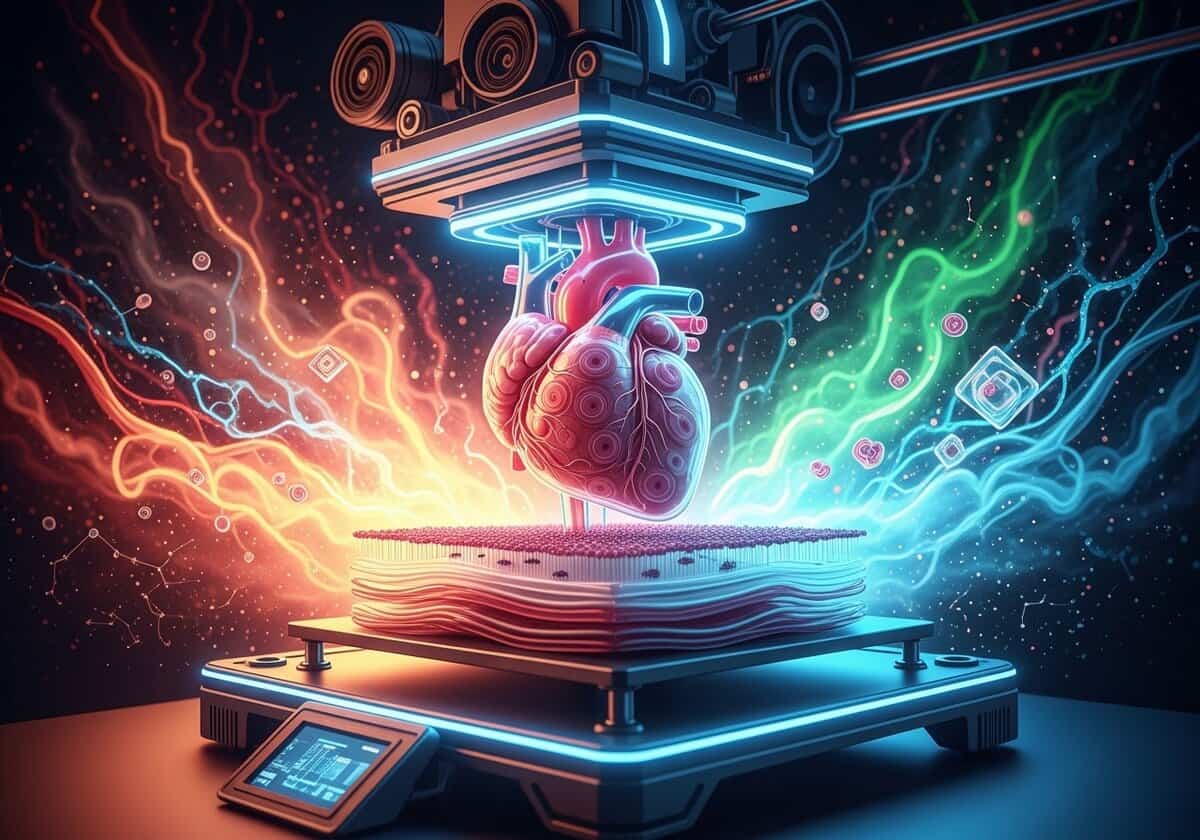
Bio-printing integrates additive manufacturing techniques with cellular biology to fabricate three-dimensional, functional living tissues and organ constructs. This domain involves precise deposition of cell-laden bio-inks, biomaterials, and growth factors to replicate native tissue architecture and microenvironment. Advances in scaffold design, vascularization strategies, and multi-material printing have propelled applications in regenerative medicine, drug testing, and personalized therapeutics. The following compilation presents the latest peer-reviewed publications and patented innovations, reflecting cutting-edge methodologies, novel bio-ink formulations, printing technologies, and translational breakthroughs shaping the future of tissue engineering and organ fabrication.
Bio-printing deposits living cells layer by layer. Printing hardware is on additive manufacturing, materials on biomaterials, and the clinical aim on regenerative medicine. Tiny channels that feed printed tissue are on microfluidics.
This is our latest selection of worldwide publications and patents in english on Bio-printing, between many scientific online journals, classified and focused on bio-printing, 3D bio-printing, tissue engineering, biomaterial, cell-laden bio-ink, scaffold fabrication, organ printing, hydrogel bio-ink, extrusion bio-printing, laser-assisted bio-printing, microvalve bio-printing, stem cell bio-printing, bio-ink formulation, bio-print, bio-printing resolution, bio-printing software, bioreactor, bio print, bio-printing of cartilage and bio-printing of skin.
Spheroid capillary vessel
Patent published on the 2026-11-05 in WO under Ref WO2026231325 by CORNING INCORPORATED [US] (Bergeron Audrey Blanche [us], Martin Gregory Roger [us])
Abstract: A microcavity bioreactor is provided that allows for culturing of three-dimensional cell cultures such as spheroids and organoids with bulk liquid exchanges that have minimal disturbance to the three-dimensional cell cultures. The microcavity bioreactor has one or more microcavities and each microcavity comprises one or more passageways through the body of each microcavity, and the smallest diameter in any passageway is a diameter between 0.5 mm and 50 mm. The microcavity bioreactor also compris[...]
Our summary: The microcavity bioreactor enables the culture of three-dimensional cell structures like spheroids and organoids. It features microcavities with passageways that facilitate bulk liquid exchanges with minimal disturbance. This design allows for effective cell seeding, liquid exchange, and harvesting of the cultures.
microcavity bioreactor, three-dimensional cell cultures, spheroids, liquid exchange
Patent
Integrated diagnostic systems and methods for exhaled breath analysis
Patent published on the 2026-11-05 in WO under Ref WO2026231923 by ZETEO TECH INC [US] (Chen Dapeng [us], Bryden Wayne A [us], Mcloughlin Michael [us], Kiser Kiana M [us], Caton Emily R [us], Haddaway Caroline R [us], Cetta Maximilian Schrier [us])
Abstract: Integrated diagnostic systems and methods including multiple analytical assays for noninvasive exhaled breath sampling to produce collected liquid samples including aerosolized non-volatile particles in exhaled breath to deliver comprehensive diagnostic data from a single sample to enhance clinical efficiency and precision in patient care. Systems and methods for capturing aerosolized organic biomaterials including proteases and beta-lactamases in exhaled air to enable rapid, low-cost detection [...]
Our summary: Integrated diagnostic systems enable noninvasive exhaled breath analysis. They capture aerosolized organic biomaterials for rapid disease detection. Multiple assays enhance clinical efficiency and precision in patient care.
breath analysis, diagnostic systems, noninvasive sampling, MALDI-TOFMS
Patent
Method for preparing a biomimetic mineralized bone repair material
Patent published on the 2026-11-04 in NL under Ref NL4002863 by NORTHWEST MINZU UNIV [CN] (Hengxiang Liu [cn], Zishuai Chen [cn], Hai He [cn], Zifan Wang [cn])
Abstract: A method for preparing a biomimetic mineralized bone repair material, relates to the technical fields of biomedical materials and tissue engineering, comprises: sequentially 5 subjecting jawbone tissue to demineralization treatment, decellularization treatment, defatting treatment, freeze-drying treatment, grinding treatment to obtain jawbone-derived decellularized extracellular matrix powder; adding the jawbone-derived decellularized extracellular matrix powder to an acidic pepsin system for di[...]
Our summary: A method for preparing a biomimetic mineralized bone repair material involves sequential treatments of jawbone tissue to create a decellularized extracellular matrix powder. This powder is combined with an acidic pepsin system and a calcium and phosphorus source for in situ mineralization. The process results in a hydrogel with improved mineral distribution and enhanced repair properties.
biomimetic, mineralization, tissue engineering, hydrogel
Patent
Method and system for producing purified biomolecules
Patent published on the 2026-10-29 in WO under Ref WO2026224410 by DONALDSON CO INC [US] (Robert Thomas [be], Votaw Nicole [us], Drugmand Jean-christophe [be], Haley Jennifer Elizabeth [us], Van Espen-boonen Laurence Bernadette [be], Subratty Shameer [be], Carvalho Rimenys Junior [be], Belasko Mauri [us])
Abstract: The current invention relates to a method for producing one or more purified biomolecules, said method comprises: a. Culturing cells in a bioreactor comprising a fixed bed, and allowing said cells to produce the one or more biomolecules; b. Harvesting said one or more biomolecules from the bioreactor; c. Performing one or more purification steps, before, simultaneously with and/or after harvest of said one or more biomolecules to obtain one or more purified biomolecules; wherein at least one or [...]
Our summary: The invention describes a method for producing purified biomolecules using a bioreactor with a fixed bed for cell culturing. It includes harvesting biomolecules and performing purification steps, including an affinity liquid phase separation. A system for this process is also detailed, along with its applications for producing purified biomolecules and related complexes.
biomolecules, purification, bioreactor, affinity separation
Patent
Method and system for cell culture
Patent published on the 2026-10-29 in US under Ref US20260337543 by THERMO SCIENT PORTABLE ANALYTICAL INSTRUMENTS INC [US] (Zustiak Matthew [us], Khadka Nimesh [us], Villa Torrecilla Juan A [es], Zhang Lin [us], Ramirez Cadavid David [us])
Abstract: [0000] Systems and methods for controlling a bioreactor are disclosed. Spectral data, such as Raman spectral data, is acquired from a cell culture media within a bioreactor and processed using a model system to generate predicted analyte values, including glucose and lactate concentrations. A composite carbon source value is determined by combining at least the predicted glucose value and the predicted lactate value. The carbon source value is compared to a predetermined threshold, and operation[...]
Our summary: A method for controlling a bioreactor using spectral data is disclosed. The system predicts analyte values like glucose and lactate concentrations to assess the carbon source value. Nutrient addition is regulated based on the comparison of this value to a predetermined threshold, enhancing bioreactor process control.
bioreactor, cell culture, spectral data, nutrient control
Patent
Compositions, systems, and methods related to cell transduction
Patent published on the 2026-10-15 in WO under Ref WO2026217941 by THE UNIV OF NORTH CAROLINA AT CHAPEL HILL [US] (Brudno Yevgeny [us], Mallory Micah [us])
Abstract: Disclosed herein are dry, macroporous biomaterial scaffolds, systems, and methods for enhancing viral transduction of cells, including primary immune cells. The scaffolds comprise an irregular, randomly distributed surface porosity, a liquid absorption rate of at least about 5 μL/min, and a flexible polymeric structure conferred by non-covalent crosslinking or intrinsic polymer chain flexibility. The disclosed scaffolds are suitable for manufacturing genetically engineered cells, including CAR-[...]
Our summary: The content discusses biomaterial scaffolds designed to enhance viral transduction of immune cells. It details the properties of these scaffolds, including porosity and liquid absorption rates. Additionally, it covers methods for controlling vector copy number and principles for developing advanced transduction-enhancing materials.
biomaterials, viral transduction, cell engineering, scaffold design
Patent
Joint material and shape optimization of a 3D printing nozzle by CFD and response surface methodology
Published on 2026-03-12 by @OXFORD
Abstract: AbstractThree-dimensional printing (3D printing) has emerged as a transformative technology in medicine, enabling the fabrication of complex structures with high precision. In bioprinting, optimization of nozzle design is essential to balance print resolution, mechanical strength, and biocompatibility. This study presents a computational framework for optimizing bioprinting performance by simultaneously accounting for nozzle geometry and biomaterial rheological properties. Using computational fl[...]
Our summary: This study presents a computational framework for optimizing bioprinting by integrating nozzle geometry and biomaterial properties. It utilizes CFD and response surface methodology to identify optimal nozzle configurations. Results show significant improvements in flow rate and reductions in wall shear stress, demonstrating the effectiveness of the approach.
3D printing, nozzle optimization, computational fluid dynamics, response surface methodology
Publication
A Case Study in Sabanalarga, Colombia
Published on 2026-02-04 by Lina Henriquez Sarmiento, Hugo Hernndez, Anderson Nieto Granados, Jorge Rodas, Andrea Liliana Moreno-Ros, Andreas Hasse, Diana Pinto, Claudete Gindri Ramos @MDPI
Abstract: Technosols are artificial soils produced from organic and inorganic solid waste to improve soil fertility and functionality. This study evaluated the potential of Technosols produced from household waste from the Altos de Guadalupe residential complex in Colombia to fertilize green areas and promote the growth of Duranta erecta. A physical characterization of waste from 46 houses was performed to estimate per capita production (PPC) and waste composition. Technosols were produced in 20, 50, and [...]
Our summary: Technosols made from household waste were evaluated for their ability to enhance soil fertility and promote plant growth in Sabanalarga, Colombia. The study found that Technosols significantly improved soil organic matter and nutrient availability, leading to increased plant height and root dry matter. These findings support the use of Technosols in urban agriculture, aligning with circular economy principles and sustainable development goals.
Technosols, soil fertility, organic waste, urban agriculture
Publication