Product Design, Manufacturing & Innovation Resources
집 » 공기역학적 힘에서의 동압

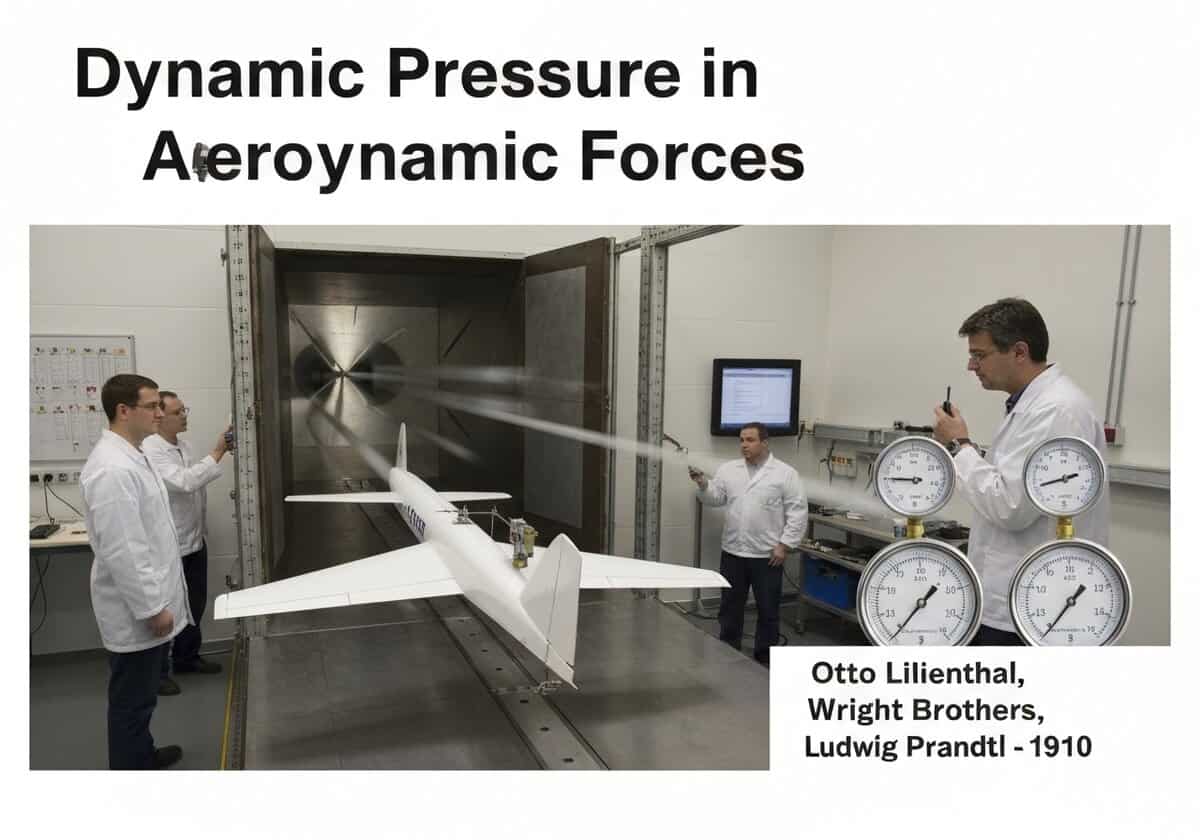
공기역학적 힘에서의 동압

1910
  • Otto Lilienthal
  • Wright brothers
  • Ludwig Prandtl
Aerodynamic testing facility with wind tunnel and model aircraft wing for aeronautical engineering.

(설명을 위한 생성된 이미지입니다)

물체에 작용하는 양력과 항력 같은 공기역학적 힘은 주변 유체의 동압에 정비례합니다. 공식은 [latex]L = C_L cdot q cdot A[/latex] 및 [latex]D = C_D cdot q cdot A[/latex]이며, 여기서 [latex]C_L[/latex]과 [latex]C_D[/latex]는 무차원 양력 및 항력 계수이고, [latex]q[/latex]는 동압, [latex]A[/latex]는 기준 면적입니다.


사용 동적 압력 to define aerodynamic forces is a cornerstone of aeronautical engineering, enabling a powerful method of analysis called dimensional analysis. By expressing lift and drag in terms of dynamic pressure ([latex]q[/latex]), a reference area ([latex]A[/latex]), and a dimensionless coefficient ([latex]C_L[/latex] or [latex]C_D[/latex]), engineers can separate the effects of fluid properties and speed from the effects of the object’s shape. The coefficients [latex]C_L[/latex] and [latex]C_D[/latex] depend primarily on the shape of the body, its orientation to the flow (angle of attack), and the 레이놀즈 수 그리고 마하수이러한 분리는 매우 유용합니다. 예를 들어, 항공기의 축소 모형을 풍동에서 시험하고 측정된 양력 및 항력 계수를 사용하여 다양한 비행 조건(다양한 고도, 따라서 다양한 밀도 및 다양한 속도)에서 실물 크기 항공기에 작용하는 힘을 정확하게 예측할 수 있습니다.

항공우주 분야에서 이 개념의 중요한 적용 사례는 '최대 Q'라는 개념입니다. 이는 우주선이 대기권 상승 중 최대 동압을 경험하는 지점을 의미합니다. 로켓이 가속함에 따라 속도(μ)가 증가하고, 이로 인해 동압(q)이 상승합니다. 동시에 고도가 높아짐에 따라 대기 밀도(ρ)가 감소하여 동압이 하강합니다. 이 두 가지 상반된 효과가 결합되어 동압이 최대값을 나타냅니다. 이 순간은 우주선에 최대 기계적 응력이 가해지는 시점이며, 우주선의 구조는 이러한 하중을 견딜 수 있도록 설계되어야 합니다. 최대 Q 부근에서 엔진 출력을 줄이는 것은 이러한 응력을 감소시키고 우주선의 구조적 안정성을 확보하기 위한 일반적인 전략입니다.

UNESCO Nomenclature: 3301
항공 공학 및 기술

유형

추상 시스템

분열

기초적인

용법

널리 사용됨

전구체

  • 베르누이의 원리
  • 동압의 정의
  • 뉴턴의 운동 법칙과 유체 저항 개념
  • 조지 케일리와 같은 선구자들이 수행한 초기 실험적 에어포일 연구

응용 프로그램

  • 항공기 날개 및 동체 설계
  • 다운포스와 효율성을 위한 자동차 및 경주용 자동차 차체 형상 설계
  • 발전용 터빈 블레이드 설계
  • 보트와 요트용 돛 디자인
  • 발사체 궤적 분석(탄도학)
  • 건물 안정성을 위한 풍력 공학

특허:

NA

잠재적 혁신 아이디어

  • morphing aircraft wings that actively change their airfoil shape to optimize the lift-to-drag ratio based on real-time dynamic pressure readings
  • smart parachutes that adjust their canopy area or porosity to maintain a constant descent rate regardless of air density at different altitudes
  • performance monitoring systems for professional cyclists that provide real-time drag coefficient data based on power output and dynamic pressure sensors
  • autonomous soaring drones that seek out and exploit thermals by detecting subtle changes in dynamic pressure and lift
  • wind turbine blades with active flow control surfaces (e.g., micro-flaps) that adjust to maximize energy capture across a range of wind speeds
  • formula 1 cars with active aerodynamic elements that reduce drag on straights and increase downforce in corners, controlled by dynamic pressure data
  • launch vehicle ascent profiles that are dynamically optimized in real-time to navigate through max q with minimum structural stress
  • advanced ballistic vests designed to better dissipate the dynamic pressure wave from a projectile’s impact
  • architectural glass for skyscrapers with embedded sensors that can predict and counteract wind-induced stresses by altering its stiffness
  • clothing for speed skaters that incorporates riblet structures whose effectiveness is tuned for the specific dynamic pressure range of the sport
Related to: aerodynamics, lift, drag, dynamic pressure, lift coefficient, drag coefficient, airfoil, fluid dynamics, 항공 engineering, max q.

역사적 맥락

공기역학적 힘에서의 동압

1903
1906
1910
1910
1910
1920
1920
1900
1903-05-10
1910
1910
1910
1910
1920
1920

(날짜를 알 수 없거나 관련이 없는 경우, 예를 들어 "유체역학"의 경우, 주목할 만한 등장 시기를 대략적으로 추정하여 제공합니다.)

10년차 기념일

고화질 이미지 및 다운로드는 등록된 회원에게만 100% 무료로 제공됩니다.

> 로그인 <