Product Design, Manufacturing & Innovation Resources
Maison » Théorème de l'énergie cinétique

Théorème de l'énergie cinétique

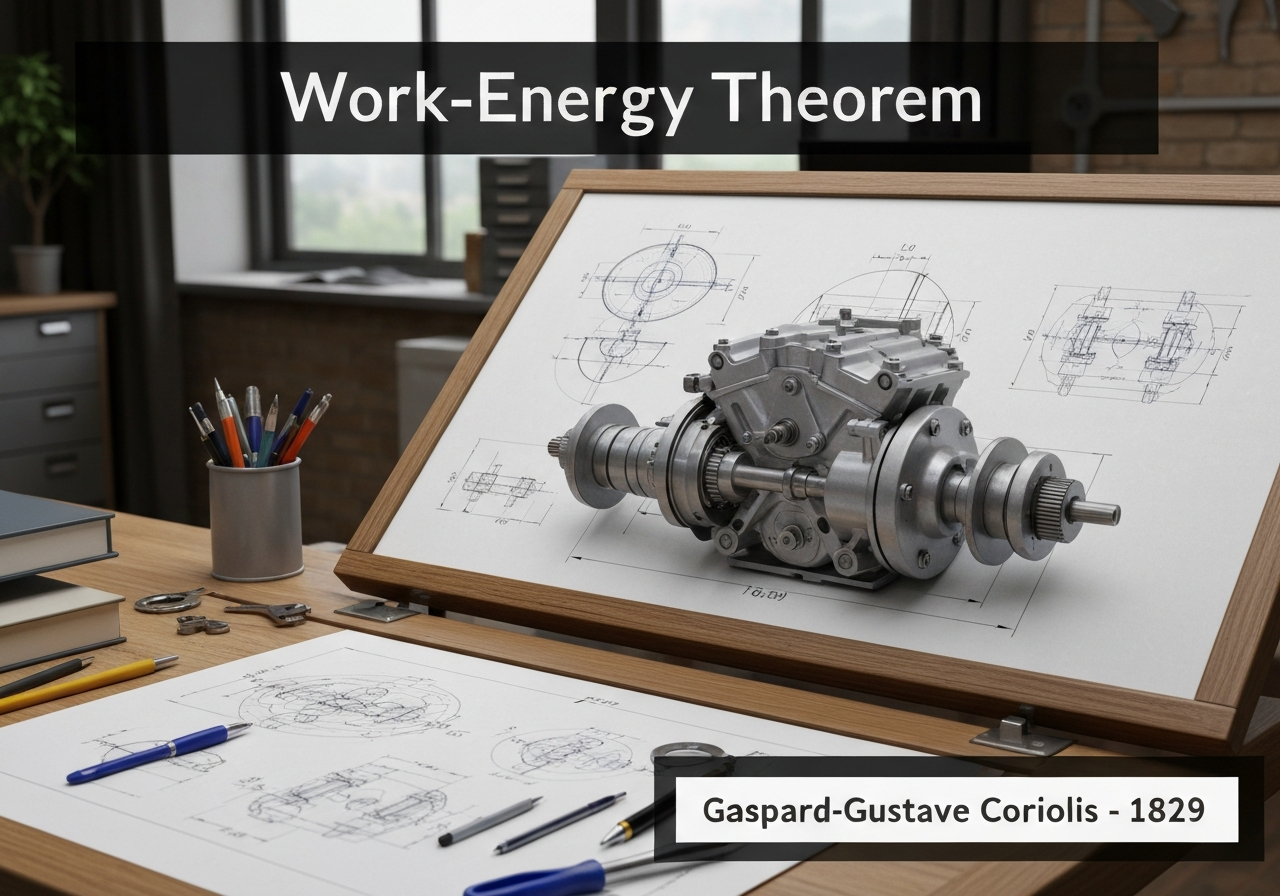
1829
  • Gaspard-Gustave Coriolis
Mechanical engineering workspace illustrating the work-energy theorem application.

(Image générée à titre d'illustration uniquement)

Le théorème de l'énergie cinétique stipule que le travail net (W) effectué par toutes les forces agissant sur une particule est égal à la variation de son énergie cinétique (ΔEk). Mathématiquement, W = ΔEk = Ek,f - Ek,i. Ce principe relie directement les concepts de force, de déplacement et d'énergie, offrant un outil puissant pour analyser le mouvement sans recourir directement aux équations de Newton. deuxième loi.

The work-energy theorem provides a direct link between the dynamics of forces and the kinematics of motion, expressed through the language of energy. It is derived directly from Newton’s deuxième loi, [latex]F_{net} = ma[/latex]. By integrating the net force with respect to displacement, one can show that this integral equals the change in the quantity [latex]\frac{1}{2}mv^2[/latex]. Coriolis formally defined this integral as “work” and [latex]\frac{1}{2}mv^2[/latex] as “kinetic energy,” thereby formulating the theorem as [latex]W_{net} = \Delta E_k[/latex]. This was a significant conceptual advance because it allows for the analysis of complex systems without needing to solve differential equations of motion directly. For example, to find the final speed of an object after being acted upon by a variable force over a certain distance, one can simply calculate the total work done and equate it to the change in kinetic energy. The theorem applies to the work done by the *net* force. If one considers the work done by individual forces, it can be partitioned. For instance, the work done by conservative forces (like gravity) equals the negative change in potential energy, leading to the broader principle of the conservation of mechanical energy ([latex]\Delta E_k + \Delta E_p = W_{non-conservative}[/latex]).

UNESCO Nomenclature: 2209
- Mécanique

Taper

Système abstrait

Perturbation

Fondamentaux

Usage

Utilisation généralisée

Précurseurs

  • La deuxième loi du mouvement d'Isaac Newton ([latex]F=ma[/latex])
  • Définition du travail mécanique : force multipliée par déplacement
  • La formule de l'énergie cinétique classique ([latex]E_k = frac{1}{2}mv^2[/latex])

Applications

  • conception technique des moteurs
  • analyse des collisions en physique
  • biomécanique du mouvement humain et animal
  • calcul des distances d'arrêt des véhicules
  • calculs astronomiques des manœuvres orbitales

Brevets:

NA

Idées d'innovations potentielles

  • software for designing more efficient internal combustion engines by precisely modeling the work done by expanding gases on pistons
  • haptic feedback suits for virtual reality that apply forces to simulate the work required to lift or push virtual objects, creating realistic immersion
  • smart prosthetic limbs that use the work-energy theorem to calculate the energy required for a desired movement, optimizing battery life
  • ai-driven robotics for manufacturing that minimize energy consumption by calculating the most efficient path and force application (work) to achieve a task (change in kinetic energy)
  • educational physics software that visually demonstrates the work-energy theorem with interactive simulations
  • advanced braking systems that calculate the exact work needed to stop a vehicle and optimize the distribution between friction and regenerative braking
  • geotechnical engineering software that models the work required for excavation and drilling in different materials
  • robotic exoskeletons for rehabilitation that apply controlled forces to help patients perform exercises, measuring the work done to track progress
  • analysis tools for asteroid deflection missions, calculating the work required from an impactor to alter a celestial body’s kinetic energy
  • computational fluid dynamics models that calculate the work done by les forces aérodynamiques on aircraft to predict changes in speed and altitude
Related to: work-energy theorem, kinetic energy, work, force, displacement, net work, économie d'énergie, classical mechanics, dynamics, physique des particules.

Contexte historique

Théorème de l'énergie cinétique

1821
1822
1827
1829
1831
1831
1833
1820
1822
1824
1827
1831
1831
1832
1834

(si la date est inconnue ou non pertinente, par exemple « mécanique des fluides », une estimation arrondie de son émergence notable est fournie)

10e année anniversaire

Les images en pleine résolution et les téléchargements sont uniquement disponibles, et 100% gratuits, pour les membres inscrits.