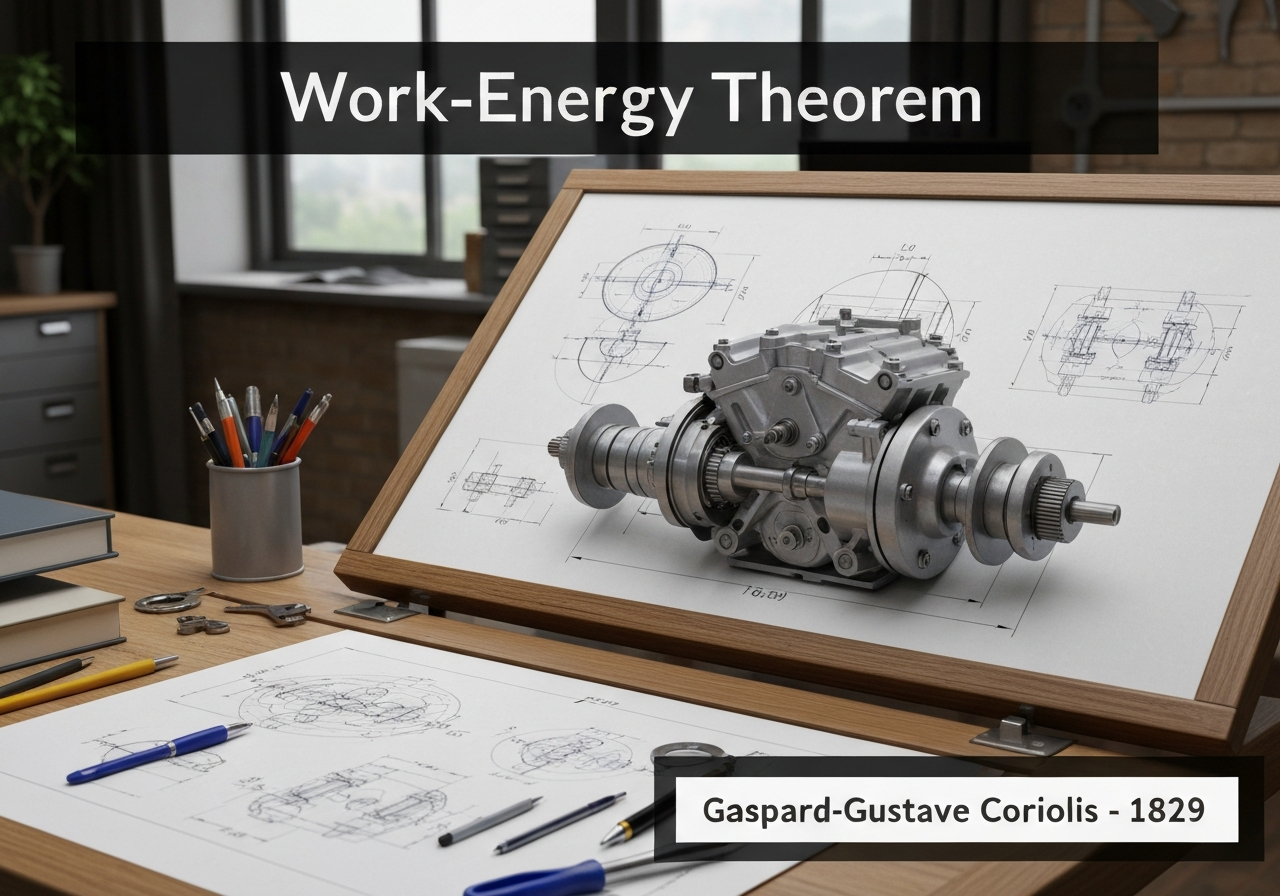
일-에너지 정리는 입자에 작용하는 모든 힘이 한 알짜 일(W)이 운동 에너지의 변화량(ΔEk)과 같다는 정리입니다. 수학적으로는 W = ΔEk = Ekf - Eki입니다. 이 원리는 힘, 변위, 에너지의 개념을 직접적으로 연결하여 뉴턴의 법칙을 직접 사용하지 않고도 운동을 분석할 수 있는 강력한 도구를 제공합니다. 두 번째 법칙.

(설명을 위한 생성된 이미지입니다)
일-에너지 정리는 입자에 작용하는 모든 힘이 한 알짜 일(W)이 운동 에너지의 변화량(ΔEk)과 같다는 정리입니다. 수학적으로는 W = ΔEk = Ekf - Eki입니다. 이 원리는 힘, 변위, 에너지의 개념을 직접적으로 연결하여 뉴턴의 법칙을 직접 사용하지 않고도 운동을 분석할 수 있는 강력한 도구를 제공합니다. 두 번째 법칙.
The work-energy theorem provides a direct link between the dynamics of forces and the kinematics of motion, expressed through the language of energy. It is derived directly from Newton’s 두 번째 법칙, [latex]F_{net} = ma[/latex]. By integrating the net force with respect to displacement, one can show that this integral equals the change in the quantity [latex]\frac{1}{2}mv^2[/latex]. Coriolis formally defined this integral as “work” and [latex]\frac{1}{2}mv^2[/latex] as “kinetic energy,” thereby formulating the theorem as [latex]W_{net} = \Delta E_k[/latex]. This was a significant conceptual advance because it allows for the analysis of complex systems without needing to solve differential equations of motion directly. For example, to find the final speed of an object after being acted upon by a variable force over a certain distance, one can simply calculate the total work done and equate it to the change in kinetic energy. The theorem applies to the work done by the *net* force. If one considers the work done by individual forces, it can be partitioned. For instance, the work done by conservative forces (like gravity) equals the negative change in potential energy, leading to the broader principle of the conservation of mechanical energy ([latex]\Delta E_k + \Delta E_p = W_{non-conservative}[/latex]).
일-에너지 정리
(날짜를 알 수 없거나 관련이 없는 경우, 예를 들어 "유체역학"의 경우, 주목할 만한 등장 시기를 대략적으로 추정하여 제공합니다.)

고화질 이미지 및 다운로드는 등록된 회원에게만 100% 무료로 제공됩니다.
> 로그인 <